L’Italien is a big, rangy defenceman who was one of Halifax’s brighter spots in a difficult 6–0 loss. Playing nearly 25 minutes, he handled a heavy workload at even strength, on the penalty kill and on Halifax’s second power-play unit. He retrieved pucks effectively in the defensive zone and consistently moved them out with ease. He showed good composure under pressure, rarely appearing rushed, and generally made smart, simple decisions rather than forcing plays that were not available.
For his size, L’Italien moves well. His pivots were smooth, and his mobility allowed him to defend effectively in space. He used his length particularly well against the rush, extending his stick to disrupt attacks and take away passing or shooting options before they could develop. Offensively, his game was relatively simple but effective, moving pucks quickly and taking what the defence gave him.
Despite the blowout, L’Italien made very few noticeable mistakes. His most significant came following a defensive-zone faceoff, where he was slow to identify and stay with his assignment, allowing his man to get open at the back door for an uncontested tap-in. Moving forward, L’Italien should continue to handle major minutes for Halifax. His combination of size, mobility, reach, composure and defensive reliability gives him an intriguing foundation, and based on this viewing, he looks like a potential first-round pick in the 2027 NHL Draft.
Connor Bedard is back practicing with the Blackhawks for the second day in a row, taking part in both 5-on-5 line rushes and powerplay drills.
The Blackhawks powerplay has struggled early on, only converting once on 14 attempts (7.1%). Their one goal coming from Sam Rinzel in the Blackhawks only win of the season.
Obviously, not having Connor Bedard hurts the powerplay, but he is back practicing, and may even play Tuesday against the Pittsburgh Penguins.
Blackhawks powerplay lines in practice:
Bertuzzi (net front)
Bedard (left wall) – Kantserov (bumper) – Kane (right wall)
Byram (point)
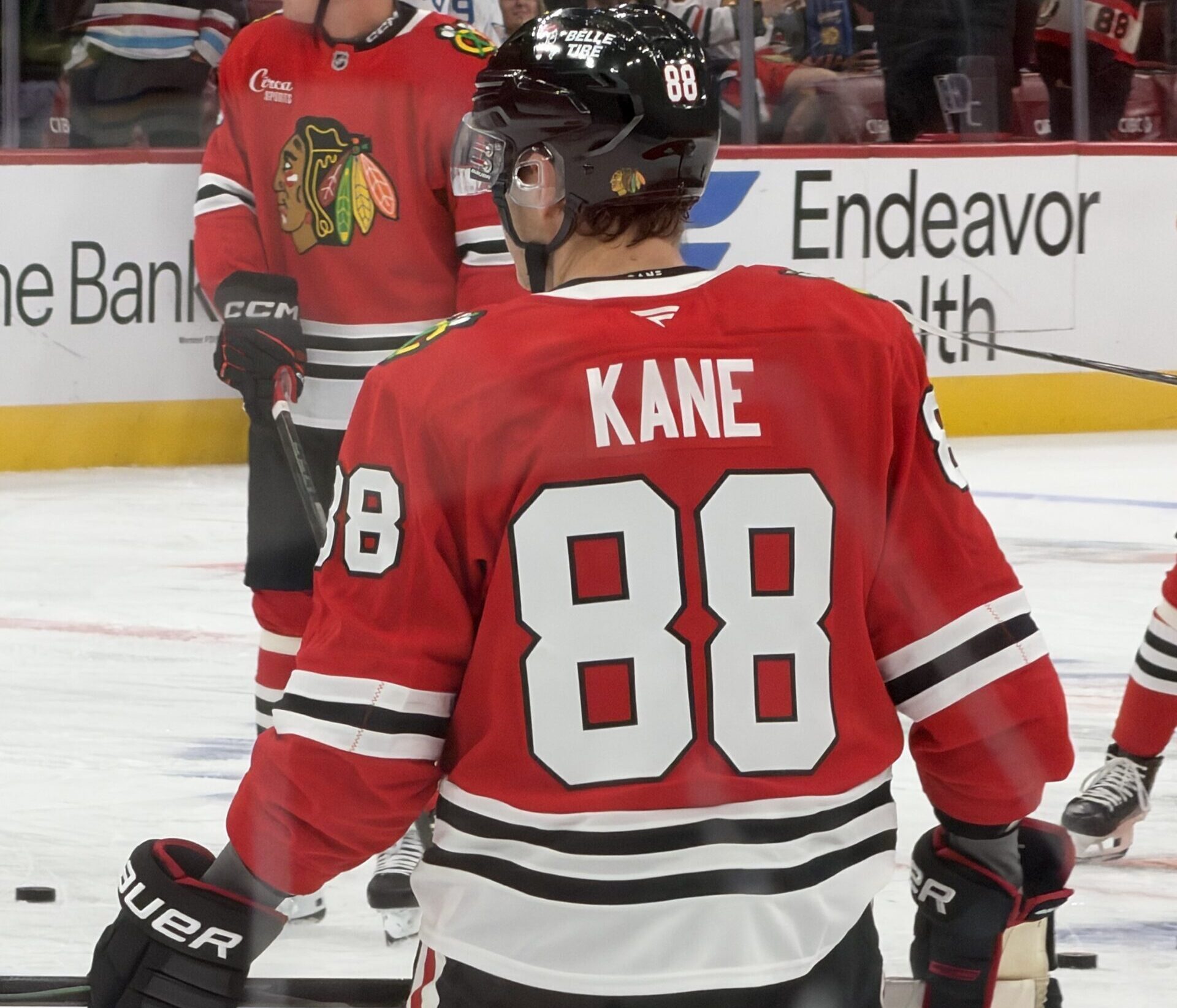
The biggest change here isn’t the addition of Connor Bedard, it’s Patrick Kane being moved back to the right wall.
Patrick Kane has been one of the best powerplay distributors in the league throughout his career, and he has always done so from the right wall.
Being a left-handed player on the right side allows Kane to open up on his forehand and survey his options. This forces the penalty kill to respect the pass as well as the shot. Patrick Kane is one of the best playmakers in the NHL, but is not afraid to put a shot on net.
I speculate the reason Kane was on the left wall up until now was because the Blackhawks have an abundance of left-handed players and this allowed Kane to find a one-timer from either the right wall, bumper, or point. Now, Kane has Bedard as a one timer option on the left wall.
Throughout his career, Kane has always been the play driver on the powerplay, so it only makes sense to have the driver in his most comfortable spot.
Having Bedard back will be a massive boost for the powerplay. If the Blackhawks want to start winning games, it is crucial that they convert far more often than the 7.1% they have been.
#4 Wenatchee Wild. Left shot defenseman, 6.02 / 197
DOB: April 13, 2009
Boston Tait is a good-sized defensive defenseman who uses his frame effectively to win puck battles, establish possession, and protect the puck during transitions. He displays a good first pass, allowing him to move the puck efficiently out of the defensive zone and help initiate the attack. Defensively, he does a good job closing the gap early, limiting opponents’ time and space to generate offense.
Tait also brings some offensive ability to his game, possessing a good shot with a nice release. He can get pucks through traffic and toward the net, creating opportunities for rebounds and deflections. His combination of size, defensive awareness, puck protection, and ability to move the puck makes him an intriguing prospect with top-four potential at the professional level.
Projection: Early second round. Projects as a top-four defenseman at the professional level.
He’s only been the number one defenseman in Chicago for five games, but the doubts surrounding Bowen Byram’s ability are getting louder and louder.
After a 5-2 beatdown from the Carolina Hurricanes, the Blackhawks have fallen to 1-5-0. This rocky start is particularly frustrating given that the players spent all summer talking about playoffs, and how this season needs to be different.
It’s only been six games and things could change, but if the Hawks don’t turn this thing around real soon, they can kiss any playoffs hopes goodbye.
Analyzing the Blackhawks without Connor Bedard is like evaluating the San Jose Sharks without Macklin Celebrini, but the Hawks’ inability to play without him is concerning.
Still, the biggest storyline of the Blackhawks season so far has been the underwhelming play of Bowen Byram.
The Blackhawks made a statement when they gave up the fourth overall pick, Louis Crevier, and a second round pick for Byram. Then they signed him to a six-year, $75 million deal.
Those transactions told the hockey world two things. The Blackhawks are ready to compete, and Bowen Byram is a number one defenseman.
six games into the season and neither look to be true.
Byram has played five games this season, it would be six, but he missed his return to Buffalo because his wife was giving birth to twins.
Through those five games, Byram has zero points and is a -8. Byram was initially deployed on his off side with Alex Vlasic. The idea was to play Byram with a shutdown defenseman who can successfully retrieve pucks and allow Byram to flourish offensively, even if it means playing his off side.
Unfortunately, that duo wasn’t working out, so Jeff Blashill made a change after just two games. Since then, Byram has been playing on his natural left side with Artyom Levshunov.
Byram has looked better since the change, but still isn’t playing anywhere near the level he is supposed to be.
At 5-on-5, Byram has been on the ice for seven goals against, two goals for, and has a 47.06% corsi (via NaturalStatTrick).
Beyond just the numbers, Byram has looked slow, at times not engaged, and is struggling to connect on passes. This is especially concerning given how dominant he looked in the preseason.
Bowen Byram oozes confidence off the ice, and yet, through five games, he seems to have non when the puck drops.
The team as a whole has been struggling in pretty much every area of the game, so it’s not all on Byram. However, great players find a way when others can’t, that’s who Byram is supposed to be.
The main issue isn’t that Byram hasn’t been able to elevate his play to that of a number one defenseman, it’s that he hasn’t even been able to play to the level he has throughout his career so far.
Byram has been a reliable second/third defenseman with number one potential. However, so far in Chicago he’s looked more like a fifth or sixth.
Like I stated earlier, adding Connor Bedard to this lineup is going to help the team win games, but his presence alone can’t fix the individual performances of 23 other guys.
There are 78 games left to play, a lot can change, and a lot will change. The question is when will things change, and how drastic will that change be.
#17 Tri-City Americans. Right-shot right wing. 5.10 / 184
DOB: January 19, 2009
McKamey is a skilled two-way forward who keeps his feet moving, draws penalties, and shows strong offensive instincts. He has excellent vision as a playmaker, moves the puck efficiently, and can find teammates in scoring positions. When given the opportunity to shoot, he has the release and accuracy to beat goaltenders. He also sees time playing the point on the power play, where his puck distribution and offensive awareness can be valuable assets.
Defensively, McKamey needs to make better decisions when operating at the point on the power play, as mistakes in that position can lead to short-handed opportunities for the opposition. Adding more physicality to his game would also help him become a more complete player.
His point production is beginning to trend upward, and he is showing signs of growing confidence. As he matures and continues to develop, I believe he has the potential to become a productive offensive contributor.
Projection: Middle of the fourth round in the 2027 NHL Entry Draft. Despite standing 5’10”, McKamey’s playmaking ability, offensive vision, and scoring touch give him the potential to develop into a top-six forward at the professional level. His size may be a consideration for some NHL teams, but continued production and improvement could strengthen his draft stock.
The Rangers started this one off with a goal very late into the 1st period; Tanner Lam made a quick pass to Luca Romano for a short one-timer to make it 1-0 going into the 2nd. The game was end-to-end action, but neither team could capitalize on any opportunities, and it would remain 1-0 going into the 3rd. Kitchener opened the 3rd perfectly as top 2027 NHL prospect Luca Santala fired a shot from the circle; it deflected more than once but found its way past Vermirovsky for a 2-0 lead. Brady Smith would bring the hounds within one with a beautiful one-handed tuck five-hole, and with 2 minutes remaining, Rangers goaltender Jason Schaubel would make his first mistake all game: a bad puck bounce off the boards, and he ended up dropping his stick before swatting it away, where Ryan Kaczynski would tap it in the empty net. Jakub Winklehofer would win it for the Greyhounds a minute into overtime.
The Standouts
Luca Santala – Luca had a slower start to the game, but looked great in the 2nd and 3rd. An ability of his that really stood out to me was his puck protection; he was very strong on his skates and used his body to distance the puck from defenders while keeping his head up, looking to make plays. He showed very good vision and made many slick passes, especially on the power play; he thinks ahead of the play and is able to put himself in scoring opportunities before they develop.
Trevor Daley Jr – Daley was on the best line for the hounds again; he, along with his line, were punishing on the forecheck, not only hitting but his relentless work ethic and pace; he is extremely effective along the boards as well, often won’t just crash and bang in the battles but will sneak in, lift a stick and take it with perfect timing.
Jason Schaubel – Schaubel was incredible, stopping 33/36 with one of them being an unlucky bounce off the boards; the Greyhounds had plenty of high-danger chances, and he kept the Rangers in it all night. He has extremely fast lateral movement, is very quick down low, and showed great positioning throughout the game, especially while on the penalty kill.
Entering Friday night’s matchup, the Brampton Steelheads were still searching for their first win of the season, having dropped their opening seven games and remaining the OHL’s only winless team. Standing in their way were the Kingston Frontenacs, who arrived in Brampton with a 4-4 record. With home-ice advantage and Kingston playing the second half of a back-to-back, this presented a great opportunity for Brampton to end its slump.
Adam Goljer made an immediate impression with his strength on the puck, particularly when carrying it in stride. Brampton’s defenders struggled to separate him from the puck, allowing him to dictate play in the offensive zone.
Kingston controlled much of the play through the opening 10 minutes, generating the majority of scoring opportunities. Despite the pressure, Brampton remained disciplined defensively, keeping Kingston to the perimeter and limiting high-danger chances.
Despite Kingston’s early pressure, Brampton struck first when 2027 NHL Draft-eligible forward Keaton Ardagh flew through the neutral zone, finding a gap between three Kingston defenders to create a breakaway. Ardagh made no mistake, finishing glove side to give the Steelheads a 1-0 lead.
Brampton’s lead nearly evaporated moments later when Adam Goljer found Aleks Kulemin with a dangerous cross-crease pass. Kulemin had positioned himself for a potential tap-in but was unable to corral the puck.
Kingston wasted little time finding the equalizer. On the following shift, André Mondoux sent a wrist shot from the point through traffic that found the back of the net. It was a shot Brampton goaltender Oskari Ahmajärvi likely should have stopped, tying the game at 1-1.
While Matthew Henderson didn’t have a particularly flashy first period, his steady defensive play provided Goljer with the freedom to take risks offensively. Goljer frequently joined the attack, often finding himself below the faceoff dots in the offensive zone, trusting Henderson to provide defensive coverage.
Kingston picked up right where it left off, applying immediate pressure to start the second period. Nolan Snyder delivered a perfectly placed pass from the slot onto Aleks Kulemin’s tape, creating a golden opportunity to take the lead, but Kulemin was unable to convert. Although he had yet to find the back of the net, Kulemin was consistently finding ways to get open in dangerous areas. For the second time in the game, he slipped behind Brampton’s defenders to put himself in prime scoring position.
Kulemin’s persistence paid off on the very next shift when Matthew Henderson sent a shot toward the net from the point. Kulemin got his stick on the puck, redirecting it past Ahmajärvi to give Kingston its first lead of the night, 2-1.
While Kingston continued to generate offense, Brampton defenseman Peter Green stood out for his ability to stretch the ice with long, tape-to-tape passes. Whenever the puck found its way onto his stick, Green demonstrated an ability to facilitate clean zone exits and quickly transition play up ice.
Continuing an impressive night for both Kingston players, Kulemin led a two-on-one rush, finding Goljer with a pass that the defenseman converted to extend the Frontenacs’ lead to 3-1.
Brampton cut the deficit to one thanks to an impressive individual effort from Nathan Amidovski. Battling multiple Kingston defenders in the high slot, Amidovski managed to maintain possession before firing a shot glove-side to make it a 3-2 game. Throughout the night, Amidovski had been Brampton’s best offensive facilitator, creating opportunities with a number of creative and dangerous passes. His goal was a well-deserved reward for his efforts.
In the dying seconds of the second period, Ardagh once again showcased his high-end speed, squeezing between a Kingston defender and the boards to create open ice ahead of him. He followed up with a pass to a teammate in a scoring position, but the teammate was unable to convert.
Kingston came out strong to start the third period, with Landon Wright generating two scoring opportunities in quick succession. After his first attempt was blocked, Wright made the most of his second chance, beating Ahmajärvi high to restore Kingston’s two-goal advantage at 4-2.
Wright’s goal appeared to spark a response from Brampton, as the Steelheads spent the next several shifts hemming Kingston in its own zone and applying sustained offensive pressure.
With approximately 10 minutes remaining, a frightening moment unfolded when Brampton’s Stepan Kuryachenkov delivered a hit from behind on Matthew Henderson, leaving the Kingston defenseman down on the ice for an extended period. Kuryachenkov was assessed a five-minute major, leaving the Steelheads facing a lengthy penalty kill while trailing by two goals. Fortunately, Henderson was able to return to the game.
Despite being shorthanded, Brampton nearly found a way back into the game when Kingston’s Landon Wright tripped in the offensive zone, creating a two-on-one rush in the opposite direction. The Steelheads were unable to capitalize on the opportunity, leaving the score at 4-2.
Brampton successfully killed off the entire five-minute major, keeping its hopes of a late comeback alive. With two minutes remaining, the Steelheads pulled Ahmajärvi for an extra attacker in a final attempt to erase the deficit. Despite sustaining offensive pressure with the empty net, Brampton was unable to find the back of the net, falling 4-2 to Kingston and suffering its eighth consecutive loss to open the season.
Naudins is a big center in his first year in the WHL. He is very responsible and trustworthy in the D-zone, getting down low and covering in front of the net to support the defenceman. When he is F2 or F3, he stays high, covers the high slot, and gets in shooting and passing lanes to stop cross-ice passes and point shots. In the offensive zone, he does well when he goes to the net, using his size to protect the puck and bang in rebounds.
He needs to use his size more and play bigger and more physically. Drive to the net more than taking shots from low-danger areas from the outside. Naudins should utilize his size more effectively and play a more physical game. He can improve his faceoff skills and work on leaning into opposing players to create turnovers. He can do this by playing more aggressively and using his strength to gain an advantage on the ice.
With his size and as he continues to mature on the ice, I think he can be a solid two-way bottom-six forward with enough offensive skill to produce as a depth forward. I see him as a 2nd- to 4th-round pick.
#8 Michigan Wolverines. Right Shot Defenseman. 6.00/190
DOB: May 28, 2009
Landon DuPont is an elite-level defenseman who is responsible at both ends of the rink. Landon can contribute on the power play, 5-on-5, and on the penalty kill. His edge work and skating help him be aggressive on puck carriers and get into shooting and passing lanes.
DuPont’s vision and Hockey IQ make him stand out on the backend. His quick decision-making and precise first pass help his team in transition to get up the ice quickly. He is always moving his feet, looking for open ice and a soft spot in the offensive zone to create Grade A scoring chances for him and his teammates with quick tape-to-tape passes.
Landon Dupont is projected as the first overall pick in the 2027 NHL draft for his elite-level skill. He is a good defender who may get overshadowed by his offensive ability. I see him as a top pairing defenseman at the next level who will play big minutes on a nightly basis. He is always one step ahead when he is on the ice with the puck.
#4 Victoria Royals. Left shot defenseman. 6.02/189
DOB: September 16, 2008
Odin Vauhkonen projects as a dependable defensive defenseman with the tools to develop into an NHL second- or third-pairing contributor. He plays a mature, structured game and consistently makes smart decisions with the puck. While his primary value comes from his defensive reliability, he also shows solid playmaking ability and can contribute to the power play. Vauhkonen moves the puck effectively, distributes with confidence, and helps maintain possession through clean exits and simple, efficient plays.
Defensively, he is an engaged shot blocker who willingly sacrifices his body to protect the net. One of his better habits is closing gaps early and using body positioning to separate opponents from the puck before dangerous plays can develop. His awareness and willingness to compete make him a difficult defender to play against.
To maximize his potential, Vauhkonen would benefit from adding strength and becoming more powerful on his skates. Improving the speed of his puck movement will help reduce turnovers under pressure, while better anticipation and preparation for opponent transitions out of the offensive zone will strengthen his overall defensive game.
At this stage, I project Vauhkonen as a middle second-round selection with the upside to become a reliable NHL second- or third-pairing defenseman.