NCAA Draft Eligible Top Prospects Spotlight
As hockey season begins in many leagues around North America, prospects eligible for
the 2026 NHL Entry Draft look to put their best foot forward to start the year. Each month, we
will cover each of the six players currently playing NCAA hockey and how they rank in this
year’s draft. Here is the report from our first month, October:
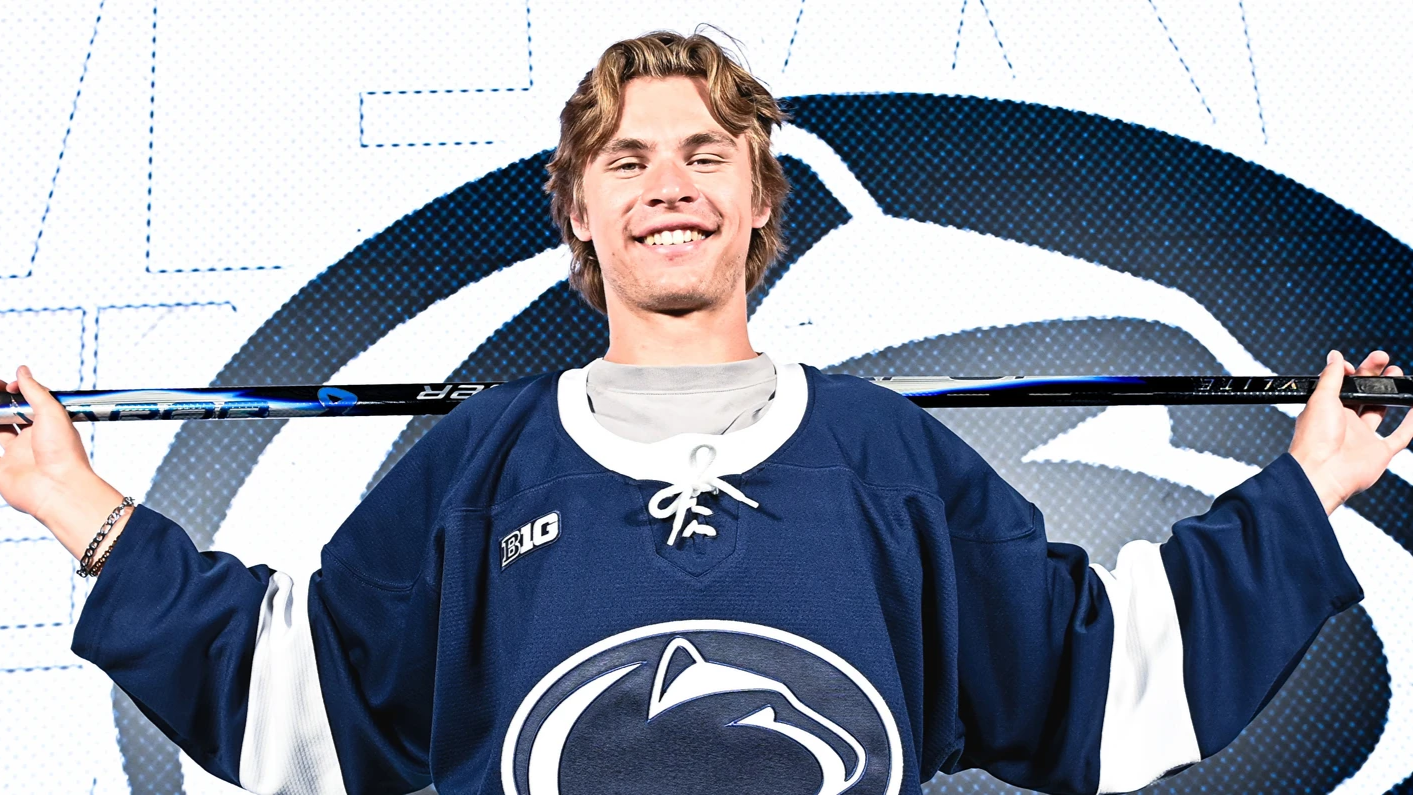
1: Gavin McKenna – LW, Penn State
- No surprises here, as McKenna rightfully takes number one. The hype around him is
real, and his abilities in the offensive zone could transform an NHL offense. I also love
the decision to go to the NCAA from McKenna, as while his production will dip and he
will struggle more often than he would in the WHL, it will pay off for him in the long run,
as the NCAA has a great track record of development. He plays on a top line in the
NCAA, playing over 21 minutes a night in his four games so far. He is trusted at a high
level, and that is mainly due to his high-end offensive traits. He is quick, and his agility
and lateral movement are excellent. He is best off the rush, using creative ways to work
the puck into the slot and rip it into the net, or find a way to dish it to a teammate. His
forecheck and defensive abilities need plenty of work, but that’s not why you draft him.
His skill is just too high to pass up on in the offensive zone, and McKenna will likely be
stapled to the number one spot on this list for the rest of the year, barring drastic
changes.
2: Keaton Verhoeff – RD, North Dakota- After an incredible year with the Victoria Royals, including 21 goals from the back end,
Verhoeff decided to take his talents to North Dakota, something that will surely improve
his development. He has great size at 6’4”, and uses it well for poke-checks and
blocking zone-entries. He also collapses gaps incredibly quickly, most times using his
size to pin an opposing player to the boards before the zone entry, and allows a
teammate to retrieve the puck if he can’t do so himself. His biggest strength, however, is
easily his shot. You don’t score 21 goals in the WHL as a 16-year-old defenseman with a
sub-par shot, and Verhoeff is certainly no exception. He takes plenty of shots from the
back-end, and when he has time to let one rip, there is a likely chance it hits twine. His
first goal in a North Dakota uniform was just that, a rocket from behind the circles.
Verhoeff isn’t perfect, though, and some of his inconsistencies bother me. First, his
skating is not great. It isn’t a weakness necessarily, but he can at times be caught flat-
footed and will flail trying to do quick crossovers to make up for it. He is a taller
defenseman, so super smooth skating isn’t a dealbreaker, but it is noticeable. Second,
he tends to be one of the first players to join the rush or head into the attacking zone.
This is great for most offensive defenders, but that means he will likely need a defensive
partner to balance him out, despite Verhoeff’s individual defense being solid. Those
aren’t huge problems, but when you are projected as a future number one defender,
small skating or defense issues will be amplified. One of the best things about Verhoeff,
though, is his age. He is only 17 and has a July birthday, meaning by the time he turns
18, he will have an entire NCAA season under his belt, one of the best development
leagues, especially for defensemen. These issues I have with him may be entirely gone
by the end of the season, or they may be his main issues. Verhoeff is definitely one to
wait and see how he develops this year, but he will likely be a top-three pick in a loaded
2026 class.
3: Ilia Morozov** – C, Miami (OH)
- Here is where we start branching out into lesser-known names; however, I doubt that will
be true of Morozov for long. He has caught my eye so quickly that he will be the topic of
the first prospect analysis article. Last year, he played for the Tri-City Storm of the
USHL, putting up 11 goals and 22 points in 56 games, a good showing for the then 16-
year-old. Now, at 17 with an August birthday, the incredibly young forward took the step
up to the NCAA. As the youngest player in the league, he has made his presence known
with 3 goals and 7 points in only four games for Miami Ohio. At 6’3”, he already has the
size to be physical and protect the puck on his stick. He isn’t a player who excels with
the puck on his stick, however. Almost any time his team enters the offensive zone,
Morozov goes directly to the front of the net. But he is not inactive, constantly shifting or
gliding behind the net to continue a cycle. He is not the best of the boards, but like
Verhoeff, that makes sense with a 17-year-old in the NCAA, even if both are above 6
feet. He has a quick release and specifically excels with his catch-and-release shot. He
also has already shown a high motor at times, but he is inconsistent and will sometimes
not push himself on a backcheck or forecheck. Not only is he inconsistent, but his
skating is also an issue and he will need to improve if he wants to make the NHL.
Overall, a fascinating package that could turn a lot of heads around hockey circles if he
can continue to produce. He has already brought the Miami Ohio Hockey program to a
better season than last year, as they have gone 4-0-0 to start the year, while they only
won 3 games all of last year. If this young prospect can continue reviving an NCHC
program as the top line center with great net-front skills, he may be a lot better than
many know right now. I think at the very least he is a first-rounder, and if he continues to
improve, he could creep into the top 15.
4: Adam Valentini – LW, Michigan- Valentini has a lot of development ahead, but he could be really good if he can continue
to grow his game. Another late-birthday 2008 (April), but chose to take the jump to the
NCAA, and in 4 games already has 3 assists. You can see what made Valentini so good
for the Chicago Steel last year, where he put up 17 goals and 39 points in 58 games, a
very good performance in the USHL. Now at Michigan, you can see how his game is a
bit less refined compared to others in the NCAA. But the skill level and talent are there;
he just needs some fine-tuning. His small area skill is great; he can stickhandle quickly
and in stride, he is a hound entering the zone, stick lifts and works around opponents,
and tries to create a chance even when the play is seemingly broken up. But his
defensive positioning, forechecking effort, and physical play all leave more to be desired.
A lot of these issues can be worked out, and like all players on this list, it will be
interesting to see how the coaching staff will develop him, especially one as good as
Michigan’s. I think Valentini is also currently a first-round level prospect, and if he
improves so should his draft stock.
5: Landon Nycz – LD, Massachusetts
- Landon Nycz is another player who I think is flying under the radar right now, but by draft
day people will know who he is. Already logging around 15 minutes a night, he may only
be the fifth option on the backend for the Minutemen, but he shows promise already. He
has good size at 6’2”, and skates incredibly well for his size. His crossovers and
transition skating is so fluid it looks second nature to Nycz. He normally begins the
breakout for his team, can fake opponents in the defensive zone, and then find a seam
pass to one side in the neutral zone to transition to offense. While he normally stays high
to be the last man back, he will occasionally cycle in the offensive zone and drive
towards the net to get a better chance. He also shoots the puck a ton, especially off
feeds at the blue-line, resulting in Nycz’ first NCAA goal last week. He is noticeable
responsible in the way he plays, and will battle net front to clear his crease. The lack of
glaring issues is also a large plus for Nycz. He is already 18 as a October birthday, but
to be a noticeable defenseman in the NCAA at 18 is no easy feat. I see him slotting into
a second round pick come draft time, as his mix of skating, size, and high level of
competition in the NCAA make him appealing. If he can keep up this pace this year, he
is likely an early day two selection.
6: Lincoln Kuehne – RD, Arizona State- Not a ton to say about Kuehne, although he is a notable prospect in his own right. He is
a 6’2”, defense-first defenseman who is currently shoring up the bottom pair for Arizona
State. He was at the United States National Development Program last year, where he
put up 3 assists and a +8 rating in 27 games. He uses his size well, effectively
eliminating rush chances against the boards. He closes gaps quickly and doesn’t give
oncoming forwards any room. This is effective; however, higher-level forwards will be
able to work around this method, so he will need to advance his defensive technique to
get to the next level. He skates fairly well and uses it to reach pucks and close lanes
quickly. He hasn’t put up any stats for ASU yet this year, but as a shutdown third-pair
defenseman, no news means a job well done. I don’t know if Kuehne has a super high
ceiling, but playing any role on a good ASU program in your draft year is a good sign.
And if you want to develop a defenseman anywhere, it’s the NCAA. A big issue with him
so far is his ice-time, as he currently ranks last on Arizona State with just over 11
minutes a night on average. When you are playing less than most forwards as a
defensemen, it may be cause for concern due to the lack of trust with the coach that
shows. How he develops throughout the year will decide his draft ranking, as he has just
not played enough at the NCAA level yet.
It may be a little ridiculous to try and project where these players will go on draft night in
nine months, but the exercise to more to express the level there are playing at over the course
of the year. These 6 players all deserve a nod in some aspect, as playing college hockey in your
draft year is impressive in itself. Im excited to keep covering them over the course of this year to
see how they can grow their games, and where they do end up in the draft.