Blog

  • DRAFTPRO – 2024 IIHF U18 WORLD CHAMPIONSHIP REVIEW – CZECHIA

    By DraftPro Staff

    The IIHF World U18 Hockey Championships just wrapped up last week in Espoo and Vantaa Finland, and was a scouting hotspot as a last big event for NHL staffs who are charged with evaluating the next wave of NHL talent.

    There were some bright spots for the upcoming 2024 NHL draft that stood out and some future draft eligibles that really grabbed the spotlight. In this ten-part series we will look at each team entry and provide some review of prospects, how they performed and how their performance might have affected their draft stock. We will start with the last place team, Kazakhstan, and work our way through to the gold medal winning Canadian squad.

    The Czechia team came in looking to do some damage with a few big bodies and some highly skilled smaller players who can create offensive chances on their own. Unfortunately they has a bit of a disappointing showing as the consistency in play was just not there as they finished sixth overall.

    Here are some player reports from our Liam Staples on the Czechia U18 players that stood out.

    #19 F Adam Jecho, Czechia, 6’5” 198 R. 26-03-2006

    A powerful skater, his skating has noticeably improved since the 2023 Hlinka-Gretzky tournament. He pivots and rotates his body correctly to stay involved in the play. His decision making needs to be quicker, against Canada and Sweden he was a step behind and as a result could not make plays like he wanted too. His offense was limited against Canada because defenders forced him to the outside with the puck, he did not try to carry the puck to the middle of the ice against Canada, he made successful seam passes but need to see him carry the puck into the middle of the ice more. Jecho is skilled with the puck, likes to make plays off the rush and take on opponents one on one. He is not overly physical, would like to see him engage in more body contact to separate the puck from his man. He is strong on the puck, protects the puck well with his wide gait and keeps his feet moving with the puck. Adam established a pre-set deke in the slot area with a quick drag and release. He scored several of his goals in the WHL this past season with his patented quick drag and release. He has a powerful shot from distance, quick release off his blade with solid accuracy capable of beating goaltenders up high on either side of the net. In a game against Sweden, Jecho showed off his impressive pre-set deke by scoring a goal on his off-side with a shot from the slot over the goalie’s shoulder on a two-on-one opportunity. He has great coordination with his body and his stick which can be credited towards his background in playing competitive tennis growing up. The reflexes he learned playing tennis translate on the ice through his quick stops and starts and maintaining control of the puck with his feet. He competes on the ice through hard backchecks and puck protection. He is very effective at using his stick to close the gap between his opponent. He is very disciplined with his stick, he does not fall into his opponent’s trap by lodging his stick into his opponent’s feet or hands causing a penalty. At this year’s tournament Czechia was missing their top-defenceman in Adam Jiricek, fourth ranked European skater by NHL Central Scouting, Jecho finished tied for the most points on his team with three points and led his team with two goals in the tournament. Czechia did not have the firepower offensively compared to previous years so the offense was limited but Jecho was one of the more productive players on the Czechia roster this year.  

    #23 F Petr Sikora, Czechia, 5’10” 172 L. 02-01-2006

    Sikora was named an assistant captain for Czechia at the tournament. He is shifty with his feet, glides through traffic and gets into open areas on the ice by shifting his feet. On the penalty kill he occupies shooting lanes to the net through his shifty lateral skating. Scored his lone goal of the tournament against Sweden on a high blocker shot from the strong side faceoff circle. He took advantage of the space the defense was giving him and he made the Swedes pay for it. Sikora is strong on the puck, plays stronger than what his weight indicates, he can be difficult to knock off the puck as he protects the puck well with his body and opens his skating gait to put more strength into his skating stride. Sikora can play the puck at his feet, he was effective at maintaining possession through excellent footwork. Sikora carries a high intensity to his game, he embraces contact well and adjusts his body position accordingly, he plays at a fast pace, speed is not the only reliable option to his arsenal. He relies more on quick lateral movements and strong edgework to open himself up to the play, his edgework and puck protection made him effective at creating quick looks for his team in the offensive zone. Watching Sikora play you can see him processing the ongoing play on the ice, this allows him to read the developing play making him the first player in position when the puck arrives. There were numerous occurrences of Sikora being in the right position at the right time to retrieve the puck, coming out unexpectedly to intercept passes or close down lanes to the net; this was very noticeable in the quarter-final matchup against rival Slovakia.

    #15 D Tomas Galvas, Czechia, 5’10 148 L. 11-02-2006

    Galvas played on the top pairing for Czechia in the tournament and looked upon in every situation. He struggled against Canada eliminating opponent’s time and space, he failed to pin players along the boards ending the ongoing cycle. He plays with the positive instincts in the defensive end but lacks size and strength, as his body further develops and adds strength to his body frame, his defensive zone reads should improve. He needs work on his gap control, Galvas does an effective job keeping his opponent to the outside but lacks the strength to eliminate them from the play, as a result, when Galvas falls a step behind his opponent, he falls out of position and cannot make up for it with his size. Watching Galvas execute his puck retrievals is enticing because he finds ways to escape on coming pressure. His skating ability is a strong suit to his game, he is strong on his edges and lateral movements and pivots extremely well with the puck to create time and space for himself. His ability to pivot with the puck adds a sense of poise to his game. He is fairly consistent in completing breakout passes from puck retrievals but he is a smooth skater when he rushes the puck. Galvas quarterbacked the top Czechia power play, he walks the line well and looks to move the puck to his forwards. He does not regularly activate himself into the play often in the offensive zone however, he will pinch in the zone to become an available passing option.

    #6 D Jakub Fibigr, Czechia, 6’0” 172 L. 22-07-2006

    Fibigr was named an assistant captain for Czechia at the tournament. Jakub played on the top pairings for Czechia throughout the tournament averaging over 20 minutes of ice time a game. He was given responsibility as quarterbacking the second power play unit and a key member of Czechia’s penalty kill. Fibigr had rough starts to a couple hockey games. He struggled out of the gate in the contest against Canada. He fanned on a pass to his partner off the opening faceoff leading to a goal-against just a mere seconds into the hockey game. On his next shift, he failed to control a pass in his feet which eventually resulted in putting his team down two goals within two minutes of the game. As the game progressed he began to use his feet more. He uses good angles to keep players to the outside of the ice but struggles with proper body positioning when trying to take away space and disrupting possession. Fibigr is a puck-moving defenceman capable of making short distance passes but inconsistent with his long stretch breakout passes. He prefers to move the puck but can use his feet to elude trouble and find a passing option. Fibigr finished the tournament with one goal, his goal was a timely goal in the quarterfinal matchup against Slovakia to bring his team to within one in the third period.

    #22 F Maxmilian Curran, Czechia, 6’3” 185 L. 27-08-2006

    Standing at 6’3” Curran patrols the middle of the ice as a two-way forward. He drops down below the dots to provide defensive support but still has areas of improvement in the defensive end. His decision making needs to be quicker in the defensive zone. Czechia plays a man-on-man style defense, when someone loses their man, Curran needs to make quicker decisions to either cover for his teammate or stick to his man, oftentimes he will hesitate and that quick hesitation provides space to the net for his opponent. Skating is another area that Curran needs to improve, he is not a physical presence nor is he a bull in a China shop when it comes to competing for loose pucks in the corners, he is lacking foot speed and he is weak on his edges. The area he excels is in front of the net. He occupies the net front presence role on the first power play unit. He plays with good instincts down low through carrying the puck to the front of the net and absorbing contact, if he sees the net is covered he will try to move the puck cross ice. Curran finished tied for the most points for his team with three points in the tournament. He scored his lone goal of the tournament using his instincts to move the puck down low to the front of the net to his teammate and timed his net drive perfectly to slide in the rebound. He finished the tournament with two primary assists, the timing of his points were clutch for his team as he scored the first goal of the hockey game in the preliminary round against Switzerland and recorded the primary assist on the first goal of the game against Sweden, both games Curran got on the statsheet Czechia would go on to win.

    #9 F Adam Benak, Czechia, 5’7” 152. L. 10-04-2007

    An underage forward that plays with explosive speed, Benak played on the top forward line for Czechia and finished tied for the most points on the team. Benak’s short skating stride allows him to reach full speed in minimal strides. He possesses break away speed with an elusive first step, he builds up speed through his windup at the start of his turn and by the time he completes the turn and gathers the puck he has reached maximal speed. Listed at 5’7” 152 lbs, he struggled with overcoming physicality, defenders were able to close down the gap on him quickly and erase him from the play through body positioning. Defenders were able to box him out in the corners and use their body to protect the puck. For a smaller player with quick speed, Benak showed higher levels of compete compared to others on his team, he supported his teammates in board battles and dropped low in the defensive end to take away passing lanes in front of the net. He has silky hands, made nice saucer passes to teammates in traffic, with his skillset, when he adds more muscle to his body, his passing ability and coordination should improve. He is not afraid to let shots go from distance, he scored his lone goal of the tournament by shooting a puck on net from distance and outworking his opponent to collect his own rebound. Benak finished the tournament with one goal and two assists. As an underager Benak played top line minutes for his team, played on the top power play unit and was put on the ice in crucial situations for his team. Benak will be a vital returning piece offensively for Czechia next season in his draft year at the 2025 IIHF U18-World Hockey Championship.

    Photos courtesy IIHF.com

    ************************************************************

    Get your hands on the comprehensive DraftPro 2024 Draft Guide now!

    In the 2024 Draft Guide our team ranks the top 224 NHL Draft eligibles, provides well-written profiles on the top 224 names for this year, includes in-depth prospect features, looks at the NHL’s top 50 drafted prospects coming down the pipe, dives into what each NHL team has in the prospect cupboard and what their draft needs are, provides a comprehensive look at the 2025 NHL Draft with profiles on the top 32, provides a top 32 ranking on the 2026 NHL Draft with profiles on the top 10, and so much more.
    https://draftprospectshockey.com/draftpro-2024-nhl-draft-guide-now-available
  • DRAFTPRO – 2024 IIHF U18 WORLD CHAMPIONSHIP REVIEW – SWITZERLAND

    By DraftPro Staff

    The IIHF World U18 Hockey Championships just wrapped up last week in Espoo and Vantaa Finland, and was a scouting hotspot as a last big event for NHL staffs who are charged with evaluating the next wave of NHL talent.

    There were some bright spots for the upcoming 2024 NHL draft that stood out and some future draft eligibles that really grabbed the spotlight. In this ten-part series we will look at each team entry and provide some review of prospects, how they performed and how their performance might have affected their draft stock. We will start with the last place team, Kazakhstan, and work our way through to the gold medal winning Canadian squad.

    The Swiss team came in with arguably the most talent we have seen at this event from them ever with more than a few projected draft picks dotting their roster. And they did not disappoint as they finished in seventh place out of a ten-team field.

    Here are some player reports from our Seth Ditchfield on the Swiss U18 players that stood out.

    23 D, LEON MUGGLI, (EV Zug, NL) 6’0, 176, L, DOB: 7.9.2006
    It cannot be overstated just how critical Leon Muggli was for this roster, serving as a catalyst who was likely to be one of the most active players in the entire tournament. Muggli started off the tournament strong, but unfortunately, he had to leave game 3 with an injury and did not return. Despite being somewhat of a hidden gem due to the smaller market he plays in, he secured a solid and permanent role on Zug’s Swiss NL team. Muggli isn’t a towering presence; instead, he opts to use his core strength wisely, playing low to the ice to maximize his strength, and defending intelligently with his active and robust stick, as well as positional awareness. He is a safe, yet productive player, not the most flashy or dynamic, but possessing an incredible ability to move the puck to high-danger areas. Muggli demonstrated his excellent skating in this tournament, able to stop and start on a dime, and catch defenders off-guard with plenty of rush opportunities, fully showcasing his transition strength. He exits the zone with crisp, solid passes, and is always engaged and tactically sound away from the puck. He’s been one of the most mature and intelligent defenders in this draft, and the same continued to be true for Team Switzerland.

    26 D, DANIIL USTINKOV, (GCK Lions, SL) 6’1, 201, L, DOB: 8.26.2006
    Daniil Ustinkov is a case of talent versus execution. He had a prime opportunity to step up after Leon Muggli’s injury, yet he failed to take advantage. Ustinkov is a strong skater with fluid edges and great stickhandling under pressure. However, he often tries to do too much, especially in the neutral zone or when exiting the zone, leading to turnovers. His slow backchecking has often resulted in creating odd-man rushes against his team. Despite these issues, Ustinkov showcased incredible composure under pressure, consistently making solid first passes and proving his worth as a notable transition defender. His lack of explosiveness and faulty decision-making was apparent, as he struggled to control the tempo and was easily outmaneuvered by opponents who would simply dump the puck or pass it around him, despite his near unbeatability in one-on-one situations. Offensively, the tournament didn’t go well either, finishing with just one assist, he was unable to consistently generate offensive opportunities due to his decision-making flaws. Ustinkov’s potential remains high, but his performance likely lowered his draft stock. Moving forward, his challenge will be to improve his decision-making and play with significantly more intensity and competitiveness than he showed in this tournament.

    4 D, GIAN MEIER, (GCK Lions, U20-Elit) 6’2, 168, R, DOB: 7.10.2006
    What a story Gian Meier was in this tournament, he found a gap in the Swiss defense and leveraged it to significantly boost his draft stock. A defensive defenseman with only 3 goals in 60 games, Meier showed off some offense by scoring 2 goals and racking up 4 points in just 5 games, leading the Swiss roster. His defensive talent shone even in tough matches against Canada, where he was a bulwark, effectively using his strength to box out forwards, enhance his gap control, and aggressively play the corners. As Meier continues to bulk up, his presence in these areas will only grow stronger. Offensively, he showcased his abilities by smoothly transitioning the puck, supporting rushes with robust 4-way skating, and confidently taking shots from the point. His rapid decision-making and evolving offensive vision marked a significant development in his game, contributing heavily not just defensively but offensively, playing crucial minutes in all situations and logging over 20 minutes per game.

    19 RW, KIMI KOERBLER, (Ottawa 67’s, OHL) 5’11, 168, L, DOB: 9.25.2006
    A spark in a quiet Swiss team, Kimi Koerbler (2 goals, 5 games) wasn’t a scoring machine, but his thrilling bursts made him a standout. With elite skating speed, Koerbler kept up with the fastest, winning puck battles and showcasing a heavy shot. His hands stayed sure under pressure, fueling his aggressive style. However, inconsistency plagued him. Passes lacked zip and variety, and his game became predictable at times. Koerbler can dominate stretches, but then disappear. For early draft consideration in 2025, consistency is key.

    1 G, CHRISTIAN KIRSCH, (Zug, U20-Elit) 6’3, 176, L, DOB: 6.18.2006
    With no shortage of activity from Day 1, Christian Kirsch was a beacon of reliability in net, showcasing his blend of tactical intelligence. Kirsch is adept at covering the lower half of the net, as he’s very prominent in a split, and fluid from post to post. He’s a big presence during breakaway action, covering large portions of the net and forcing a deke. However, Kirsch also struggled with vision and technical talent. He let in some clean floater shots from the point due to screens, and the puck would slip through him when he was cleanly in position and ready. Despite the negatives, Kirsch has a solid frame and intelligence to build off of, making him one of the higher-upside goaltenders in the class.

    7 LD, BASILE SANSONNENS, (Fribourg-Gottéron, U20-Elit) 6’3, 198, L, DOB: 8.19.2006
    Basile Sansonnens is hardly an offensive dynamo, yet he stands out as a promising shutdown defenseman with solid 4-way skating, notably effective in backward crossovers and edgework. Despite his physical approach, particularly effective along the boards, he struggles against fast wingers and needs to boost his backward speed and physical assertiveness. During penalty kills, while he identifies passing lanes well, his blocking execution is lacking. Sansonnens must also refine his physical presence; his body checks often lack impact, necessitating further bulking up. Despite these areas for improvement, his potential as a reliable defenseman is evident, making him a valuable later-round pick.

    18 LW, ROBIN NICO ANTENEN, (Zug, U20-Elit) 6’2, 190, L, DOB: 5.21.2006
    Robin Antenen improved as the tournament went along, showing a strong work ethic away from the puck and a large presence on the ice. Known for his aggressive approach to puck battles, Antenen does a great job pressuring opponents on both forechecks and backchecks. While he lacks top speed, he’s persistent and competitive. He needs to improve his overall 4-way speed, particularly his first step, as it’s quite slow. Despite being quite strong, he doesn’t fully leverage that strength yet. I can see the potential for a strong bottom 6 player, with a strong shot, making him someone teams may target with a late-round pick.

    6 C, JAMIRO REBER, (HV71, J20 Nationell) 5’10, 176, L, DOB: 9.4.2006
    Jamiro Reber showed off a quick first step and held onto the puck well at top speed. He displayed impressive rush-shooting skills, creating numerous scoring chances every chance he got. His offensive style, though predictable, involved shooting at every opportunity from any angle, as well as handling the puck well in motion. He’s a strong transition player who became increasingly better at distributing the puck as the tournament progressed, though his playmaking ability still needs further development. At times, Reber struggled against tight defensive pressure, notably from Canada. As one of the youngest players in the draft, he has potential. To realize this potential, he needs to improve his agility, decision-making, and overall offensive variety to break through tougher systems.

    3 LD, LUDVIG JOHNSON, (Zug, U20-Elit) 5’10, 174, L, DOB: 7.27.2006
    Ludvig Johnson jumped into game action after the Leon Muggli injury, and he continued to show the intrigue he did in league games. He’s not the biggest, strongest, or most aware in his defensive end, but he was the most flashy in the offensive zone. He moves the puck extremely well in all 3 zones, he’s a great 4-way skater and pinches at all times. He got a secondary assist in his first shift against the Swedes and continued to impress with his puck skills in motion, as well as offensive zone possession. Johnson has a lot to work on: strength, defensive awareness, stick strength and awareness, rush defense, and more. However, I believe he’s an intriguing option to pick in the late rounds due to the potential he shows.


    It is also almost that time of year where you can get your hands on the comprehensive DraftPro 2024 Draft Guide which will be released in just a few days.

    In the 2024 Draft Guide our team ranks the top 224 NHL Draft eligibles, provides well-written profiles on the top 224 names for this year, includes in-depth prospect features, looks at the NHL’s top 50 drafted prospects coming down the pipe, dives into what each NHL team has in the prospect cupboard and what their draft needs are, provides a comprehensive look at the 2025 NHL Draft with profiles on the top 32, provides a top 32 ranking on the 2026 NHL Draft with profiles on the top 10, and so much more.
    This year everyone who pre-orders the 2024 Draft Guide digital edition will receive a pre-order discount off the cover price of $12.99 $10.00 each. So don’t wait, get your copy on order for just ten bucks and be the first to receive it as soon as it is published.

    https://draftprospectshockey.com/draftpro-2024-nhl-draft-guide-pre-order-special
  • DRAFTPRO – 2024 IIHF U18 WORLD CHAMPIONSHIP REVIEW – LATVIA

    DRAFTPRO – 2024 IIHF U18 WORLD CHAMPIONSHIP REVIEW – LATVIA

    By DraftPro Staff

    The IIHF World U18 Hockey Championships just wrapped up last week in Espoo and Vantaa Finland, and was a scouting hotspot as a last big event for NHL staffs who are charged with evaluating the next wave of NHL talent.

    There were some bright spots for the upcoming 2024 NHL draft that stood out and some future draft eligibles that really grabbed the spotlight. In this ten-part series we will look at each team entry and provide some review of prospects, how they performed and how their performance might have affected their draft stock. We will start with the last place team, Kazakhstan, and work our way through to the gold medal winning Canadian squad.

    The Latvian roster was overmatched as were the other four bottom of the standing teams against the powerhouse nations like Canada, USA, Sweden, and Finland. The Latvian crew did manage to claw their way to an eighth-place finish meaning they will be back for the 2025 tournament.

    Here are some player reports from our Joseph Stanislau on the Latvian U18 players that stood out.

    14# Olivers Murnieks, C, 6’1, 181 lb, born 31.07.2008 (HK MOGO)

    Murnieks  has put up 3 points in 5 games with 2 assists. He is growing into his frame early on in this phase of his hockey career for team Latvia. He could grow to be a similar player to Juraj Slafkovsky in a few years where he is a really good power forward, strong as an ox, and already has the nose for the net. Olivers defends his own zone better than kids his age minus the -5 in plus minus on the Latvian national team. He forechecks really well and at this early on in his life he looks like a 3rd line center, but he’s only going to get better and could easily become a really solid 2nd line centerman as he progresses. Versus Finland and Slovakia he played over 20 minutes a game getting 1 goal and 1 assist and Slovakia was a team that failed to medal in the Bronze medal game. So the upside is absolutely there and could definitely build into something special overtime.

    8# Oskars Nyls Briedis, D, 6’3, 183 lb, born 10.07.2006 (HS Riga 17)

    Oskars played big in the corners like a true stay at home defenseman and did a magnificent job clogging the neutral zone being part of a defensive trap scheme. He did a tremendous job tying up his opponents sticks along the crease and played really sound, being able to skate well via the neutral zone to the offensive zone, and did a good job covering open lanes. He plays 15 to 16 minutes a game and could easily fit into a teams defensive structure easily and would do well playing in the AHL for a little bit before he takes on a bigger role in the NHL.

    #15 Maksims Haritoncevs, F, 5’11, 161 lb, 27.07.2006 (Mora IK J18)

    Maksims for a very young forward has had very good reads on the cycle via the power play. He knew how to isolate himself a bit and moved in from the blueline to the point with a wrist shot for a power play goal. He had 3 points (2 assists) in 4 games, and played well against Slovakia and the USA where he got his big points. He is a strong competitor going up against some of the strongest teams in the tournament that went off to medal games. So anyone looking for a strong competitive player on forward would be very fortunate to have him in their farm system.

    #1 Mikus Vecvanags, GK, 6’3, 159, 17.01.2006 (HS RIGA 17)

    There was some adversity Mikus had to deal with versus a soon to be silver medal USA roster stacked with studs who were precision like passers, and snipers. He bounced back immensely using his mechanics, and his really quick recovery, and his rebound control improved against Canada after a let down 2 games before against the Americans. If Mikus had some goal support versus Canada, Vecvanags had the ability to steal a game from the soon to be Canadian national team. The big game he had before in a win was against Slovakia in a 5-3 win and he was not given goal support in the first half of the game but in the last half because of his fast edges, positioning, and taking up as much net coverage gave his defense a lot of breathing room to follow suit. He is a big goalie, but he needs to add some more muscle to his lower and mid section so that way he can keep covering that lower third on the ice where he has done an amazing job poking pucks away, and keeping that five hole covered.

    #25 Darels Uljanskis, D, 6’2, 192 lb, 25.08.2006 (AIK J20)

    Darels logged an average time on ice of over 23:26 playing key defensive roles for Team Latvia at the U18 men’s tournament in Finland. He averaged 1 hit a game and over 2.6 blocked shots on average in a span of 5 games for Latvia for every 3 shots on net out of 5 attempts he took during that span. Uljanskis likes to keep the pace of play going for his team and is very responsible in his own zone. He is a good sized defenseman and is a very reliable defender with a really big reach and with that he does a really good job boxing out opponents. He is a very undervalued defenseman and he definitely could serve as a 2-way defenseman as he molds into a rock solid player for any team that acquires him.

    ************************************************************

    It is also almost that time of year where you can get your hands on the comprehensive DraftPro 2024 Draft Guide which will be released in just a few days.

    In the 2024 Draft Guide our team ranks the top 224 NHL Draft eligibles, provides well-written profiles on the top 224 names for this year, includes in-depth prospect features, looks at the NHL’s top 50 drafted prospects coming down the pipe, dives into what each NHL team has in the prospect cupboard and what their draft needs are, provides a comprehensive look at the 2025 NHL Draft with profiles on the top 32, provides a top 32 ranking on the 2026 NHL Draft with profiles on the top 10, and so much more.
    This year everyone who pre-orders the 2024 Draft Guide digital edition will receive a pre-order discount off the cover price of $12.99 $10.00 each. So don’t wait, get your copy on order for just ten bucks and be the first to receive it as soon as it is published.

    https://draftprospectshockey.com/draftpro-2024-nhl-draft-guide-pre-order-special
  • DRAFTPRO – 2024 IIHF U18 WORLD CHAMPIONSHIP REVIEW – NORWAY

    DRAFTPRO – 2024 IIHF U18 WORLD CHAMPIONSHIP REVIEW – NORWAY

    By DraftPro Staff

    The IIHF World U18 Hockey Championships just wrapped up last week in Espoo and Vantaa Finland, and was a scouting hotspot as a last big event for NHL staffs who are charged with evaluating the next wave of NHL talent.

    There were some bright spots for the upcoming 2024 NHL draft that stood out and some future draft eligibles that really grabbed the spotlight. In this ten-part series we will look at each team entry and provide some review of prospects, how they performed and how their performance might have affected their draft stock. We will start with the last place team, Kazakhstan, and work our way through to the gold medal winning Canadian squad.

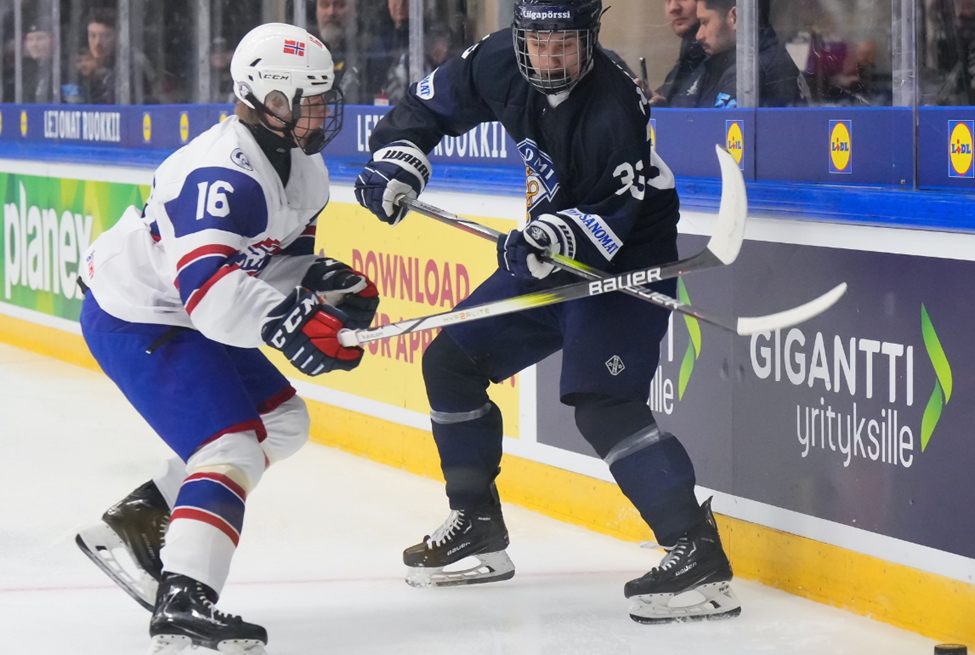
    Norway, being one of the weaker teams in the tournament, was not expected to make a major impact as a team in this tournament. However, the team still had memorable moments with the best one being the team’s win against Kazakhstan in a shootout which saved the Norway U18 team from relegation next season. Throughout the tournament there were some prospects who impressed and those who did not fulfill expectations.

    Here are some player reports from our John Peters on the Norwegian U18 players that stood out.

    #22 F, Elias Vatne, Norway (Färjestad BK J20, J20 Nationell), 5’9”, 165, L, DOB 04.21.2006

    An undersized playmaker that played a pivotal role in Norway’s win against Kazakhstan which saved Norway U18 from relegation. The game against Kazakhstan was by far his most impressive outing. In the game he led the way with a goal and three points in regulation, which was then followed up by his clutch performance in the shootout where he would score not one but two shootout goals to win his team the game. He was an impact player for Norway throughout the tournament and led the team in assists with 6 in 5 games. His offensive creativity stood out on the team with the way he would skate with the puck in the offensive zone using his speed and quick cuts to create time and space for passing lanes to open. He also demonstrated the willingness to drive to the front of the net and create scoring chances in tight. He was arguably Norway’s top player in the tournament. Due to his size, lack of high-end speed, and weak shot, he will likely go undrafted. Even if his name is not called on draft day, this event will be one he will never forget for his outstanding performance.

    #17 F, Mathias Dehli, Norway (Mora IK, HockeyAllsvenskan), 6’2”, 187, R, DOB 01.13.2006

    A big center that plays a power forward type game. On more than one occasion he drove to the front of the net by lowering his shoulder and using his weight to create separation from the defender leading to a scoring chance for himself. In the tournament, he relied heavily on his size and strength to hold onto the puck and create scoring chances for his team. His skating ability is one of his biggest weaknesses. He has a slow first step and his top speed is below average for his age group. Additionally, he struggles to make crisp passes to teammates in tight windows and does not see the ice as well as one would like. His shot and size are the greatest gifts he has at this stage. Additionally, he has some pretty good hands which was demonstrated on one of his goals against Kazakhstan where he made a powerful move to the net. Overall, he is a serious project and at best will be a fourth line guy in the NHL. He did impress enough to at least earn consideration for the 2024 NHL draft.

    #16 F, Mikkel Eriksen, Norway (Valerenga U20, Norway U20), 5’11”, 181, L, DOB 09.13.2007

    Eriksen led the team in goals for the tournament with 4 goals in 5 games played. The centerman played a strong two-way game with little flashes of skill here and there. At times, he was physically outmatched and easily knocked off the puck. With another year of physical development, he should fare much better at the tournament next season. All his goals scored in the tournament were scored within 5-10 feet of the crease. He showed a willingness to skate hard to the front of the net and open up for one-timers and to put home rebounds. He played a simple and smart game and was a huge reason why Norway won their game against Kazakhstan, scoring 2 goals and 3 points. Overall, he had an impressive tournament for a D-1 season and has a promising future with the potential of being a mid-round pick in next year’s NHL draft.   

    #15 F, Jorgen Myhre, Norway (Färjestad BK J20, J20 Nationell), 6’0”, 203, L, DOB 09.22.2006

    A playmaking forward who is eligible for the 2025 NHL draft. In the tournament he showed flashes of his playmaking ability and improved his game as the tournament went on. He is a hard-working forward that plays a strong 2-way game, but he lacks the puck handling skills, speed, and shot to someday become a top-9 contributor at the NHL level. Major improvements are needed for him to ever make the NHL, and even if he does the ceiling is low. His continued improvement in play throughout the tournament is what stuck out most.

    #5 D, Ludvig Lafton, Norway (Frisk Asker U20, Norway U20), 6’2”, 187, L, DOB 01.11.2006

    The big left-shot defensive defenseman was playing in this tournament to earn a spot in the 2024 NHL draft. Struggled against speed and skill. He has slow feet and is a very upright skater which limits his ability to generate speed and explosiveness in his skating. His physical play and smarts compensated for a lot of this. He was especially strong along the boards in the defensive zone at eliminating opponents from play. Was called upon to play in all situations even though he is not an offensively gifted player. A very low ceiling and has a lot of work to do to someday crack a lineup in the NHL. He impressed defensively and was far and away Norway’s most reliable defender throughout the tournament.

    ************************************************************

    It is also almost that time of year where you can get your hands on the comprehensive DraftPro 2024 Draft Guide which will be released in just a few days.

    In the 2024 Draft Guide our team ranks the top 224 NHL Draft eligibles, provides well-written profiles on the top 224 names for this year, includes in-depth prospect features, looks at the NHL’s top 50 drafted prospects coming down the pipe, dives into what each NHL team has in the prospect cupboard and what their draft needs are, provides a comprehensive look at the 2025 NHL Draft with profiles on the top 32, provides a top 32 ranking on the 2026 NHL Draft with profiles on the top 10, and so much more.
    This year everyone who pre-orders the 2024 Draft Guide digital edition will receive a pre-order discount off the cover price of $12.99 $10.00 each. So don’t wait, get your copy on order for just ten bucks and be the first to receive it as soon as it is published.

    https://draftprospectshockey.com/draftpro-2024-nhl-draft-guide-pre-order-special
  • DRAFTPRO – 2024 IIHF U18 WORLD CHAMPIONSHIP REVIEW – KAZAKHSTAN

    DRAFTPRO – 2024 IIHF U18 WORLD CHAMPIONSHIP REVIEW – KAZAKHSTAN

    By DraftPro Staff

    The IIHF World U18 Hockey Championships just wrapped up last week in Espoo and Vantaa Finland, and was a scouting hotspot as a last big event for NHL staffs who are charged with evaluating the next wave of NHL talent.

    There were some bright spots for the upcoming 2024 NHL draft that stood out and some future draft eligibles that really grabbed the spotlight. In this ten-part series we will look at each team entry and provide some review of prospects, how they performed and how their performance might have affected their draft stock. We will start with the last place team, Kazakhstan, and work our way through to the gold medal winning Canadian squad.

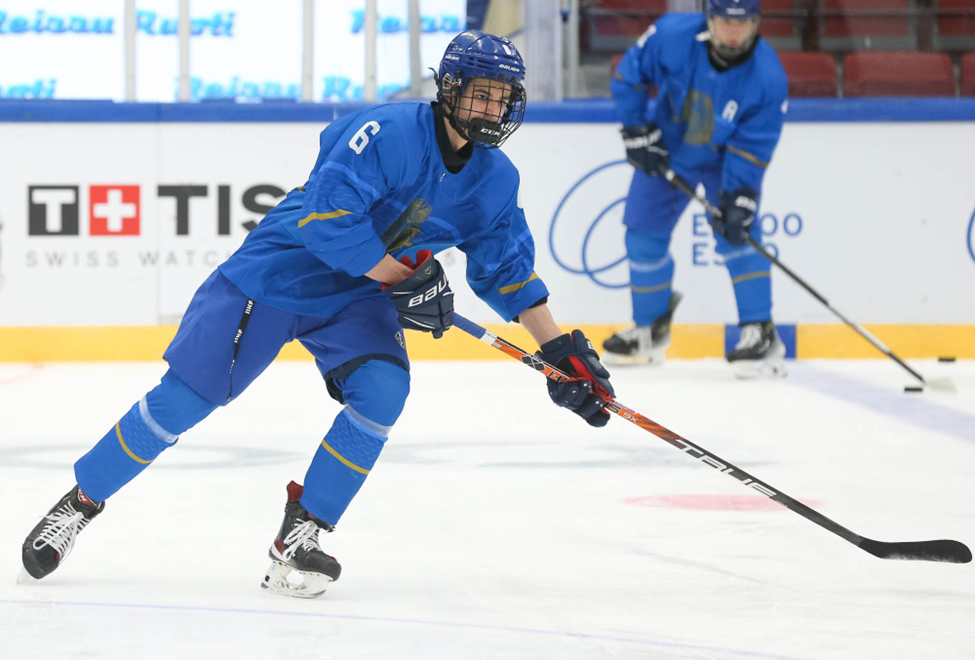
    The Kazakhstan roster often came out of the gates strong, grabbing early leads like 2-0 against Switzerland and 1-0 against Sweden, and starting 1-1 against Canada. Despite these promising starts, victories were tough to come across until Game 3 against the Czechs, where Kazakhstan pulled off one of the tournament’s biggest upsets by securing their first-ever victory at the U18 top event. It was a team effort led by captain Abzal Alibek and defenseman Roman Bolshedvorsky. This high point, however, was bittersweet as Kazakhstan found themselves relegated to Division 1A, setting up a challenge to fight their way back for the 2026 tournament.

    Here are some player reports from our Seth Ditchfield on the Kazakhstan U18 players that stood out.

    #25 Tanirkhan Alpysbayev G, Barys Astana U18 (Russia U18) 6’1, 165, R, DOB: 2.15.2007

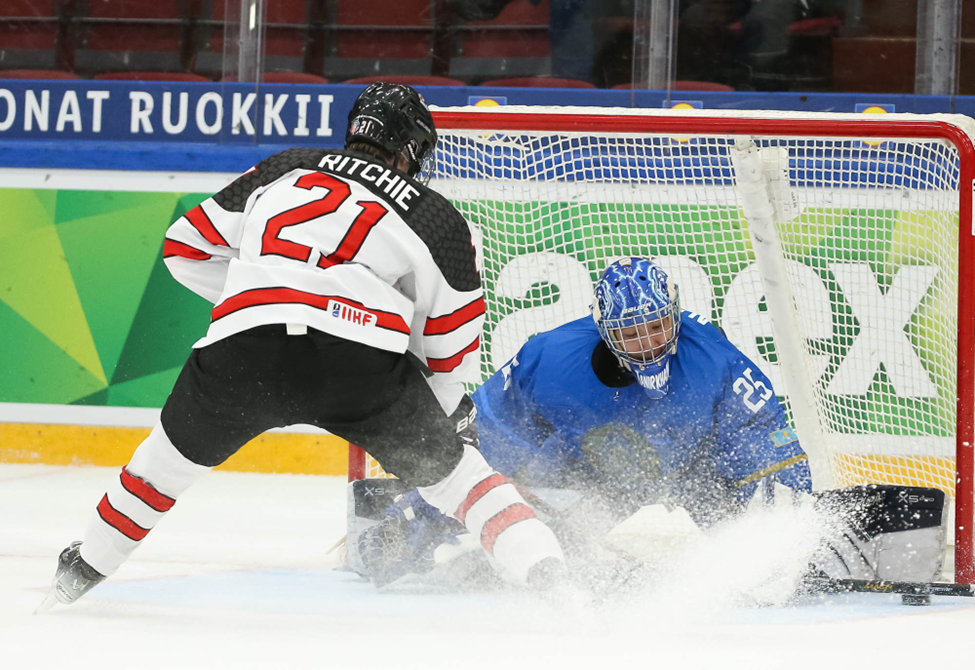
    When a small nation gets pummeled in the shot department, it’s not surprising to see a goaltender, known for their confidence and drive, stand on his head at times. However, Tanirkhan Alpysbayev was a different story. With stylistic shades of Jonathan Quick, he produced one highlight reel after another, showing an exceptional level of flexibility and agility that was astonishing, especially for an underager in this tournament. Alpysbayev is a goaltender who effectively combines athleticism, speed, agility, and flexibility. His ability to cover post-to-post with lightning speed underscores his dynamic and somewhat risky playing style, although improved positional play could help reduce the need for such dramatic saves. His rebound control remains a work in progress; he generally manages to swallow the puck and opts for safer plays, whether covering the puck or playing it cautiously. However, his blocker work could be more consistent, often sending pucks flying in unpredictable directions. In the crease, he adopts a tall and aggressive stance, which helps cover the top half of the net, but as a butterfly goalie who frequently drops low, he exposes the top of the net again. On breakaways, his assertive approach effectively shuts down shooting lanes, compelling forwards to attempt dekes, which are usually useless given his strength down low. Although he has some technical challenges and issues with positional consistency, Alpysbayev’s quick recovery and stamina consistently kept his team in the game. If he can refine his technical skills to match his natural talent, he has the potential to excel in the 2025 class and beyond.

    #11 Assanali Sarkenov RW, Snezhnye Barys Astana (MHL) 6’4, 187, L, DOB: 7.22.2006

    Sarkenov didn’t start the tournament as he would have hoped, looking disinterested in game 1 and earning a suspension in game 2. However, his resurgence against Canada, where he scored three goals against a team that had only let in seven during the entire round-robin, was a dramatic turnaround. This performance showcased Sarkenov’s tenacity and aggressive playing style, a welcome change from his earlier issues. Notably, he’s a natural goal scorer with a quick, heavy release from the high slot that makes him a significant threat whenever he has time and space. Despite occasional moments of frustration and lapses in composure, Sarkenov’s physical attributes—standing at 6’4″ with soft hands, a strong stick, and rapid shot—allow him to excel in puck possession. His skating overall could use improvement, but his solid first step helps him keep pace with, and sometimes overpower, top-level defenders. While his performance in league games might raise questions about his draft potential, Sarkenov’s ability to dominate a game when given a chance indicates that he could be a smart pick in the later rounds. His second-half performance in the tournament revealed a high-upside player who could flourish with the right development.

    #10 Abzal Alibek LW, Snezhnye Barys Astana (MHL) 6’0, 163, L, DOB: 3.39.2006

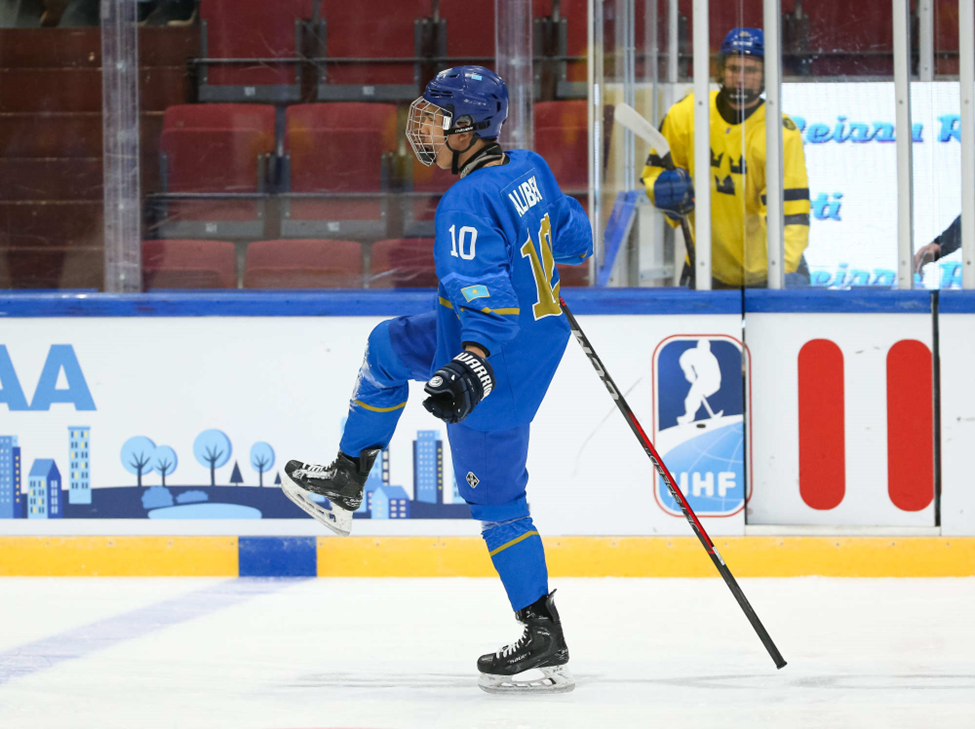
    Alibek was a standout player for the Kazakhstan team, combining strong puck skills with notable leadership qualities. Recognized as possibly the strongest skater on his team, Alibek matched the pace of the tournament’s top players, consistently creating opportunities and effectively backchecking and closing lanes. He excelled in transition, adeptly handling passes of any quality and swiftly navigating the neutral zone with confidence. His offensive talent was evident in his snapshot, which secured two early goals against Sweden and Switzerland. Over five games, Alibek tallied five points, missing the scoresheet in only one game, which ironically was arguably his most impressive game—demonstrating his commitment across all three zones and playing a huge role in Kazakhstan’s first-ever win against Czechia in this tournament. Alibek’s work ethic and leadership influenced his team in a big way; he was a constant force on the ice and a seemingly positive presence in the locker room. His engagement off the puck was just as impressive, excelling in puck retrievals and showing keen positional awareness. While moving through defenders, his solid hand skills were apparent. Despite the need to bulk up, improve his balance, and expand his offensive toolkit, Alibek’s foundational strength of character and leadership highlighted his potential every shift. Although his league performance might raise concerns about his draft-ability, any team seeking a hardworking player who can contribute both on and off the ice and develop within their system would find Alibek to be a valuable late-round pick.

    #5 Mstislav Shipilin LD, Snezhnye Barys Astana (MHL) 6’0, 174, L, DOB: 3.31.2006

    Shipilin, traditionally a stay-at-home defender in the MHL, took on a more mobile and aggressive role during this tournament. He started rough, appearing completely out of place and struggling to keep up with the speedy Swedes. However, he dramatically improved in the second half of the tournament, highlighted by a big game against the Czechs. In that match, he logged 23 minutes and scored the game-winning goal, showcasing a level of mobility and puck skills not previously seen, handling pressure well and creating effectively in the neutral zone. Looking ahead, Shipilin is likely to jump to professional hockey as a mobile defensive defenseman. To succeed, he needs to bulk up, strengthen his play in the slot, and enhance his 4-way skating ability to better handle rush defense.

    #4 Roman Bolshedvorsky RD, Snezhnye Barys Astana (MHL) 6’3, 212, L, DOB: 6.18.2006

    Bolshedvorsky entered this tournament as an unknown, but he exited the tournament with the attention of scouts on him. Despite not being known as an offensive threat, his first goal of the season against Czechia showed a notable improvement in his puck control and activity, both in the neutral and offensive zones. There were initial doubts about whether his 6’3” frame could translate his potential into the NHL, especially as he often got pushed around and failed to use his size effectively. However, as the tournament progressed, Bolshedvorsky evolved into Kazakhstan’s toughest defender, notably in a standout performance against Czechia where he not only scored 2 points but also logged 21 minutes to help secure the win. While offense may not be his forte, his positional play and physicality lay a solid foundation. Moving forward, maintaining this newfound aggressive edge will be crucial for his development.

    #6 Syvatoslav Evplov, LD, Armiya-SKA St.Petersburg U16 (Russia U16) 6’0, 157, L, DOB: 8.27.2008

    Evplov stuck out from day one, something the other Kazakhstan defenders could not match. He stood out in the defensively-oriented system with his strong mobility and 4-way skating ability. Evplov effectively controlled the game’s pace from the backend, despite often facing tougher competition. He generally opts for a conservative approach, holding his position and containing forwards over pinching. However, his decision-making in the neutral zone was notably aggressive, demonstrating good timing and spatial awareness. Despite these strengths, Evplov needs to refine his puck retrievals and enhance his passing skills. His strength transition made him a catalyst in starting rushes, although his smaller frame and tendency to rely on reach rather than physical engagement sometimes left him exposed. To continue his development and become a prominent figure for Kazakhstan in 2026, Evplov will need to build up strength to improve his defensive strength against faster and more agile opponents.

    ************************************************************

    It is also almost that time of year where you can get your hands on the comprehensive DraftPro 2024 Draft Guide which will be released in just a few days.

    In the 2024 Draft Guide our team ranks the top 224 NHL Draft eligibles, provides well-written profiles on the top 224 names for this year, includes in-depth prospect features, looks at the NHL’s top 50 drafted prospects coming down the pipe, dives into what each NHL team has in the prospect cupboard and what their draft needs are, provides a comprehensive look at the 2025 NHL Draft with profiles on the top 32, provides a top 32 ranking on the 2026 NHL Draft with profiles on the top 10, and so much more.
    This year everyone who pre-orders the 2024 Draft Guide digital edition will receive a pre-order discount off the cover price of $12.99 $10.00 each. So don’t wait, get your copy on order for just ten bucks and be the first to receive it as soon as it is published.

    https://draftprospectshockey.com/draftpro-2024-nhl-draft-guide-pre-order-special/embed/#?secret=KJRJc8oOp7#?secret=nRtXdjRPSG

  • 2024 NHL DRAFT – DRAFTPRO SPRING RANKINGS

    2024 NHL DRAFT – DRAFTPRO SPRING RANKINGS

    By DraftPro Staff

    We are officially on the home stretch of the 2024 NHL Draft race.

    With most junior teams gearing up, or already in, playoff mode and the IIHF U18 World Championships and CHL Memorial Cup on the horizon, the majority of our evaluation process for the 2024 NHL Draft, where we watched these guys for two or more years, before the spotlight of draft night is now behind us. Through that time names have risen and fallen on the backs of what they have shown our scouts in their various league games and international events.

    Sure, there will be a few more games to scout during playoffs and events like mentioned above but we now know who we are watching and typically what they are capable of. With that said even over the past few weeks of views there have been a few names who have moved around the rankings as we try to get it right with our list.

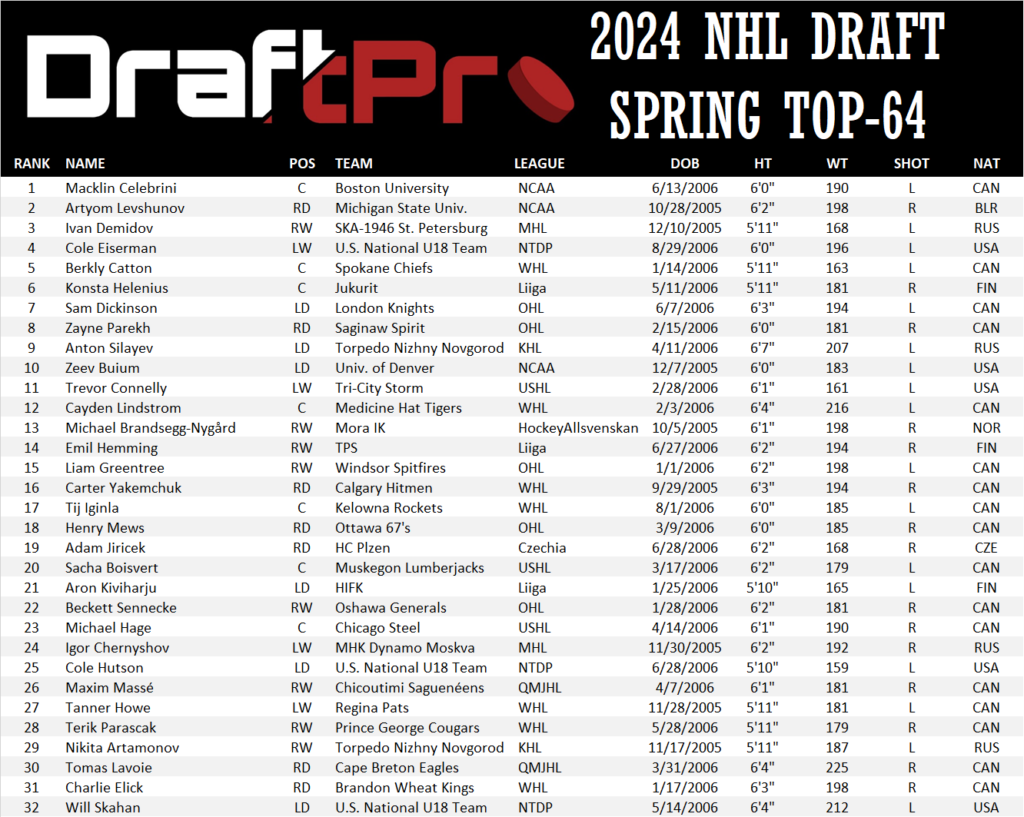
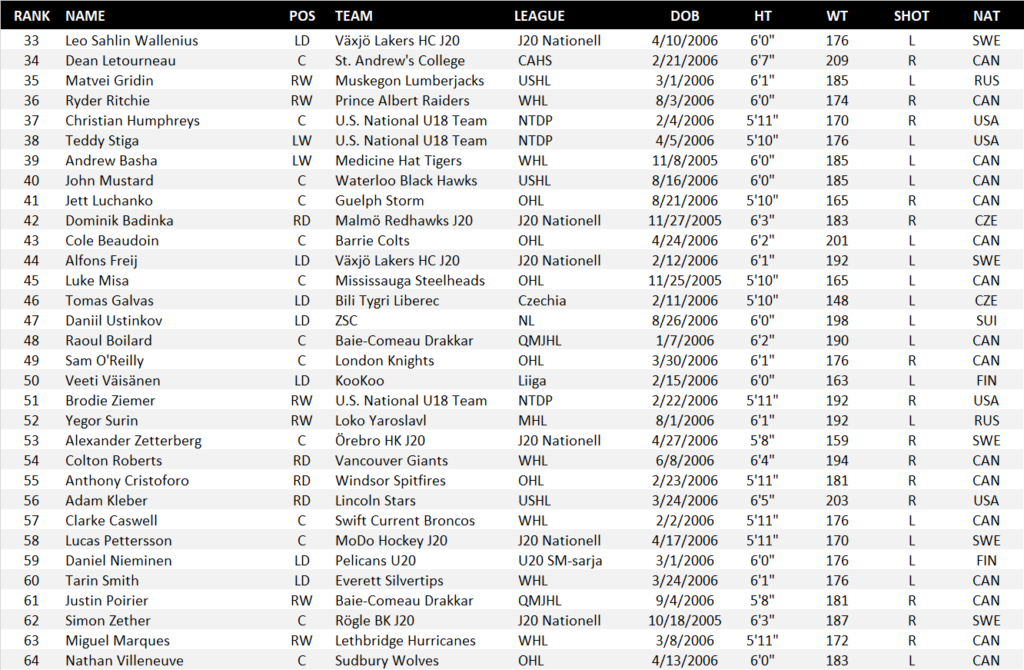
    Below is the Draft Prospects Hockey Spring Top 64 for the 2024 NHL Draft.

    If you are looking for more in-depth information and reports on the 2024 NHL Draft, be sure to pick up your digital or physical copy of the DraftPro 2024 Preview Magazine available now.

    https://draftprospectshockey.com/draftpro-order-your-2024-preview-magazine-today/

    It is also almost that time of year where you can get your hands on the comprehensive DraftPro 2024 Draft Guide which will be released in early May.

    In the 2024 Draft Guide our team ranks the top 224 NHL Draft eligibles, provides well-written profiles on the top 224 names for this year, includes in-depth prospect features, looks at the NHL’s top 50 drafted prospects coming down the pipe, dives into what each NHL team has in the prospect cupboard and what their draft needs are, provides a comprehensive look at the 2025 NHL Draft with profiles on the top 32, provides a top 32 ranking on the 2026 NHL Draft with profiles on the top 10, and so much more.
    This year everyone who pre-orders the 2024 Draft Guide digital edition will receive a pre-order discount off the cover price of $12.99 $10.00 each. So don’t wait, get your copy on order for just ten bucks and be the first to receive it as soon as it is published.

    https://draftprospectshockey.com/draftpro-2024-nhl-draft-guide-pre-order-special/
  • DRAFTPRO – 2024 NHL DRAFT GUIDE NOW AVAILABLE!

    DRAFTPRO – 2024 NHL DRAFT GUIDE NOW AVAILABLE!

    Get your digital copy of the Draft Prospects Hockey comprehensive 2024 NHL Entry Draft Guide chalk full of scouting information on this impressive 2024 NHL Draft crop. Inside the 305 pages you will find our top 240 ranking for the 2024 NHL Draft, profiles on the top 224 names, NHL team reports, ranking of the top 50 NHL affiliated prospects, prospect features, as well as profiles and notes on many 2025, 2026, and 2027 eligible prospects plus so much more all for the low price of $12.99 (POST DRAFT SPECIAL $4.99) CAD.

    This is an instant download digital magazine as you will be re-directed to the download page once payment is made.

    For those who prefer the physical copy magazine we publish through your regional Amazon website.

    For U.S. based customers here is the Amazon.com link.

    For Canadian customers here is the Amazon.ca link.

    If you have any questions feel free to email prospectevaluations@gmail.com

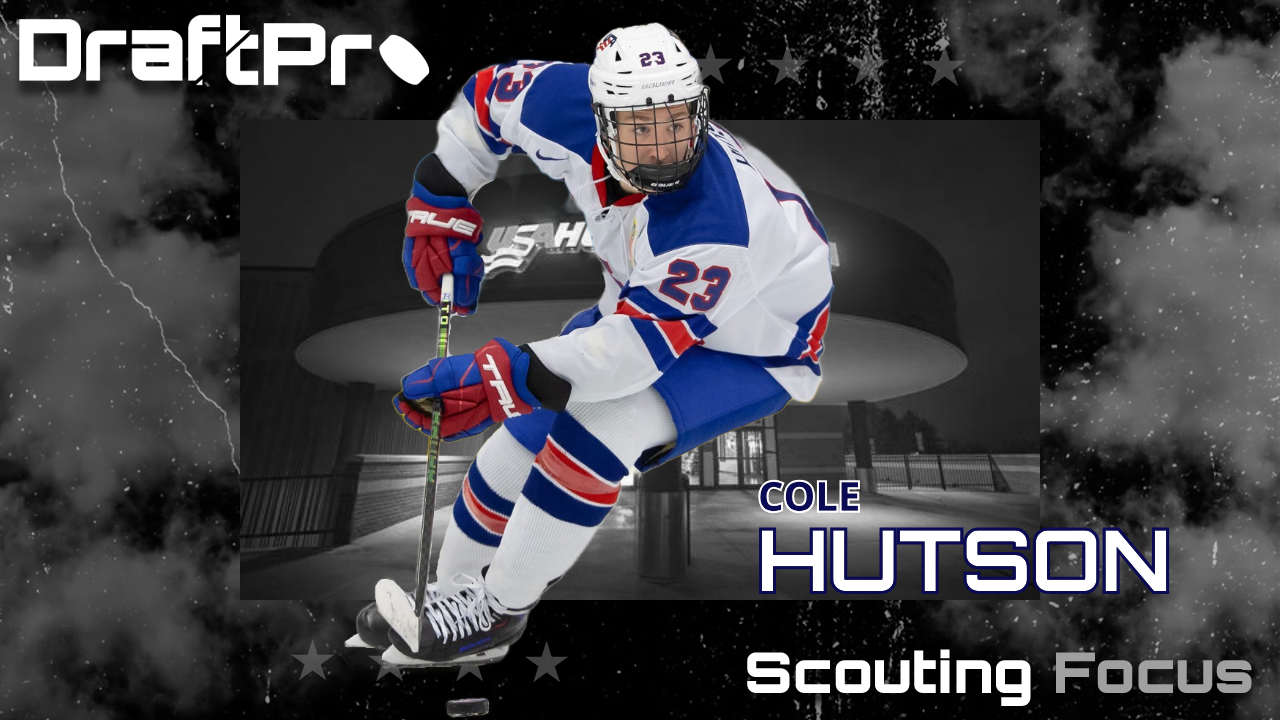
  • 2024 NHL DRAFT – DRAFTPRO SCOUTING FOCUS: COLE HUTSON

    2024 NHL DRAFT – DRAFTPRO SCOUTING FOCUS: COLE HUTSON

    By Andy Miller

    Cole Hutson, a carbon copy of his brother Lane? 

    Cole grew up in a hockey family, his dad played in the NCAA and two of his brothers are currently playing at BU, where Cole will play next season.  His brother, fellow defender Lane was drafted in the second round by the Montreal Canadiens in the 2022 draft.  Cole is playing on the USNTDP at the U18 level this year after a very strong season with the U17’s recording 42 points, including 8 goals in 42 games.  He actually recorded a higher ppg with the U18’s with 26 points in 19 games.  Hutson actually eclipsed the total points of Eiserman at the U18 worlds with 12 points.  He is a much more offensive defender, which is good since he is not a giant on the back end, but is a very fluid skater who changes directions with ease.

    Cole likely has more potential than Lane, who most now think was a steal in the late second round.    He is an electric player on the ice who dances around with the puck on his stick and often dictates the play.   Hutson has the potential to be a PP1 Quarterback at the NHL level and be the offensive catalyst for a team from the back end.  While his defensive game is not his strength it is not a deficiency either as he is responsible and a capable defender.  He has the capability to be a Tory Krug or Sam Girard type defender at the NHL level in about 5 years time.  These are the best comparisons as his offensive side of the game is his strength.

    The question is why is Hutson seen as a top prospect for the 2024 NHL Draft in June? Andy Miller with Draft Prospects Hockey breaks down Hutson’s game as he tries to answers that question.

    Skating

    Hutson has good foot speed and acceleration.  He skates well backwards and his transitions are seamless with or without the puck.    Hutson capably rushes the puck up the ice and creates havoc.  He sometimes will not be square to the play, likely because he is very confident in his skating ability.

    You see Hutson’s ability to retreat and pick up the puck with ease and speed.  He then appears to call an audible on the play and takes the puck into the zone when the drop pass has not worked.  Not a lot happens offensively but you can see how he uses his edges and body to protect the puck on this play.

    Here you see Hutson follow up the rush and fill in the high slot as the puck is retrieved he is ready and gets off a quality shot toward the net.

    Puck Skill

    Hutson is very good at protecting the puck from forecheckers and uses his edges to help with that.  He can corral passes that many others couldn’t, but at times he can get a bit too showy with the puck on his stick and take more time than needed.  Hutson can dictate the pace of the play when he has the puck on his stick.

    Here you see him move up the ice with the puck and he demonstrates excellent skating, puckskill, decision making and scoring sense here.  He is able to read the play and support it and transition to leading the rush.  From there  makes some nice passes to create chances for his team and buys time to open lanes that allows him to get a quality shot on net too.  He returns to his defensive position at a good time after he supports down low.

    Scoring Ability

    Hutson has very good shot velocity and an incredible release.  His accuracy is good, even though he misses the net on this clip, he still makes a great read and has the ability to get to the dangerous areas on the ice and puts the puck up high as the goaltender is coming from low to high and moving laterally. 

    Playmaking Ability

    Hutson is a very creative player who is clearly engaged in the offensive side of the game.  He generates scoring chances for himself and his teammates routinely.  He opens up well (as could be seen in the Scoring Ability clip) and adjusts to poor passes.  Hutson capably makes good passes on the tape that are easy to receive.

    Here we see Cole Hutson dancing around the offensive zone with the puck buying time and space while also exhibiting patience and waiting for a lane to open to make a pass or shoot.  He eventually gets a quality shot on net.

    Hockey Sense/IQ

    Hutson has excellent awareness on the ice, particularly when looking at the offensive side of things.  He sees lanes that are open or that he could open and finds them with good firm passes.  He typically makes quick decisions that are good on review.  He could improve his decision making in his defensive end as he frequently is looking to rush the puck up the ice, sometimes even before his team has possession and that can create some adventures.

    Here you see him on the point on a 5 on 3 and he is moving most of the time, but when the puck gets to Eiserman on the far side he could do a bit more to be a passing option here and support his teammate under pressure.  This play required elevated reads for a player looking to be selected in the first round.

    Here you see Hutson’s ability to control the play with the puck on his stick and he capably directs his teammates and is very aware of where the defenders are and directs them too.  He made better reads here then in the previous clip.

    Character

    Hutson demonstrates leadership and character on the ice.  In this clip you see him directing traffic as the play exits the offensive zone and the team transitions to defend.  He is a reliable player who works hard and is very consistent for a young player.

    Defensive play

    Hutson is surprisingly responsible in the defensive zone and he frequently takes charge in his zone to ensure that the house is protected.  He is a reliable defender but this is not his area of strength as that is with the puck on the offensive side of the game.   He does use his skating ability to help him back check which will be displayed in a clip included shortly.

    Here you see Hutson have a large gap in the neutral zone likely due to hinging to support his D partner, but he quickly closes due to his strong skating skills.  Moments later in the zone he uses some good edge work to work the puck out of the high slot and then keeps his hips facing his net and recovers to cover a player on the back door with ease.

    You can see how Hutson maintains a good gap with his opponent and capably keeps in the lane and blocks the shot attempt with ease.  He is also still on his edges and can track down the loose puck too.  You see him enter the corner and come out with the puck and he knows exactly what he is doing and makes an excellent pass across the house to Cole Eiserman to start the breakout.

    You see Hutson thinking offensive as he misreads a breakout for USNTDP that doesn’t happen and he has to rush back to help support and while he gets in the vicinity of the player out front he is not effective in checking him and gets lucky.

    Hutson has a tough play where the puck ends up in his feet at the tops of the circles skating backwards and while he doesn’t do poorly his body language shows indecisiveness which ends up in a turnover and a quality chance.  He needs to find a way to keep the puck going around the boards or try to pin it to the boards here.  Not an easy play but if he is going to be a top NHL defender he needs to be able to execute that some of the time.

    ****************************************************

    If you are looking for a mid-season rundown on the 2024 draft class as a whole be sure to pick up your copy of the Draft Prospects Hockey 2024 Preview Magazine available for instant download or print through Amazon.

    https://draftprospectshockey.com/draftpro-order-your-2024-preview-magazine-today/
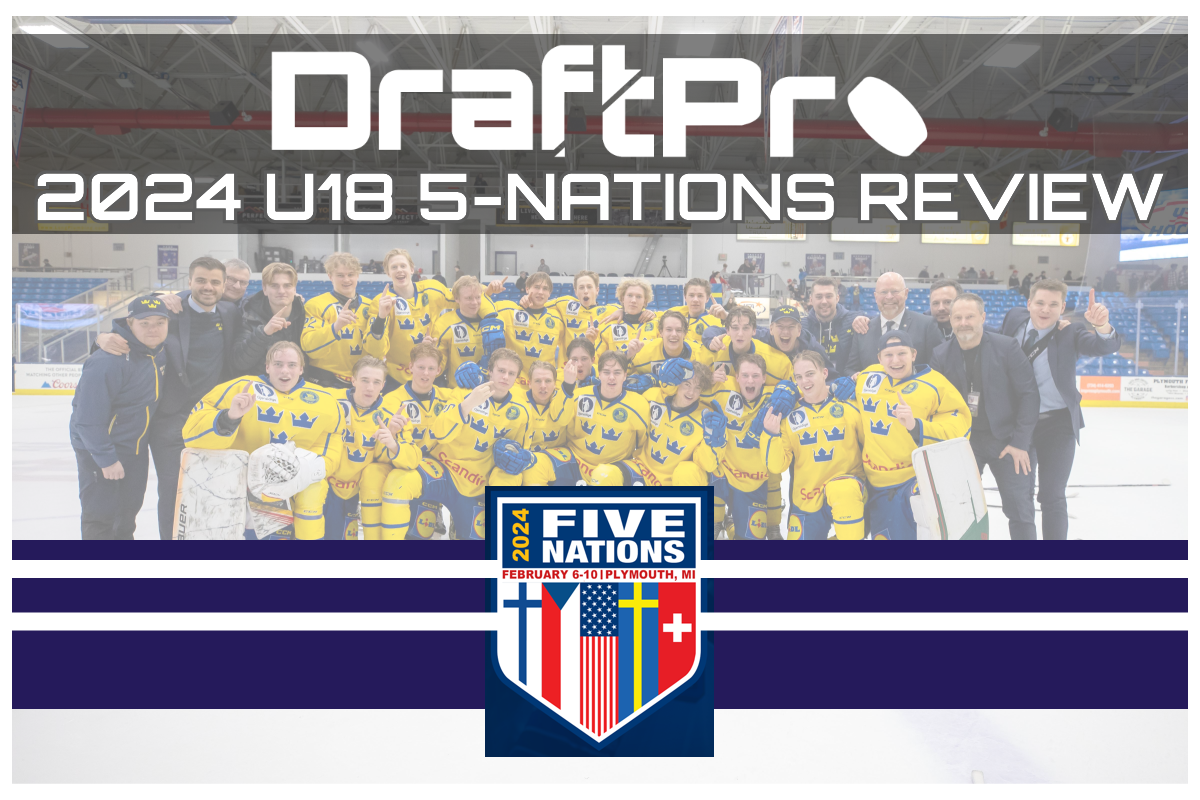
  • FEBRUARY 2024 U18 5-NATION REVIEW

    FEBRUARY 2024 U18 5-NATION REVIEW

    By DraftPro Staff

    The last big hockey scouting event for the 2024 NHL Draft, before the IIHF U18 World Hockey Championships in April, wrapped up at USA Hockey Arena in Plymouth, Michigan when the Sweden entry beat the Americans in the waning seconds of the final game. The 2024 U18 Five Nations Tournament is a five-team tournament that took place from February 6-10 with entries from Sweden, Finland, Czechia, Switzerland, and the USA.

    Here at DraftPro Hockey, we had multiple sets of eyes from our scouting team watching the games with reports rolling in highlighting who impressed our scouts from this event. Below are a list of ten 2024 eligible names, plus a couple future eligibles, who impressed us with their play and ongoing development at this event.

    4 LEO SAHLIN WALLENIUS, D, SWEDEN

    6’0”, 179, L, DOB 4.10.2006 – 2024 ELIGIBLE
    U18 5-NATS STATS: 4 GP 1 G 6 A 7 PTS 6 PEN
    EVENT NOTE: Stood out as Sweden’s most reliable defender and arguably top performer at this event.
    SCOUTS QUOTE: “Sahlin Wallenius stood out as a player with a commendable ability to facilitate play transitions, marked by his smooth skating and quick coverage of the ice. Sahlin Wallenius exemplified the archetype of a modern defenseman, equally adept at contributing offensively as he is solid in his defensive responsibilities. His skating was notably fluid, allowing him to move across the ice with an ease that complemented his skillful puck handling under pressure.” – Seth Ditchfield

    20 ALFONS FREIJ, D, SWEDEN

    6’1”, 196, L, DOB 212.2006 – 2024 ELIGIBLE
    U18 5-NATS STATS: 4 GP 1 G 6 A 7 PTS 4 PEN
    EVENT NOTE: Continued his highly impressive offensive play we’ve seen all season driving the game from the backend.
    SCOUTS QUOTE: “Alfons’s exceptional mobility is a cornerstone of his game, making him a key player in eating up ice time for the Swedish team. He navigates the ice effortlessly, showcasing explosive speed when transitioning from forward to backward skating. His versatility shines on the power play and during 4-on-4 situations, where he seamlessly transitions from defensive positioning to more aggressive offensive zones. Confident in puck possession, he demonstrates a willingness to backtrack quickly if additional skating or passing lanes fail to materialize. Alfons exhibits deception while navigating the blue line, occasionally delivering no-look passes to teammates in prime scoring areas.” – Steven Pratas

    15 ANTON FRONDELL, C, SWEDEN

    6’0”, 179, L, DOB 5.7.2007 – 2025 ELIGIBLE
    U18 5-NATS STATS: 4 GP 5 G 2 A 7 PTS 0 PEN
    EVENT NOTE: Looked to push his name into the top of the 2025 draft with his outstanding performance here as a DY-1.
    SCOUTS QUOTE: “Frondell is an extraordinary player and he showed why in Plymouth with some great play driving shifts. He does a good job of protecting the puck when driving to the net. He is an excellent skater. He demonstrated his creativity in a face-off circle. He crashes the net when a teammate shoots and tries to clean up any rebounds. He was the point man on the powerplay and demonstrated his excellent slapshot. He also showed he isn’t afraid to use his size and throw some hits. He is really good at stripping pucks by using his poke check and stick lifts. – Zach Morris

    11 LUCAS PETTERSSON, C, SWEDEN

    5’11”, 170, L, DOB 4.17.2006 – 2024 ELIGIBLE
    U18 5-NATS STATS: 4 GP 1 G 3 A 4 PTS 0 PEN
    EVENT NOTE: Solid two-way centerman, played top line minutes for Sweden and brought his 200ft game to Plymouth.
    SCOUTS QUOTE: “Pettersson immediately distinguished himself as a standout force for the Swedish team. His composure and poise are evident, particularly in the faceoff circle where he excels with remarkable success. Pettersson demonstrates a seamless give-and-go approach; his quick acceleration and deft tap-passing skills position him as a formidable transition player. One of the team’s strongest passers, Pettersson focuses on crisp, timely passes rather than flashy plays. His passing is reliable and rarely flutters, demonstrating impressive control. While not always the most offensively explosive or dangerous player, his defensive responsibility makes him a vital asset. He sees significant ice time in challenging situations and provides reliable tactical support. Pettersson’s skating is effortless and smooth, contributing to his ability to swiftly outmaneuver opponents. While he may currently lack raw offensive power, his intelligence, anticipation, and tactical sense often result in timely, impactful plays.” – Seth Ditchfield

    8 TEDDY STIGA, LW, USA

    5’10”, 176, L, DOB 4.5.2006 – 2024 ELIGIBLE
    U18 5-NATS STATS: 4 GP 3 G 6 A 9 PTS 4 PEN
    EVENT NOTE: Stiga took his game to another level as one of the American’s top offensive producers at this event. He showed he is a player that can play up and down the lineup and be effective.
    SCOUTS QUOTE: “Stiga is a slick player who has the ability to turn quickly and lose coverage. He is a well-rounded player who is an effective player in both the offensive and defensive zones. Possesses a solid shot with quick, deceptive release that is hard to read. He is an effective player on the penalty kill who can keep the puck and players to the outside. An effective player on the powerplay who can set up on the half wall and get a shot on net often. A relentless forechecker. Needs to continue to develop his ability to make reads and good decisions without the puck.” – Andy Miller

    2 BRODIE ZIEMER, RW, USA

    5’11”, 192, R, DOB 2.22.2006 – 2024 ELIGIBLE
    U18 5-NATS STATS: 4 GP 6 G 2 A 8 PTS 2 PEN
    EVENT NOTE: Ziemer not only brought his all-round high-intensity two-way game to this event but likely boosted his draft stock due to his offensive showing in Plymouth, MI as well.
    SCOUTS QUOTE: “Ziemer is a strong skater with great edge control and balance. He is relentless on the forecheck and ensures that he takes away time and space. An effective offensive player who is a very strong passer and puck carrier. He could shoot the puck more often and be a bit more selfish in his game because when he does good things happen like here. Ziemer does have a nose for the net and drives it with and without the puck on his stick. He is a very strong penalty killer who gets on the puck carrier quickly and limits his opponents options. In his zone he gets his stick in the passing lanes and knows most of the tricks of the trade and is a player who anticipates well and reads the play effectively. Ziemer is a player who typically doesn’t hesitate and makes good decisions. He has the ability to work the wall well and protect the puck effectively. He has good hands and can change the angle of the puck or release with little time or space. Has great hands at the net front and typically finishes off the plays. He goes to the dirty areas and pays the price.” – Andy Miller

    23 COLE HUTSON, D, USA

    5’10”, 159, L, DOB 6.28.2006 – 2024 ELIGIBLE
    U18 5-NATS STATS: 4 GP 2 G 6 A 8 PTS 10 PEN
    EVENT NOTE: Brought the offensive game has been known for and looked like a first rounder as he was driving much of the offense for the American squad.
    SCOUTS QUOTE: “Hutson is an extremely offensive defenseman with a great skating stride. Very mobile and agile. He uses his edges very well to move laterally, and his change of direction is quick and he moves very well with the puck. His hands are just as quick as he is often the puck carrier as the team gains the zone and sets up. His speed allows him to join the rush often. He’s all about offense, but he can sometimes be out of position defensively. His offensive IQ enables him to find space in the offensive zone. He uses his vision to find his teammates and create scoring opportunities. He is used on the PP for his mobility and passing skills. His shot is opportunistic, and he can change his angle well. Sure, with his size, he doesn’t have the most powerful shot, but it’s quick. Hutson finishes his checks well. He’s not the strongest, but he doesn’t hesitate to hit. The aspect of his game that needs the most improvement is his defensive play and to add considerable strength.” – Samuel Laplante

    34 COLE EISERMAN, LW, USA

    6’0”, 196, L, DOB 8.29.2006 – 2024 ELIGIBLE
    U18 5-NATS STATS: 4 GP 4 G 1 A 5 PTS 14 PEN
    EVENT NOTE: Has been getting criticism for his lack of dimensions to his game, but at this event there was considerable effort shown on the puck distribution and overall engagement sides of things. Still a very dangerous scorer who teams needed to gear defenses for.
    SCOUTS QUOTE: “An elite goal scorer with an excellent shot. His shot is very quick and accurate. He already has a better than most NHLer release. Rarely misses the net. Eiserman loves to shoot and is used on PP at the top of the circles for his deadly one-timer. He could already do some damage in the NHL. It’s clear that Eiserman is a shot-first type of player, but he can also be a good passer. He has great vision, which enables him to find his teammates in the offensive zone. He likes to fake the shot and pass the puck to an open player. He’s also a good skater. His agility and speed enable him to create space for his shots. His change of direction allows him to move well with the puck and beat defenders 1-on-1. He also has good hands and loves to use the tip of his stick to make a move and get a shot off quickly. I was surprised to see him often finishes his checks and showing he isn’t afraid to hit. Defensively, he can get in front of a defender to block a shot and from time to time, he will come back in his zone to support the defense. But other than that, he’s an offensive first player.” – Samuel Laplante

    15 ADAM NOVOTNÝ, RW, CZECHIA

    6’0”, 174, L, DOB 11.13.2007 – 2026 ELIGIBLE
    U18 5-NATS STATS: 4 GP 4 G 2 A 6 PTS 0 PEN
    EVENT NOTE: Had a great showing for a weaker Czech team as a DY-2 and solidified his name as someone to watch for the top of the 2026 draft with his outstanding performance here.
    SCOUTS QUOTE: “Novotný had a great tournament for the Czech and without him, they would not have even had a chance. His shot is one of the highlights of his game and it was evident. He fired plenty of powerful wristers that were dangerous. He was great at leading the rush and deked through defenders in the neutral zone. He is an extremely fast skater thanks to his long strides and crossovers. His speed led to some good chances off the rush. He displayed his dangerous one-timer on the powerplay and was able to sneak it through the smallest of holes in the goaltender’s coverage. He has a good poke check and decent stick lift. He uses his reach well to attack opponents and cut off passing lanes.” – Zach Morris

    9 ADAM BENAK, C, CZECHIA

    5’7”, 152, L, DOB 4.10.2007 – 2025 ELIGIBLE
    U18 5-NATS STATS: 4 GP 3 G 2 A 5 PTS 2 PEN
    EVENT NOTE: This pint-sized center continued to show his elite skill level and be a major offensive threat at international events for Czechia. His size is a major detractor teams will need to weigh against his obvious talent.
    SCOUTS QUOTE: “Benak is incredibly fast and takes no time to get to top speed. He dances on the ice with the puck on his stick and he is near impossible to cover. Benak has elite level skill. He is an exceptional player who drives the play. Benak will shoot from anywhere, at times to his detriment, but his decision making in this area should improve as he matures. He has the ability to put his U18 team on his back and he is not going to be drafted for another year. Benak has a skill set that pulls spectators out of their seats. He could improve his play away from the puck but that will hopefully develop next season.” – Andy Miller

    24 JOONA SAARELAINEN, C/W, FINLAND

    5’9”, 176, L, DOB 5.5.2006 – 2024 ELIGIBLE
    U18 5-NATS STATS: 4 GP 6 G 1 A 7 PTS 0 PEN
    EVENT NOTE: Smaller but solid skating center who dictated much of the offensive play for the undermanned Finnish squad what the teams standout forward. His offensive production in Plymouth had NHL teams excited for his upside.
    SCOUTS QUOTE: “Saarelainen demonstrates a smart and reliable game as an undersized centerman for the Finns, showcasing quick hands and an offensive spark, particularly evident in his performance against Sweden. His ability to read the game and react quickly to defenders allows him to provide support for his defensemen along the point. His lightning-quick feet enable him to generate rushes or join them seamlessly. Maneuvering through tough situations with his stickhandling and slipping past defenders is a hallmark of his game, making him elusive to contain due to his smaller stature. Given adequate time and space, he consistently capitalizes on scoring opportunities. Saarelainen displays a feisty demeanor when hunting down the puck, often leading to him or his team gaining possession. His relentless stick pressure and competitive spirit resulted in him leading his team in takeaways. However, his smaller frame makes him susceptible to being physically outworked, leading to turnovers. Despite this, he doesn’t shy away from physical play and is willing to absorb hits to make plays, especially in the defensive zone.” – Steven Pratas

    3 DANIEL NIEMINEN, D, FINLAND

    6’0”, 175, L, DOB 3.1.2006 – 2024 ELIGIBLE
    U18 5-NATS STATS: 4 GP 1 G 2 A 3 PTS 2 PEN
    EVENT NOTE: Impressive rearguard, who tends to lean more to the offensive side, was one of Finland’s top blueliners in Plymouth. He used his skating ability and creative puck moving skills to be effective.
    SCOUTS QUOTE: “An offensive minded defender, who is a threat on the PP. Very mobile with the puck. He has quick hands, is able to make fancy maneuvers and change direction quickly with the puck. He’s very mobile. He can move well with the puck on the blue line. He has great agility, which enables him to be effective when carrying the puck. Nieminen has a good first pass and is able to find his teammates. His passes are accurate and strong. That’s why he’s used as a QB on the PP. But he has to be careful with the puck in his zone. He can sometimes either make a risky play or a risky pass that causes a turnover. His shot can be very damaging. He can shoot well from anywhere. Whether it’s a one-timer or a wrist-shot, his shot can cut through traffic. Strong enough for his size. However, Nieminen has some defensive weaknesses. For a start, his positioning needs work. He plays very high up in his zone. He loves to join the rush, but needs to learn to find the perfect time to join the attack. When well positioned, he defends passing lines well with his stick.” – Samuel Laplante

    12 AATOS KOIVU, C, FINLAND

    6’0”, 165, R, DOB 6.22.2006 – 2024 ELIGIBLE
    U18 5NATS STATS: 4 GP 1 G 1 A 2 PTS 2 PEN
    EVENT NOTE: While not being a big point producer in Plymouth, MI for his team, Koivu showed so many other qualities that make his game so well rounded and have his shooting up draft boards this season with this solid two-way approach.
    SCOUTS QUOTE: “Koivu is a good two-way center who can position himself very well in all areas of the ice. Whether he has the puck or not, he’s involved in the game from both sides of the ice. Koivu supports his defense well. He’s excellent at being the F3 on the forecheck and supporting the space in the zone. He backchecks a lot and is very good at supporting his defensemen in his zone. He’s also very good with his stick to support his battles along the boards and to poke check the puck. His stick speed also makes him very good at face-offs. He uses his edges well to be agile and sneaky in tight spaces. A good playmaker who finds his teammates well in all areas of the ice. He’s not the most creative player. He has got a great shot. His shots are accurate, fast and very useful on the PP. Whether it’s a one-time or a wrist-shot, Koivu knows how to score goals.” – Samuel Laplante

    Photos by Rena Laverty/USA Hockey.


    If you are looking for a mid-season rundown on the 2024 draft class as a whole be sure to pick up your copy of the Draft Prospects Hockey 2024 Preview Magazine available for instant download or print through Amazon.

    https://draftprospectshockey.com/draftpro-order-your-2024-preview-magazine-today/
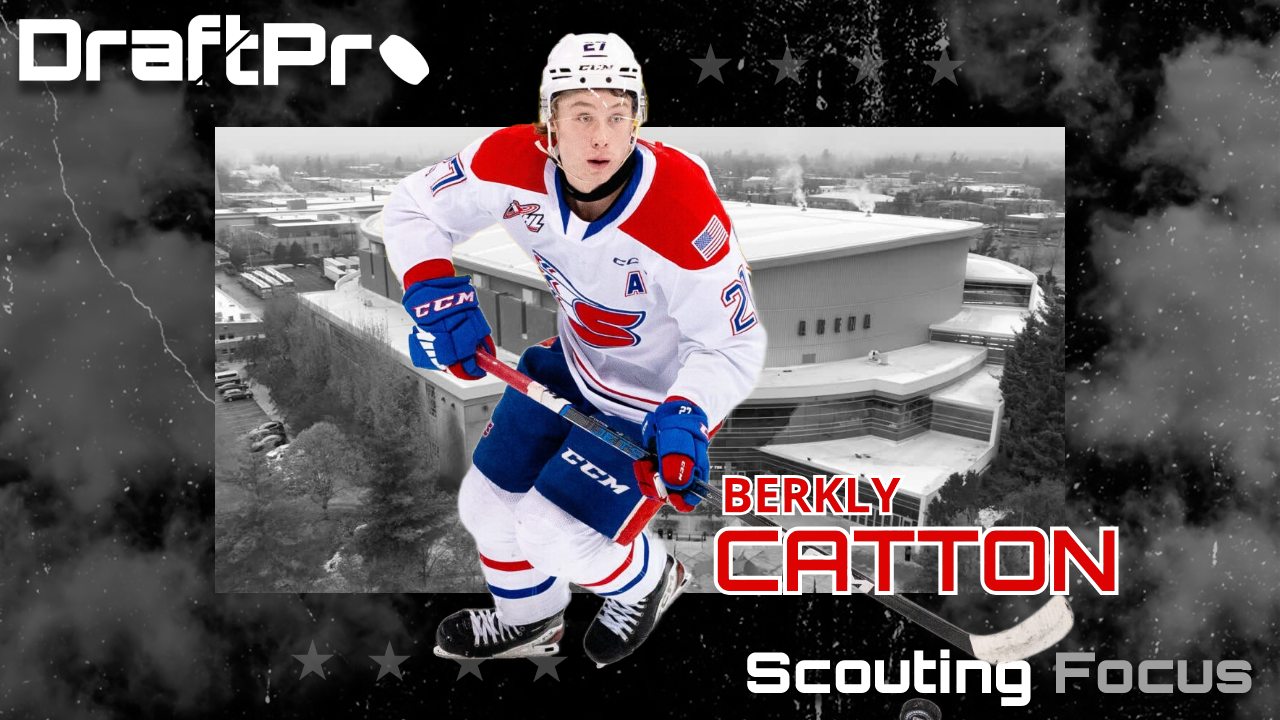
  • 2024 NHL DRAFT – DRAFTPRO SCOUTING FOCUS: BERKLY CATTON

    2024 NHL DRAFT – DRAFTPRO SCOUTING FOCUS: BERKLY CATTON

    By Colin Johnson

    Berkly Catton is a hockey star on the rise. 

    A highly touted Centerman from the Spokane Chiefs of the Western Hockey League. He is a former #1 overall pick in the 2021 WHL Bantam draft and dominated his competition in Saskatoon, Saskatchewan. Putting up 108 points in 30 games before the 2020/21 season was cut short due to the COIVD-19 pandemic.

    The January 2006 born prospect features a wide range of skill and talent and is currently projected as a consensus top 10 pick in the upcoming 2024 NHL Entry Draft in June. In his first full season with the Spokane Chiefs, Catton accumulated 23 goals and 32 assists, for 55 points in 63 games playing as a 16-year-old. This season, his draft year he is well over 1.5 points per game as an offensive leader for the Chiefs.

    The question is why is Catton is seen as a top prospect for the 2024 NHL Draft in June? Colin Johnson with Draft Prospects Hockey breaks down Catton’s game as he tries to answers that question.

    Puck Handling and Driving the Play

    Catton is a player that controls the pace of play and forces the opposition to play the type of game that he wants. With control of the puck, he is extremely efficient at zone entries and exits, as he slithers in and out of openings and works around what the defence gives him to find open ice.

    The clip below shows his ability to effortlessly exit his own zone and enter the offensive zone with possession. He calmy makes a move at center ice to open up space, uses his teammate on a give and go, pulling the defenders focus away from him, finding the dead zone between 3 Seattle defenders, gets the puck back and then makes a nifty backhand pass that tees up a grade A scoring opportunity.

    He has quick reaction time and fast twitch movements, making him an excellent puck handler who is able to create space from defenders thus, opening up opportunities for himself and his teammates. These quick movements get combined with excellent footwork making him a dangerous offensive player in tight quarters. While his agility and puck possession at top speed makes him a nightmare in space for defenders and even more dangerous in 1-on-1 situations.

    This next clip showcases this elusiveness as he starts by opening up space on the defender, followed up by a quick change of direction where he drives to the net for a scoring opportunity that gets blocked.

    His ability to drive and control the pace of play is best shown when he is on the powerplay or in sustained offensive zone situations. With the puck he is calm and composed and can choose whether to methodically break down the defence or choosing to ratchet up the pace and pressure the defence to create disorganization and chaos, opening up passing and shooting lanes for himself and his teammates. Either way, in both situations he is effective and the longer he possesses the puck the more dangerous he seems to become.

    In this next clip, Spokane is on the Powerplay and Catton starts by slowing down the play and finding his teammate across the ice with an excellent saucer pass. The play then transitions back towards Catton who receives a pass that would normally result in a one-timer; however, Catton patiently receives the pass, drawing the defender out of position and feeds a perfectly located shot pass to his teammate, who taps in the backdoor feed.

    Sometimes Catton is able to control the play without even possessing the puck, in this clip his effort and tenacious play forces multiple turnovers and creates chaos for the opposition. Multiple times he has a takeaway and creates an opportunity, only to have it be unsuccessful. However instead of giving up and allowing a breakout or going for a change, Catton jumps right back into the dirty work and makes it hard for Seattle to breakout. This type of willingness and effort is what makes him a sure-fire NHL player in the future.

    Shooting/Scoring Ability

    Catton can score in a multitude of ways but is the most dangerous when he is coming off the rush with speed. His wrist shot has a lightning quick release and he is able to contort and adjust his release point, making his shot more and more deceptive for goaltenders. He’s able to pull the puck in or push it out at all ranges and is still strong enough to get a powerful shot off. Techniques such as this is what makes players like Connor Bedard and Auston Matthews so prolific goal scorers at the next level.

    This clip shows how fast he can pull the puck in to change the angle of his shot. It is also impressive how he is able to do this at such a high speed with a defender in his face.

    The next clip is Catton recognizing the bad change and using that space to turn on the jets, backing up the tired Swiss defenceman. Just before it looks like he’s going to drive by the defender, Catton pulls up makes a quick move from his backhand to his forehand, and lets a perfectly placed wrist shot go into the top left-hand corner.

    Down low around the net Catton is very creative, using his hands and hockey IQ to make intelligent reads and score high percentage opportunities or somehow create something out of nothing. With possession he searches for open space and drives towards the net, taking advantage of positional errors by both the opposing defence and goalie and uses his quick hands to make split second changes to his release point and fool the goaltender. He also shows a willingness to grind it out, follow up his shot and finish the play, which is crucial for young players adjusting to the much tighter checking of the NHL.

    Here Catton gets a rebound that takes him below the goal line. He recognizes the goalie is out of position, cheating towards the other side and not protecting his near post. Catton smartly looks to throw the puck off the goaltenders back, resulting in a very high IQ goal.

    The next clip shows 4 separate instances where Catton drives to the net and finishes off a play with a goal. Each goal is different and requires a different skillset. Whether it’s hunting for a loose puck, finishing at high speed, bulldozing your way to the net, or making a flashy finish to elude a defender, he can do it all.

    Passing Vision, IQ and Playmaking

    Catton is a highly creative player with elite offensive IQ who looks to create high percentage looks for his teammates. On the Powerplay he is the Quarterback, controlling the puck and manipulating the opposing Penalty Kill to his liking before slipping quick tape-to-tape passes to wide open teammates that are swinging through or in high percentage scoring areas.

    This Powerplay clip is in Overtime. Catton draws his defender towards him by opening up as if he’s going to drive the slot or shoot. As soon as the forward turns his skates towards Catton, he feeds a slick pass to his teammate who wires the one-timer home and wins the game.

    Catton has phenomenal touch and is able to pass effectively on both his forehand and backhand. He can zip passes across the ice with velocity or put just the right amount of speed/height on a pass to feather the puck through tight windows to his teammates. He has an uncanny ability to get the puck through tightly covered passing lanes without turning the puck over. The puck seems to find it’s way to it’s intended destination consistently, just out of the reach of defenders.

    The first clip is just a phenomenal cross ice backhand pass through the slot that lands perfectly for a one-timer and subsequential goal.

    The next clip shows how he can put some speed on a pass, accurately to a streaking teammate without having it get intercepted by the defenceman.

    Skating

    Berkly Catton is not a burner. His top end speed is not next level or anything more than above average (something that you would expect from a top 10 pick), but he is extremely agile and uses elite level edgework to be elusive and dynamic on the rush and in the offensive zone. He has a second gear of acceleration that he uses to change speeds and gain a step on defenders. His first step is crucial to his game and he is very good at changing speeds when attacking, keeping the opposing team off balance.

    This first clip shows how his ability to change speeds is dynamic and throws off everyone on the ice, leading to pretty easy goal.

    With the puck he uses his edgework and balance to shield defenders from the puck and if he manages to get a step on the defender it’s either a blow by or a penalty incoming because he will use his body and skating to step in front and effectively rub the defender out of the play. He effectively uses his edges to gain speed without striding and make quick changes of direction. This clip displays all of those skills leading to a highlight reel finish.

    Game Breaking Ability

    This is what separates the good from the great. Great players can be struggling or be playing with players deeper in the lineup and still find a way to produce. It doesn’t matter if you’ve held him down all game, all it takes is a moment of lapse defensively and Catton will capitalize. Open space and puck possession is a recipe for the something to happen. Catton plays with high hockey IQ and can be an easy player to play with, meaning he can play with depth players and elevate their production or play alongside other top players and fit in and play as a unit.

    The clip here is against Kelowna in a close game where Catton had been objectively shut down for most of the game. All of a sudden with a poor change and a regroup, Catton gets the puck with space and attacks the slot scoring a highlight reel goal and getting Spokane back into the thick of this game, late in the third period.

    Areas in Need of Improvement

    There isn’t much to complain about in Catton’s game, but one area he does need to improve in is maturing physically and growing more into his body, establishing more muscle mass and getting stronger. Catton can be shut down by physical play that smothers his ability to move with the puck and establish separation. He struggles to win battles along the wall and often can’t handle larger defenders when they tie him up in the corners. Despite his balance and edgework, physical play can knock him off the puck and he doesn’t attack well against physical defenders. The positive to this is he is only 17 and there is plenty of time before he is at his athletic potential. He also doesn’t shy away from contact and isn’t someone that plays scared. He is willing to work hard and attack the dirty areas, so his deficiency in this area can certainly be improved upon.

    One sneaky concern with his game is his overall tendency to avoid his backhand when finishing. He has next to no shots taken off the backhand, which can be an effective tool to fool the goalie in tight and especially on breakaways. All of his shootout attempts in the WHL are close to carbon copies of one another and all result in the move finishing on his forehand. While shooting on your forehand does improve the percentages for success, having predictability could hinder him a bit at the next level.

    The positive here is that Catton did show some flashes of a strong backhand last season (2022/23) and even just the ability to use it as a reliable breakaway/shootout move would be enough to implant that scoring idea in the back of opposing players/goalie’s minds.

    Overall Summary

    Overall Berkly Catton is an elite level prospect heading into the 2024 NHL Entry Draft. He possesses elite offensive talent with consistent production, no matter his situation, linemates, and coaching. He presents a future top 6 forward at the NHL level and the ceiling of a top 15 scorer. An excellent shot combined with playmaking ability will help him translate his offensive game to the next level because he can attack defences and do damage in a multitude of ways. He is currently slight of frame and not mature enough physically to be an NHL ready player, but the skill level is near the top of the Draft class. Every night he provides a high effort performance and is willing to forecheck and play an all-around game. Most importantly he is a play driver, no matter the linemates, he controls the puck consistently and breaks the puck in and out of the zones with possession. His mind for the game and creativity allows him to control the flow and pace of play, forcing opposing teams to conform to his style until they regain possession. Qualities like this in a forward are minimally available in the Draft and he should be a slam dunk top 10 selection, and in my professional opinion, Catton deserves to be in the top 5 come June 2024.

    ********************************************

    If you are looking for a mid-season rundown on the 2024 draft class as a whole be sure to pick up your copy of the Draft Prospects Hockey 2024 Preview Magazine available for instant download or print through Amazon.

    https://draftprospectshockey.com/draftpro-order-your-2024-preview-magazine-today/