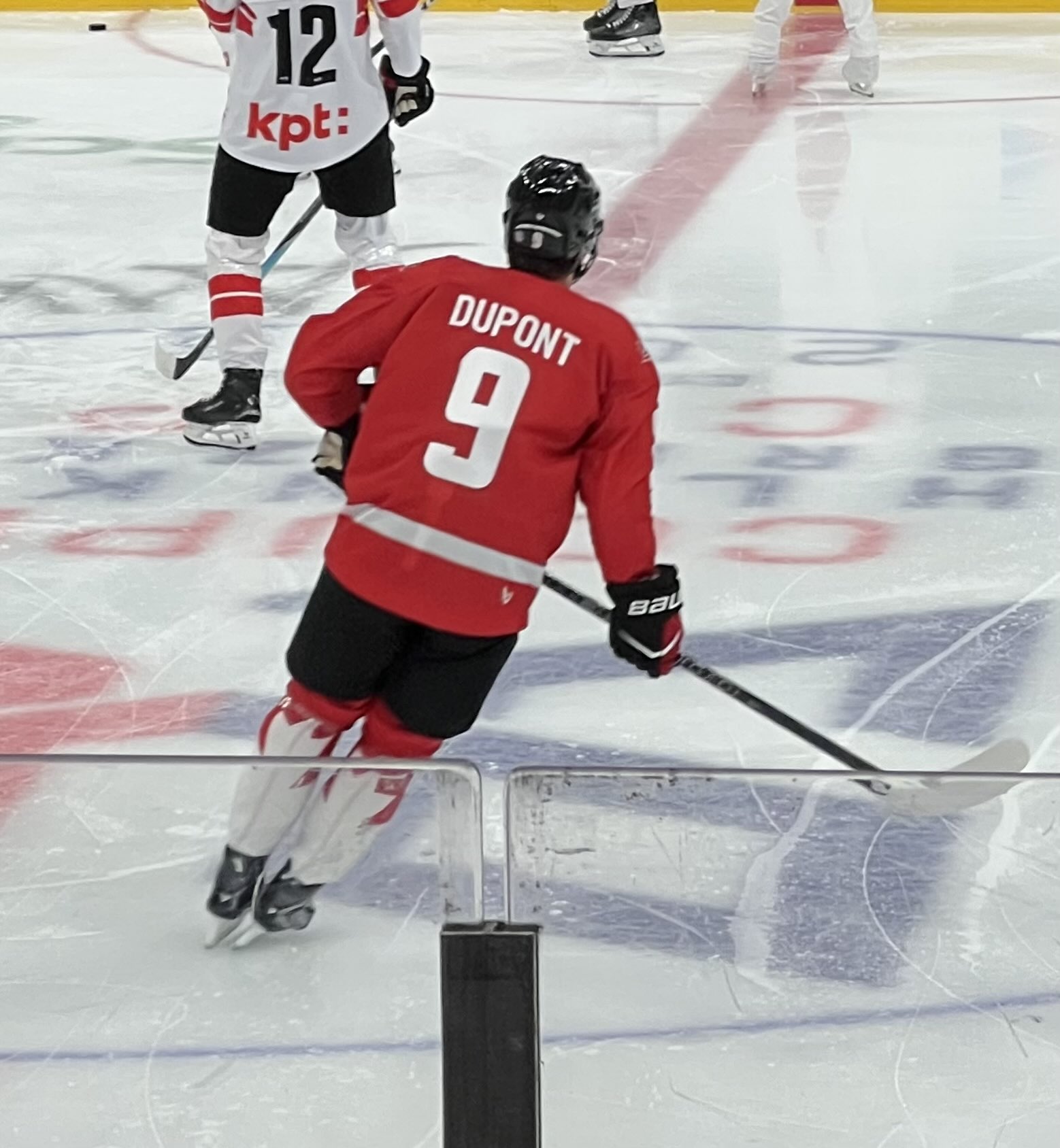
#8 Michigan Wolverines. Right Shot Defenseman. 6.00/190
DOB: May 28, 2009
Landon DuPont is an elite-level defenseman who is responsible at both ends of the rink. Landon can contribute on the power play, 5-on-5, and on the penalty kill. His edge work and skating help him be aggressive on puck carriers and get into shooting and passing lanes.
DuPont’s vision and Hockey IQ make him stand out on the backend. His quick decision-making and precise first pass help his team in transition to get up the ice quickly. He is always moving his feet, looking for open ice and a soft spot in the offensive zone to create Grade A scoring chances for him and his teammates with quick tape-to-tape passes.
Landon Dupont is projected as the first overall pick in the 2027 NHL draft for his elite-level skill. He is a good defender who may get overshadowed by his offensive ability. I see him as a top pairing defenseman at the next level who will play big minutes on a nightly basis. He is always one step ahead when he is on the ice with the puck.
Despite recent discussions and narratives, I still firmly believe DuPont is the 1st overall pick, and quite frankly it’s not very close.
DuPont’s offensive upside and ability is a very evident trait, he is tremendous at creating space and open lanes, not just for himself but also his teammates, he’s able to force multiple defenders on him at once and create opportunities before they close in. Offensively he can essentially do it all, but what impresses me the most is his growth in other areas of the game, all while maintaining such a high level of offence, he has developed so much defensively in the last year, he is not out of position nearly as much, corrects himself much faster, and uses his skating to close on players.
2 – Nazar Privalov
Privalov is an absolute force of a player, a player that any team would be ecstatic to have on their team.
After torching the MHL last season with 30 goals, he looks to perform and prove himself in a pro environment, the KHL will undoubtedly test him, but I believe he is more than up for the challenge. At 6’4, he plays a very heavy game, and looks to use his size to his advantage whenever he can, he has a very impressive skating ability for his size, something that interests me so much is how he plays like a small forward, he is always open, always able to separate from defenders and find himself wide open for an opportunity, he plays with so much energy, tenacity and personality, traits that bigger forwards like himself lack very often.
3 – Sergei Skvortsov
Skvortsov is such an interesting player to me, probably the most intriguing in this year’s draft.
He possesses an elite skating ability, his speed and edgework combine for incredible movement, and he is often able to blow past defenders with ease. His shot is very unique, the timing and speed of the release is extremely unpredictable to read, the shot itself isn’t necessarily fast or hard, but he is able to throw the opposition off so much, and the accuracy is definitely there. I wouldn’t say he shy’s away from physicality, but he does struggle with it, a lot at times, will need to gain some strength this season. Its difficult to pinpoint a clear player comparison, but I see a lot Travis Konecny, a flashier version.
4 – Jonah Neuenschwander
Neuenschwander already has an incredible resume, has played at so many levels, and has impressed at every single one.
I believe he is the most well rounded forward in this draft so far, I really like so many aspects of his game. He has a very strong, accurate shot, uses his size well, sturdy with the puck, good vision and playmaking ability, and is another large player that can skate extremely well for his size.
5 – Milan Sundstrom
Another very good all-around player and is one of the safer bets in this draft.
Sundstrom has the ability to completely take over a game, from his strong playmaking ability to frequent speed bursts, and the ability to find the back of the net from anywhere. There are two things for me that are limiting him to 5 as of now, his compete level, and upper body movement, I find it’s a little slow and choppy right now, he needs to get to pucks quicker, and his compete level can fade at times.
6 – Brock England
Speed.
Brock England is the fastest player in this draft, everything he does, every aspect of his game revolves around his speed. He is relentless on the forecheck, and is underrated physically, especially for his size. He’s not super small, but he is very lean, not a player you would expect to be first into the board battle. He is very good at reading and forcing plays and can make a quick pass or use his shot, which you guessed it, is very fast.
7 – Carter Meyer
Meyer has game-breaking ability, a must-watch for this year’s draft.
He possesses one of, if not the best shot in this draft, and uses it very often. As good as his shot is, he has much more than that in his bag. He is a great playmaker and plays a smart brand of hockey. I think his season in the QMJHL may shoot him up to my top 3 conversation, but as of right now, I need to see more, so he lands at 7 on my list.
8 – Andrei Pustovoy
Another player that can find the back of the net with ease.
Although I do not think he has the best shot in the draft, he is the best pure goal scorer, he is able to score from anywhere, can snipe from the point on a powerplay, and can find loose pucks and easy tap ins. A concern I have that is the reasoning for 8th is his overall game, he is somewhat one dimensional right now, need to see more playmaking, quicker skating and edgework, as well as more on the defensive side.
9 – Petr Tomek
I am more impressed with Tomek every time I watch him. If I had to choose a player that will climb the ranks this year, it’s Petr Tomek.
Similar to Brock England, his game is heavily revolved around his skating ability, he is such a fun player to watch. He plays with so much energy and effort, loves to shoot the puck, has a quick, snappy release, he is not afraid of physicality, takes a hit and pops right back up to make a play. He both forechecks and backchecks very hard, you are not safe from him anywhere on the ice.
10 – Dima Zhilkin
Relentless is a huge buzzword for Dima Zhilkin.
He displays so much drive and effort into every single shift, probably the most frustrating player to play against in this draft. He is dangerous from anywhere on the ice as well, has incredible vision and sees plays before most, also has a strong shot, he is another player to watch for in the rankings this year, could easily shoot up to my top 5.
11 – Alexis Joseph
Joseph has been frustrating for me to watch so far, there are times in a game where I see a clear top 3 player in this draft, has an extremely dangerous shot, power and accuracy is evident, he can use his power to go around and through players, and also has very good vision. The problem is, there are huge chunks in a game where you don’t see any of it. He will sometimes be completely checked out and non-effective, often times in the biggest games, which worries me even more.
12 – Jaxon Jacobson
Jacobson is arguably the best playmaker in the draft, he has incredible vision, is 2 steps ahead of everyone on the ice and can create a scoring opportunity out of nothing. He is able to make passes from any situation, can make the first pass into the zone, from the neutral, on the powerplay, he is always dangerous and forces defenders to overthink the play, often leading to open teammates.
13 – Timothy Kazda
Kazda loves to shoot the puck, possesses a very dangerous one timer, and is a threat at all areas of the ice. He is a good skater, he plays an awkward but efficient style and pace of the game, often doesn’t look like he’s putting in much effort, but ultimately ends up in a perfect spot for a scoring chance.
14 – Sammy Nelson
Nelson is a player that I wouldn’t say has one standout attribute, but you can’t find many areas concerning about his game either. He plays a fast game, is always moving and tough to contain, he has it all, he can shoot, very good at finding open lanes for cross ice passes, both receiving and dishing, and is all around just a very hard-working player.
15 – Levi Harper
One of my favorite players to watch in this draft, he is and will more than likely remain underrated all year. Harper is an incredible skater, can effortlessly walk the blue line and creates space for himself with ease, he has a very unpredictable and accurate shot from the point, and will wait for the most unexpected time before firing on net, which leads to goals, redirections or a broken play that creates a scoring chance.
16 – Jaakko Wycisk
He is a very intriguing player to watch, can create a highlight reel from nothing, has incredible puck skills, uses his reach to dance by defenders and makes it difficult to read his moves. Often draws a lot of attention to himself, which opens up opportunities for his line mates, and that paired with his elite vision, consistently creates so many scoring chances.
17 – Kohyn Eshkawkogan
Like Harper, he is a magician on the blueline, incredible skating ability and can find an open gap or lane in a split second and make you pay, loves using his shot from any angle so is always dangerous. He is an offensive force, but I would also say he is safer than the usual smaller, offensive defensemen, he rarely tries to force a play, and his elite skating is in more of spontaneous bursts than consistent, he often plays a relaxed and calm style, which helps out his defensive side.
18 – Bosse Meijer
Not many negatives you could point out in his game, Meijer plays a smart, reliable game. He uses his hockey IQ in many ways, you may not always see a highlight reel play, but he is always in the right spot, has an accurate shot, is able to find players for cross ice, back door tap ins and also works well behind the net, one of those players that is just strong in almost every area of the game.
19 – Schaefer Gordon Carroll
An electric player, another player in this draft that you just hate to play against. He plays a very fast game, hard and heavy on the forecheck at all times, extremely agile which makes him hard to shake off, and then very difficult to take off the puck. He plays a style that can go anywhere in the lineup, has the skill for a top 6 role, and has the motor and IQ for a bottom 6, more physical and defensive role.
20 – Brock Cripps
I may not be as high on him as others, but the offensive capabilities are undeniable. He is an elite skater, is nonstop moving, very hard to defend and contain, and has very good vision. He dictates the ice from the blueline and can thread the needle with passes through sticks and bodies. My concerns are his size, is his edgework and skating ability enough to make his 5’10, 165lb frame a non issue?
The consensus first overall pick was dominant at the recent Hlinka Gretzky Cup.
Posting an impressive eight points in five games from the blue line, Landon DuPont demonstrated that his game extends far beyond raw puck skills.
Built on an elite skating foundation, he uses his edges seamlessly to shake defenders, create space, and set up high-danger scoring chances with top-tier playmaking vision.
Defensively, his quickness allows him to close gaps rapidly and clog shooting lanes, making high-quality chances hard to come by when he’s on the ice.
As he transitions to the NCAA with Michigan, the main question is how his 6’0”, 190-pound frame will adjust to the added physicality.
But if his Hlinka performance was any indication, he remains the frontrunner to go number one overall.
We start off our 2027 NHL Draft Rankings in partnership with @DraftProHockey with Landon DuPont.
The consensus first overall pick was dominant at the recent Hlinka Gretzky Cup.
Posting an impressive eight points in five games from the blue line, Landon DuPont demonstrated that… pic.twitter.com/PUoNwjtusY
While the first pick is relatively straightforward, the board really opens up at second overall, and that is where I have Jonah Neuenschwander.
Though still raw and continuing to fill out his 6’3” frame, the combination of size, shot, and strong two-way play is hard to ignore.
He has been a consistent standout across international play, anchoring top lines for Switzerland at the WJC, U18, and Hlinka Gretzky tournaments even as an underager.
Although his pro stint in the Swiss NL may be non-traditional, his high-end toolkit, defensive maturity, and 6’3” frame are why you bet on him at pick two.
While the first pick is relatively straightforward, the board really opens up at second overall, and that is where I have Jonah Neuenschwander.
Though still raw and continuing to fill out his 6’3” frame, the combination of size, shot, and strong two-way play is hard to ignore.… pic.twitter.com/zrXldAWxv5
3. Nazar Privalov (6’4″ | 227lbs | C/LW | Krasnaya Armiya Moskva | Russia)
The Russian goal-scoring pest who lit up the MHL this season, racking up 30 goals and 19 assists in 51 games, ranks third overall on my board.
There’s a lot to like about Nazar Privalov, who uses his 6’4″ frame to infiltrate high-danger areas as a true power forward with elite finishing ability and soft hands.
He plays a heavy, physical game, leveraging his size as a relentless forechecker who makes defensemen shake in their skates.
The main drawback to his draft stock is a recently signed four-year extension with CSKA Moscow, delaying his North American debut until the 2030-31 season.
The wait is long, but the upside is worth the top-three risk.
The Russian goal-scoring pest who lit up the MHL this season, racking up 30 goals and 19 assists in 51 games, ranks third overall on my board.
There’s a lot to like about Nazar Privalov, who uses his 6'4" frame to infiltrate high-danger areas as a true power forward with elite… pic.twitter.com/Sto5mmgsne
4. Alexis Joseph (6’5″ | 201lbs | C | Saint John Sea Dogs | Canada)
Alexis Joseph’s draft stock took a hit after a tough Hlinka Gretzky Cup, but one mid-summer tournament shouldn’t drop him out of the top five.
At 6’5″, his size is an immediate standout. When he’s dialled in, he uses that frame to bully his way into tight spaces, unlocking exceptional hands and a high hockey IQ.
That combination gives him the foundation of a dominant offensive weapon, reminiscent of the Tage Thompson-style game he showcased at the U17s.
NHL front offices are always looking for size, and Joseph delivers that in spades.
He needs to round out his overall game, but expect a big bounce-back season with Saint John to put him right back on track.
August NHL Draft Ranking: Alexis Joseph (#4)
Alexis Joseph’s draft stock took a hit after a tough Hlinka Gretzky Cup, but one mid-summer tournament shouldn't drop him out of the top five.
At 6'5", his size is an immediate standout. When he's dialled in, he uses that frame to… pic.twitter.com/bUufxXdcBZ
5. Carter Meyer (6’0″ | 176lbs | C | Québec Remparts | USA)
Meyer has a huge season ahead in Quebec after leaving the USNTDP.
A high-IQ, hardworking playmaker who does a bit of everything, he should see his offensive game flourish in the QMJHL following a solid USHL campaign.
He already has a proven international track record, standing out at the U17 World Hockey Challenge with 10 points in four games and adding five points in five games as an underager at the U18s.
He has plenty to prove this year, but a strong season could easily vault him into the top-three conversation.
NHL Draft Rankings: Carter Meyer (#5)
Meyer has a huge season ahead in Quebec after leaving the USNTDP.
A high-IQ, hardworking playmaker who does a bit of everything, he should see his offensive game flourish in the QMJHL following a solid USHL campaign.
6. Milan Sundström (6’2″ | 198lbs | C | MoDo Hockey U20 | Sweden)
Both Team Sweden and Milan Sundström had similar outings at the Hlinka Gretzky Cup, struggling to find consistency while still showing flashes of brilliance.
At times, Sundström looked like an elite playmaker with high-end top speed; whenever the puck was on his stick, you felt something special was coming.
On the flip side, there were noticeable issues with his initial acceleration, paired with instances of forced plays and lackluster effort.
While one mid-summer tournament shouldn’t drastically impact his draft stock, maintaining consistency will be a key storyline to monitor as the season progresses.
The raw tools are undeniably there; his compete level will ultimately determine whether he separates himself from the pack.
NHL Draft Rankings: Milan Sundström (#6)
Both Team Sweden and Milan Sundström had similar outings at the Hlinka Gretzky Cup, struggling to find consistency while still showing flashes of brilliance.
7. Brock England (5’11” | 174lbs | C | Seattle Thunderbirds | Canada)
We knew Brock England was fast, like really fast, but what stood out most about his game at the Hlinka Gretzky Cup was his physicality.
At 5’11”, you wouldn’t expect it, but England was relentless with his body checking, making life miserable for anyone facing him in puck battles. Paired with his elite speed, he is an absolute nightmare to play against.
His performance solidified him as a clear top-10 prospect, with a very real chance to push into the top five if his offensive touch carries over into the season.
Throw in his finishing ability, potting four goals at Hlinka, and England has made a compelling case for himself heading into his draft year.
NHL Draft Rankings: Brock England (#7)
We knew Brock England was fast, like really fast, but what stood out most about his game at the Hlinka Gretzky Cup was his physicality.
At 5’11”, you wouldn’t expect it, but England was relentless with his body checking, making life… pic.twitter.com/SbqGJ95eYZ
Dima Zhilkin has built up some serious momentum heading into his draft year.
At the U18s, he put up 7 points in 5 games and, more recently, tied for the Team Canada lead with 4 points over 2 games at the World Junior Summer Showcase.
He boasts a relentless motor and the speed to match it. Paired with strong playmaking and an even better scoring touch, he is a threat whenever he’s on the ice.
The primary concern for Zhilkin looking to play at the next level is his size; listed at only 5’10”, he may simply struggle to sustain his aggressive style against larger competition.
However, with his dog-on-a-bone mentality, he rarely lets anything slow him down, and he’ll be one to watch as the season progresses.
NHL Draft Rankings: Dima Zhilkin (#8)
Dima Zhilkin has built up some serious momentum heading into his draft year.
At the U18s, he put up 7 points in 5 games and, more recently, tied for the Team Canada lead with 4 points over 2 games at the World Junior Summer Showcase.
You’ll hear a lot of buzz around Sergei Skvortsov over the coming months, but he comes with plenty of question marks.
He is going to be one of the biggest wildcard prospects in this draft, a player who could very well challenge for the #1 spot or fall to the back half of the first round.
His game revolves around strong skating and elite edge work to evade defenders, creating space for his high IQ, playmaking, and finishing ability to flourish.
Physicality remains the main concern; at 6’0″ and just 154 lbs, he has a long way to go in terms of adding strength for the NHL level, though doing so without sacrificing his dynamic agility will be a delicate balance.
It’s early, but if Skvortsov can bulk up while maintaining his pace, he could very well push for the top spot come draft day.
NHL Draft Rankings: Sergei Skvortsov (#9)
You’ll hear a lot of buzz around Sergei Skvortsov over the coming months, but he comes with plenty of question marks.
He is going to be one of the biggest wildcard prospects in this draft, a player who could very well challenge for… pic.twitter.com/xIm1rZIhYM
I really like Luca Santala right now, and his development is about to skyrocket in a London program that continues to pump out first-round picks.
He is a mature player who prioritizes the defensive end first, driving a strong transition game which is backed by a 6’2” frame, soft hands, and a nose for the net when needed.
Santala has been tremendous internationally, racking up 6 points over 5 games at both the Hlinka Gretzky Cup and as an underager at the U18s, while also posting a strong 5 points in 4 games at the U17 World Hockey Challenge.
Whether he ultimately projects at center or on the wing remains a question mark, but with a strong year in London, Santala could hear his name called very early on draft night.
NHL Draft Rankings: Luca Santala (#10)
I really like Luca Santala right now, and his development is about to skyrocket in a London program that continues to pump out first-round picks.
He is a mature player who prioritizes the defensive end first, driving a strong transition… pic.twitter.com/iPnQWzVQi2
11. Sammy Nelson (6’2″ | 192lbs | F | Notre Dame Fighting Irish | USA)
One of the oldest players in this 2027 draft class, Nelson has a certain refinement to his game that most players lack.
Much of his game revolves around north-south hockey, where he generates offence off the rush, showcasing his speed, playmaking, and finishing abilities.
He’s also dependable in his own end, serving in a penalty-killing role on the USNTDP and for Team USA at the World Junior Summer Showcase this past July.
An intriguing mix of speed, size, and heart, Nelson will look to make noise at Notre Dame ahead of next year’s draft.
NHL Draft Rankings: Sammy Nelson (#11)
One of the oldest players in this 2027 draft class, Nelson has a certain refinement to his game that most players lack.
Much of his game revolves around north-south hockey, where he generates offence off the rush, showcasing his speed,… pic.twitter.com/yz2qUOnYOv
After earning tournament MVP with 12 points in 7 games, the U18 World Championship sensation comes in at #12 on my list and although I want to put him higher, he’ll need to round out some areas this year in Guelph.
Kazda is a prolific scorer featuring one of the best releases in this draft class. He can beat you from any spot on the ice and has good vision and awareness to complement the scoring touch.
At 6’1”, he’s not afraid to attack the net and frequently drives into danger areas searching for rebounds.
While his top-end speed needs work to help maximize his power-forward style, Kazda has already proven he can dominate his age group; now he’ll need to continue it against OHL competition.
NHL Draft Rankings: Timothy Kazda (#12)
After earning tournament MVP with 12 points in 7 games, the U18 World Championship sensation comes in at #12 on my list and although I want to put him higher, he’ll need to round out some areas this year in Guelph.
13. Brock Cripps (5’10” | 161lbs | RD | Prince Albert Raiders | Canada)
While Landon DuPont captured most of the headlines on the Canadian blue line at the Hlinka Gretzky Cup, Brock Cripps quietly put together one of the best all-around performances of the tournament.
He is incredibly gifted with the puck, using his elusive edge-work to shake forecheckers, opening up passing lanes, and driving offence from the back end.
Despite a smaller 5’10” frame, Cripps played physical, never shying away from contact, making life miserable for opposing forwards in corner battles.
Drawing comparisons to recent early-round draftees in Tommy Bleyl and Xavier Villeneuve, Cripps is making a compelling case to join the growing list of undersized defensemen who hear their names called in the opening rounds in June.
NHL Draft Rankings: Brock Cripps (#13)
While Landon DuPont captured most of the headlines on the Canadian blue line at the Hlinka Gretzky Cup, Brock Cripps quietly put together one of the best all-around performances of the tournament.
An emerging prospect at the Hlinka Gretzky Cup, Jaakko Wycisk excelled by collecting 10 points and tying for the tournament lead.
He does it all: he’s physical, a strong skater, a capable playmaker, highly competitive, and able to finish when needed.
While no single attribute of his jumps off the page, the well-rounded nature of his game makes him a dangerous player and a strong candidate for the first round.
He faces a big upcoming season with Guelph, where he’ll look to secure his day-one draft position following a 43-point, 61-game campaign last year.
NHL Draft Rankings: Jaakko Wycisk (#14)
An emerging prospect at the Hlinka Gretzky Cup, Jaakko Wycisk excelled by collecting 10 points and tying for the tournament lead.
He does it all: he’s physical, a strong skater, a capable playmaker, highly competitive, and able to finish… pic.twitter.com/EpkPqx8CIi
15. Max Calce (5’11” | 181lbs | C | Adler Mannheim | Germany)
Heralded as the future of German hockey, Max Calce is the most exciting German prospect since the back-to-back draft classes of Tim Stützle and Moritz Seider.
Having already participated in two U18 World Championships and Hlinka Gretzky Cups as an underager, along with being a late injury scratch from last year’s World Junior squad, Calce has shown he can consistently elevate his game against older competition.
As he transitions into a full-time DEL role after splitting time in the DNL U20, we’ll get a clear look at how his game translates against men.
Calce brings a versatile toolkit anchored by a defence-first mindset. He brings a strong first step and poses a real threat in the offensive zone thanks to his crafty hands, sharp edge work, and dependable finishing ability.
He is a key player to watch this season and will have a massive opportunity to elevate his draft stock at the World Juniors in December with Germany.
NHL Draft Rankings: Max Calce (#15)
Heralded as the future of German hockey, Max Calce is the most exciting German prospect since the back-to-back draft classes of Tim Stützle and Moritz Seider.
Having already participated in two U18 World Championships and Hlinka Gretzky Cups… pic.twitter.com/6HqZzkqSIG
16. Petr Tomek (5’10” | 165lbs | C | HC Energie Karlovy Vary | Czechia)
Petr Tomek may not possess elite size, but his skill and relentless motor allow him to play far bigger than his frame.
Captaining Czechia to a U18 bronze medal, he relied on that motor to set the pace for his game, consistently infiltrating high-danger areas.
Once inside those tight spaces, his hands and vision take over, making him just as dangerous slipping passes through narrow seams as he is finishing in close.
The blend of compete and talent has already earned him 51 pro games with HC Energie Karlovy Vary, proving his game holds up against men.
An expected roster spot at the upcoming World Juniors will give another key look at how he stacks up against top NHL talent.
NHL Draft Rankings: Petr Tomek (#16)
Petr Tomek may not possess elite size, but his skill and relentless motor allow him to play far bigger than his frame.
Captaining Czechia to a U18 bronze medal, he relied on that motor to set the pace for his game, consistently infiltrating… pic.twitter.com/qatrvuFlCZ
Small but mighty, there’s a lot to like about Jaxon Jacobson’s game.
Known for his playmaking ability, he has a knack for finding seams before they even open.
Coming off an 85-point season, including 60 assists in 63 games with Brandon in the WHL, Jacobson is poised for another big year.
While finishing isn’t his strongest attribute, he has good hands and tends to score from close range.
His U18 Worlds stint began with him on the bench, but he quickly made an impact, recording three points in three games.
He’ll need to continue developing his skating and physical play if he wants to keep pace at the NHL level.
Jacobson’s IQ and play-driving ability allow him to consistently create offence despite his smaller frame, making him an intriguing player to watch as the season progresses.
NHL Draft Rankings: Jaxon Jacobson (#17)
Small but mighty, there’s a lot to like about Jaxon Jacobson’s game.
Known for his playmaking ability, he has a knack for finding seams before they even open.
18. Tomáš Selič (6’3″ | 198lbs | RW | HC Kometa Brno | Slovakia)
Talk about rising to the moment, Tomáš Selič did it again on the international stage, this time at the Hlinka Gretzky Cup.
He exploded for four goals and two assists in a must-win game against Switzerland, helping Slovakia clinch a playoff spot.
He finished the tournament with eight points in five games, adding to the six points he recorded in seven games at the U18 Worlds as an underager.
But Selič’s game goes far beyond the stat sheet. He’s strong defensively and plays with plenty of physicality, making good use of his 6’3”, 198-pound frame.
Selič could realistically find himself on both the WJC and U18 Worlds teams this year, presenting a huge opportunity for the 2009-born Slovak.
If his offensive game continues to shine, this could be a major stepping stone toward a potential top-10 selection.
NHL Draft Rankings: Tomas Selic (#18)
Talk about rising to the moment, Tomas Selic did it again on the international stage, this time at the Hlinka Gretzky Cup.
He exploded for four goals and two assists in a must-win game against Switzerland, helping Slovakia clinch a playoff… pic.twitter.com/8omyWNsjIa
20. Bosse Meijer (5’10” | 168lbs | C | Frölunda HC | Sweden)
One of the more complete players in this draft, Bosse Meijer is difficult to pinpoint because no single attribute defines his success, yet he racks up a ton of points while remaining strong defensively.
He’s produced above a point-per-game pace across the U18s, Hlinka, and U20 Nationell. While the mobility is solid, he thrives down low by hunting rebounds, winning battles, and navigating tight spaces with his 5’10” frame.
Beyond his offensive output, Meijer is a reliable defensive presence who projects as a staple on the penalty kill.
The skating should be enough for him to stick at centre in the NHL, though the physicality aspect will be key to monitor.
Given his proven international track record, expect him to be at the World Juniors, even with Sweden’s deep talent pool to choose from.
NHL Draft Rankings: Bosse Meijer (#20)
One of the more complete players in this draft, Bosse Meijer is difficult to pinpoint because no single attribute defines his success, yet he racks up a ton of points while remaining strong defensively.
21. Yevgeni Yakunin (6’3″ | 194lbs | C | MHK Spartak Moskva | Russia)
Yevgeni Yakunin is a compelling prospect with intriguing upside. He has a knack for slowing the game down, taking an extra half-second to read the ice before making the right play. That high offensive IQ fuels the rest of his game and helped him rack up 47 points in the MHL last season.
At 6’3”, Yakunin excels around the crease, using his frame to establish net-front presence and make life difficult for opposing defenders.
While his skating mechanics look a bit awkward and will need refining before he can transition to the NHL, his combination of size and awareness gives him a strong projection.
Despite being under contract in Russia, he should still expect to hear his name called early on draft night.
NHL Draft Rankings: Yevgeni Yakunin (#21)
Yevgeni Yakunin is a compelling prospect with intriguing upside.
He has a knack for slowing the game down, taking an extra half-second to read the ice before making the right play.
An undersized but at times game-altering blueliner, Douglas Johnsson had a must-watch performance at the Hlinka Gretzky Cup on an underwhelming Swedish team.
Skating is the focal point of his game, using exceptional edge work and top speed to generate separation in all three zones.
Although not known for a heavy point shot, his softer, more tactical release consistently finds its way through traffic to create chaos and high-danger rebound opportunities in front.
He’s a dynamic playmaker who regularly finds the highlight reel by deking through opponents before finding his teammates on the backdoor tap-in.
Finding better consistency will be key to elevating his draft stock, but if he can undergo a late growth spurt closer to his dad Pierre’s 6’2″ frame, Johnsson could become a marquee feature of this draft class.
NHL Draft Rankings: Douglas Johnsson (#22)
An undersized but at times, game-altering blueliner, Douglas Johnsson had a must-watch performance at the Hlinka Gretzky Cup on an underwhelming Swedish team.
23. Roberts Naudiņš (6’6″ | 212lbs | F | Penticton Vees | Latvia)
Standing at a staggering 6’6”, Roberts Naudiņš has tons of potential through his sheer physical presence alone. Pair that frame with soft hands and respectable mobility, and he projects as a sneaky high-upside option who could end up as the steal of the draft class.
While he didn’t put up massive numbers at the World Juniors, he did hold his own as a 16- and 17-year-old against much older competition, highlighting his drive and maturity.
He has made significant strides in filling out his massive frame, and as he transitions to Penticton in the WHL, a breakout campaign could easily vault him into top-20 consideration.
NHL Draft Rankings: Roberts Naudiņš (#23)
Standing at a staggering 6’6”, Roberts Naudiņš has tons of potential through his sheer physical presence alone.
Pair that frame with soft hands and respectable mobility, and he projects as a sneaky high-upside option who could end up… pic.twitter.com/DK2qWLRK8X
Ryerson Edgar is an electric, fun-to-watch forward. He loves to attack defenders head-on in one-on-one scenarios, where his high-end hands and dynamic skill allow him to regularly beat opponents clean en route to the net.
He pairs good speed with a well-rounded offensive toolkit, capable of hurting teams as both a sharp shooting threat and an inventive playmaker once inside the zone.
While his 5’10” frame doesn’t offer high-end physical leverage, his overall skill set is undeniable.
He will need to post some elite offensive numbers to cement his status in the first-round conversation, but given his raw toolkit, the likelihood of a breakout year is high.
NHL Draft Rankings: Ryerson Edgar (#24)
Ryerson Edgar is an electric, fun-to-watch forward. He loves to attack defenders head-on in one-on-one scenarios, where his high-end hands and dynamic skill allow him to regularly beat opponents clean en route to the net.
A standout performer from the Hlinka Gretzky Cup, Lenni Kokkonen demonstrated why he sits a tier above his fellow Finnish defenders through his well-rounded, mature game.
He establishes his value in his own zone first, utilizing his frame and stickwork to kill plays and protect the house. Transitioning up the ice, his offensive instincts shine as a calculated playmaker with a sneaky, deceptive point shot.
At 6’2”, his frame is projectable, and as a coveted right-shot blueliner, he is an even higher-valued asset in this draft class.
He is expected to earn reps in Liiga with Kärpät this season, which will only accelerate his adjustment to senior hockey, and continuing that momentum will be his primary focus as the year unfolds.
NHL Draft Rankings: Lenni Kokkonen (#25)
A standout performer from the Hlinka Gretzky Cup, Lenni Kokkonen demonstrated why he sits a tier above his fellow Finnish defenders through his well-rounded, mature game.
If there’s a net, you can expect Maxmilian Mareš to be around it. Utilizing his massive 6’6” frame, he consistently infiltrates high-danger areas, combining soft hands with good finishing, especially in tight, to cash in.
He delivered a stellar performance at the Hlinka Gretzky Cup, posting six points in four games, and will look to carry that momentum into his campaign with Rimouski.
While still raw in terms of overall development, he moves remarkably well for his size, making him a fascinating high-upside target for any team looking to take a gamble in the first round.
NHL Draft Rankings: Maximilian Mares (#26)
If there’s a net, you can expect Maximilian Mares to be around it.
Utilizing his massive 6’6” frame, he consistently infiltrates high-danger areas, combining soft hands with good finishing, especially in tight, to cash in.
27. Shaeffer Gordon-Carroll (6’0″ | 190lbs | F | Medicine Hat Tigers | USA)
Shaeffer Gordon-Carroll can absolutely fly. Working at a relentless pace, he wreaks havoc on the forecheck by forcing turnovers that quickly turn into high-danger scoring opportunities, with the majority of his offensive threats generated off the rush.
While his overall production hasn’t quite reached first-round calibre yet, expect that trajectory to shift upward during the 2026–27 campaign with Medicine Hat.
Combine his dynamic speed with exceptional efficiency in the face-off circle, and he projects cleanly as a reliable middle-six center at the NHL level.
NHL Draft Rankings: Shaeffer Gordon-Carroll (#27)
Shaeffer Gordon-Carroll can absolutely fly. Working at a relentless pace, he wreaks havoc on the forecheck by forcing turnovers that quickly turn into high-danger scoring opportunities, with the majority of his offensive threats… pic.twitter.com/WjiZogODbZ
Vladimir Shtyrkhunov is an intriguing, offensively minded defenceman who loves to join the rush and faces a pivotal season ahead as he transitions from Russia to the QMJHL.
Standing at 5’10”, he lacks imposing size, relying instead on high-end mobility and sharp anticipation to disrupt plays defensively and drive transition up the ice.
Offensively, he has solid vision paired with a functional point shot, traits that should continue to refine as he adapts to the North American game.
With a strong skating base and proven offensive instincts, Shtyrkhunov is a prime candidate for a breakout year with Shawinigan.
NHL Draft Rankings: Vladimir Shtyrkhunov (#28)
Vladimir Shtyrkhunov is an intriguing, offensively minded defenceman who loves to join the rush and faces a pivotal season ahead as he transitions from Russia to the QMJHL.
While not the flashiest defenceman projected for the first round, Boston Tait is a very reliable defender who manages both ends of the ice with quiet precision.
Utilizing his 6’2” frame, Tait thrives in dirty areas, battling relentlessly in corners and punishing anyone who tries to establish a net-front presence.
He racks up heavy penalty-kill minutes and projects as someone who can be trusted in any situation. Though his point shot lags behind some of his class’s higher-end offensive peers, his transition passing and breakout vision are crisp and efficient.
As a defence-first anchor with ideal size and mobility, Tait will be a prime target for teams seeking stability on the back end.
NHL Draft Rankings: Boston Tait (#29)
While not the flashiest defenceman projected for the first round, Boston Tait is a very reliable defender who manages both ends of the ice with quiet precision.
Utilizing his 6’2” frame, Tait thrives in dirty areas, battling relentlessly… pic.twitter.com/yowddVXVbo
Making serious noise at the Hlinka Gretzky Cup, Lukáš Kachlíř looked every bit the part of a first-round pick after piling up six points in four games.
His offensive tool set is undeniable: he leverages sharp edge work to create passing seams or unleash a dangerous release from distance.
While already possessing good speed, his top-end pace should only continue to improve. Defensively, he uses that mobility to overcome his smaller 5’8” frame, closing gaps quickly and maintaining sound positioning.
After going pointless in a 13-game stint with the senior Bílí Tygři Liberec team last season, increasing minutes in the Czech Extraliga will be his true proving ground.
Call it recency bias if you will, but Kachlíř carries some serious momentum heading into his draft year.
NHL Draft Rankings: Lukas Kachlir (#30)
Making serious noise at the Hlinka Gretzky Cup, Lukas Kachlir looked every bit the part of a first-round pick after piling up six points in four games.
His offensive tool set is undeniable: he leverages sharp edge work to create passing… pic.twitter.com/YHLV51iZUc
31. Nolan Fitzhenry (5’11” | 183lbs | C | USNTDP Juniors | USA)
It’s set to be a big year for Nolan Fitzhenry as he aims to cement his status as a first-round selection.
The toolbox is there; he is a fluid skater, a creative playmaker, and possesses a lethal release to match. He generates high-volume offence off the rush and executes clean, composed breakouts the moment the puck hits his stick in the defensive zone.
Although a limited role at the U18 Worlds yielded a single assist in three games, his offensive ceiling was on full display at the World U17 Hockey Challenge, where he posted seven points in four games.
Stepping into a primary role with the USNTDP this season, Fitzhenry has every opportunity to prove he belongs in the upper echelon of the draft.
NHL Draft Rankings: Nolan Fitzhenry (#31)
It’s set to be a big year for Nolan Fitzhenry as he aims to cement his status as a first-round selection.
The toolbox is there; he is a fluid skater, a creative playmaker, and possesses a lethal release to match.
In a draft class full of smaller-framed blueliners, it wouldn’t surprise me to see 6’3” Malik L’Italien selected early on draft day.
Primarily serving as a shutdown defender, he embraces physical play, clearing out the net front and battling relentlessly along the boards.
While his offensive tools are built around a heavy point shot and solid distribution vision during power-play minutes with Halifax, they don’t project as high-end attributes just yet.
L’Italien possesses the defensive ability of a top-10 talent, but expanding his offensive toolbox will be the key to climbing into that top tier.
NHL Draft Rankings: Malik L’Italien (#32)
In a draft class full of smaller-framed blueliners, it wouldn’t surprise me to see 6’3” Malik L’Italien selected early on draft day.
Primarily serving as a shutdown defender, he embraces physical play, clearing out the net front and… pic.twitter.com/YQPhzjxwey
Landon DuPont had a game that was indicative of his entire tournament, finishing with only one point despite being by far the most dominant player on the ice. Canada was in rough shape early, being outshot 10-1, but DuPont never let that get to him and continued making plays on every shift even while the players around him were struggling. Earning the C on his jersey, he dragged Canada back into the game with a slap shot from the high slot to tie it late in the first period.
While he didn’t find the scoresheet again, DuPont remained dynamic in the offensive zone, whipping the puck around and controlling play. His second point of the night nearly came when he set up Maddox Schultz in the dying seconds of the first period, but time ran out. He didn’t receive a point on Malik L’Italien’s goal to give Canada a 3-2 lead either, but the play couldn’t have happened without him. DuPont caused havoc in the offensive zone, crashed the slot and drew all the attention away from L’Italien, giving him the time and space to score.
Jack Hextall: Projection: Middle 6 Forward Strengths: Compete, Playmaking, Puck control Weaknesses: Strength of competition, Physicality
Analysis: Jack Hextall doesn’t know what it means to quit. He is relentless and consistently giving it his all on the ice. He plays with a level of care and competitiveness that not many players have. Without the puck, he does whatever it takes to regain possession or provide his teammates with another option to pass to. With the puck, he has exceptional stickhandling, vision, and passing, which makes him a lethal power play or transition player. He is also a great skater, so chasing after opponents or barreling towards loose pucks comes easily to him. In all honesty, I really like his game and see him as an excellent, well-rounded, versatile middle 6 forward.
My concern for Jack has nothing to do with his play at all, but more with the players he plays against. Playing in the USHL, the competition isn’t as high as the CHL or NCAA, so to do what he is doing in the USHL is still impressive, but it would be much more impressive in a harder league. That gives me worries that if he isn’t extremely dominant in the USHL, how easily would it be for him to translate his game and style to a harder or even professional league? Next year, when he is playing for Michigan State, if he has very good numbers and plays well there, whatever team picks him could have a very promising player on their hands. I also wish he could be more physical and have better body positioning along the walls, but again, that’s something to work more on in harder leagues.
Tynan Lawrence is a tremendously smooth, finesse-driven skater whose pace and nonstop motor make him a constant factor in all three zones, projecting clearly as a top-line center in this draft class. He forechecks and backchecks with purpose, generating a high volume of touches in the offensive zone through his ability to stay in motion and attack both the perimeter and interior, consistently working into the slot. His offensive game is driven by skill and poise, he’s a slick puck-handler who can separate the puck from pressure, manipulate defenders, and create his own chances before finding teammates off the advantage, though he leans more toward self-generated offense. Around the net, he’s a finesse finisher who beats goalies with patience and touch rather than power, and while his shot is effective, adding more strength and explosiveness to his wrist shot and one-timer would elevate his ceiling further. He competes well in puck battles, doesn’t rely solely on his skating, and shows strong positional awareness, making him a player who can be trusted in all areas of the ice. He reminds me a lot of Oliver Moore in his draft year but with more offensive upside, and in my opinion, profiles as a definite top-6 player and one of the top centers available in this class.
Gavin McKenna (Ranked #2 on my list): Projection: First Liner Strengths: Handles and playmaking, Hockey IQ and vision, Skating and footwork Weaknesses: Defensive aspects of the game, Physicality
Analysis: The best way I could describe McKenna’s game would be using the analogy that he has the NHL’s EDGE goal visualizer implanted in his brain. The way he has a sixth sense of knowing wherever everyone is on the ice at all times allows him to anticipate the play before it happens, find passing lanes and open players unlike any other, and dictate or control the game to his liking. If the puck is on his stick, he will find a way to create a play, not just any play, the correct play. His stick handling and puck control are through the roof, he has a dangerous shot he can take from anywhere on the ice, his skating and stride are almost elite, and he is reliable defensively. He played center when he was in Medicine Hat, so he’s capable of taking a faceoff, which just adds to his versatility. He honestly has it all, with the only flaw being that he needs to “grow up”, putting on some extra muscle and becoming a formidable physical threat.
Keaton Verhoeff is a right-handed two-way defenseman who brings a steady, reliable presence with strong instincts on both sides of the ice, backed by a good motor and good compete to match, and he also likes to push up the ice to stay involved in transition, but he lacks creativity and higher-end offensive touch. He has the base of a solid puck mover with a good first pass, though his puck control can be loose at times, especially under pressure, where he will cough it up more than you would like. Offensively, he shows some habits like cutting to his backhand, but struggles to make plays after that, often throwing pucks on net without much conviction. His skating is decent overall, not overly powerful or fast, and his edges are not a major strength, but he can still angle off opposing threats effectively and hold his own defensively. With his frame, you would like to see him use his body more consistently both with and without the puck to elevate his impact. I think there is a path for him to become a good puck-moving defenseman, and while the ceiling could look something like Noah Dobson, I am not convinced he reaches that level. For me, he sits more in the mid-first round range and likely rounds out as a top five defenseman in this draft class.
January is almost over, and the 2026 NHL Draft inches closer with every flip of the calendar. For draft-eligible players, the next few months will do a lot to decide the future for these guys. This week’s Draft Prospects Hockey weekly three stars feature two of the projected top defensemen in the class and a forward who is rising up the boards.
Chase Reid | RHD | Soo Greyhounds (OHL)
After a short stint in the NAHL with the Bismarck Bobcats, right-handed defenseman Chase Reid joined the Soo Greyhounds and started piling up points in the 2024-25 season. In 39 games, the smooth-skating rearguard had 40 points (seven goals, 33 assists). In the same number of games so far in 2025-26, the Chesterfield, MI, native is leading all OHL draft-eligible defensemen in points with 45 (18 goals, 27 assists).
Reid, the number 10 ranked skater on Draft Prospect Hockey’s 2026 NHL Draft Prospect Ranking, continued his impressive offensive season with five points in three games. He started with three assists while taking five shots in a 5-3 win over the London Knights. Despite not finding the scoresheet, Reid played over 25 minutes in a 3-0 shutout of the North Bay Battalion for Los Angeles Kings prospect Carter George. He polished up the weekend with a pair of goals with five shots on goal in a 6-1 victory over the Battalion.
Keaton Verhoeff | RHD | Univ. of North Dakota (NCAA)
Keaton Verhoeff is one of five 17-year-old players in the NCAA this season but is the only defenseman. His 17 points (six goals, 11 assists) in 22 games place him third in draft-eligible scoring in college hockey behind Penn State’s Gavin McKenna and Michigan’s Adam Valentini. Verhoeff was a proven scorer at the junior level after scoring 21 goals and 45 points in 63 games as a 16-year-old with the Victoria Royals in 2024-25, but a move to the NCAA presented a potential challenge.
The Fort Saskatchewan, AB, native has been up to the task and is showing why he is Draft Prospect Hockey’s third-best skater and top defender on the Draft Prospect Hockey 2026 NHL Draft Rankings. This week in a pair of matchups with Arizona State, he scored twice while adding three assists.
Jaxon Cover | LW | London Knights (OHL)
Jaxon Cover has one of the most unique paths to becoming a prospect for the 2026 NHL Draft. He didn’t start playing ice hockey until he was 13, and before that, he was a sensation at inline hockey. After playing with the St. Andrews prep school team, he joined the London Knights full-time for the 2025-26 season.
In 45 games this season, Cover has 34 points (14 goals, 20 assists), which might not scream NHL top prospect, but remember he grew up in the Cayman Islands and has only been playing competitive ice hockey for four seasons.
Cover was held off the scoresheet in his first game of the week against the Soo Greyhounds but scored four goals in his next two games. He tied the game at two against the Sarnia Sting with eight minutes left in regulation. After getting the puck from a scrum, he walked into the left faceoff circle and lifted a backhand up and over the Sting goaltender.
To end the week, Cover potted his first career OHL hat trick in a dominant 10-2 shellacking of the Peterborough Petes.
As hockey season begins in many leagues around North America, prospects eligible for the 2026 NHL Entry Draft look to put their best foot forward to start the year. Each month, we will cover each of the six players currently playing NCAA hockey and how they rank in this year’s draft. Here is the report from our first month, October:
1: Gavin McKenna – LW, Penn State
No surprises here, as McKenna rightfully takes number one. The hype around him is real, and his abilities in the offensive zone could transform an NHL offense. I also love the decision to go to the NCAA from McKenna, as while his production will dip and he will struggle more often than he would in the WHL, it will pay off for him in the long run, as the NCAA has a great track record of development. He plays on a top line in the NCAA, playing over 21 minutes a night in his four games so far. He is trusted at a high level, and that is mainly due to his high-end offensive traits. He is quick, and his agility and lateral movement are excellent. He is best off the rush, using creative ways to work the puck into the slot and rip it into the net, or find a way to dish it to a teammate. His forecheck and defensive abilities need plenty of work, but that’s not why you draft him. His skill is just too high to pass up on in the offensive zone, and McKenna will likely be stapled to the number one spot on this list for the rest of the year, barring drastic changes.
2: Keaton Verhoeff – RD, North Dakota
After an incredible year with the Victoria Royals, including 21 goals from the back end, Verhoeff decided to take his talents to North Dakota, something that will surely improve his development. He has great size at 6’4”, and uses it well for poke-checks and blocking zone-entries. He also collapses gaps incredibly quickly, most times using his size to pin an opposing player to the boards before the zone entry, and allows a teammate to retrieve the puck if he can’t do so himself. His biggest strength, however, is easily his shot. You don’t score 21 goals in the WHL as a 16-year-old defenseman with a sub-par shot, and Verhoeff is certainly no exception. He takes plenty of shots from the back-end, and when he has time to let one rip, there is a likely chance it hits twine. His first goal in a North Dakota uniform was just that, a rocket from behind the circles. Verhoeff isn’t perfect, though, and some of his inconsistencies bother me. First, his skating is not great. It isn’t a weakness necessarily, but he can at times be caught flat- footed and will flail trying to do quick crossovers to make up for it. He is a taller defenseman, so super smooth skating isn’t a dealbreaker, but it is noticeable. Second, he tends to be one of the first players to join the rush or head into the attacking zone. This is great for most offensive defenders, but that means he will likely need a defensive partner to balance him out, despite Verhoeff’s individual defense being solid. Those aren’t huge problems, but when you are projected as a future number one defender, small skating or defense issues will be amplified. One of the best things about Verhoeff, though, is his age. He is only 17 and has a July birthday, meaning by the time he turns 18, he will have an entire NCAA season under his belt, one of the best developments
leagues, especially for defensemen. These issues I have with him may be entirely gone by the end of the season, or they may be his main issues. Verhoeff is definitely one to wait and see how he develops this year, but he will likely be a top-three pick in a loaded 2026 class.
3: Ilia Morozov** – C, Miami (OH)
Here is where we start branching out into lesser-known names; however, I doubt that will be true of Morozov for long. He has caught my eye so quickly that he will be the topic of the first prospect analysis article. Last year, he played for the Tri-City Storm of the USHL, putting up 11 goals and 22 points in 56 games, a good showing for the then 16- year-old. Now, at 17 with an August birthday, the incredibly young forward took the step up to the NCAA. As the youngest player in the league, he has made his presence known with 3 goals and 7 points in only four games for Miami Ohio. At 6’3”, he already has the size to be physical and protect the puck on his stick. He isn’t a player who excels with the puck on his stick, however. Almost any time his team enters the offensive zone, Morozov goes directly to the front of the net. But he is not inactive, constantly shifting or gliding behind the net to continue a cycle. He is not the best of the boards, but like Verhoeff, that makes sense with a 17-year-old in the NCAA, even if both are above 6 feet. He has a quick release and specifically excels with his catch-and-release shot. He also has already shown a high motor at times, but he is inconsistent and will sometimes not push himself on a backcheck or forecheck. Not only is he inconsistent, but his skating is also an issue and he will need to improve if he wants to make the NHL. Overall, a fascinating package that could turn a lot of heads around hockey circles if he can continue to produce. He has already brought the Miami Ohio Hockey program to a better season than last year, as they have gone 4-0-0 to start the year, while they only won 3 games all of last year. If this young prospect can continue reviving an NCHC program as the top line center with great net-front skills, he may be a lot better than many know right now. I think at the very least he is a first-rounder, and if he continues to improve, he could creep into the top 15.
4: Adam Valentini – LW, Michigan
Valentini has a lot of development ahead, but he could be really good if he can continue to grow his game. Another late-birthday 2008 (April), but chose to take the jump to the NCAA, and in 4 games already has 3 assists. You can see what made Valentini so good for the Chicago Steel last year, where he put up 17 goals and 39 points in 58 games, a very good performance in the USHL. Now at Michigan, you can see how his game is a bit less refined compared to others in the NCAA. But the skill level and talent are there; he just needs some fine-tuning. His small area skill is great; he can stickhandle quickly and in stride, he is a hound entering the zone, stick lifts and works around opponents, and tries to create a chance even when the play is seemingly broken up. But his defensive positioning, forechecking effort, and physical play all leave more to be desired. A lot of these issues can be worked out, and like all players on this list, it will be interesting to see how the coaching staff will develop him, especially one as good as
Michigan’s. I think Valentini is also currently a first-round level prospect, and if he improves so should his draft stock.
5: Landon Nycz – LD, Massachusetts
Landon Nycz is another player who I think is flying under the radar right now, but by draft day people will know who he is. Already logging around 15 minutes a night, he may only be the fifth option on the backend for the Minutemen, but he shows promise already. He has good size at 6’2”, and skates incredibly well for his size. His crossovers and transition skating is so fluid it looks second nature to Nycz. He normally begins the breakout for his team, can fake opponents in the defensive zone, and then find a seam pass to one side in the neutral zone to transition to offense. While he normally stays high to be the last man back, he will occasionally cycle in the offensive zone and drive towards the net to get a better chance. He also shoots the puck a ton, especially off feeds at the blue-line, resulting in Nycz’ first NCAA goal last week. He is noticeable responsible in the way he plays and will battle net front to clear his crease. The lack of glaring issues is also a large plus for Nycz. He is already 18 as a October birthday, but to be a noticeable defenseman in the NCAA at 18 is no easy feat. I see him slotting into a second-round pick come draft time, as his mix of skating, size, and high level of competition in the NCAA make him appealing. If he can keep up this pace this year, he is likely an early day two selection.
6: Lincoln Kuehne – RD, Arizona State
Not a ton to say about Kuehne, although he is a notable prospect in his own right. He is a 6’2”, defense-first defenseman who is currently shoring up the bottom pair for Arizona State. He was at the United States National Development Program last year, where he put up 3 assists and a +8 rating in 27 games. He uses his size well, effectively eliminating rush chances against the boards. He closes gaps quickly and doesn’t give oncoming forwards any room. This is effective; however, higher-level forwards will be able to work around this method, so he will need to advance his defensive technique to get to the next level. He skates fairly well and uses it to reach pucks and close lanes quickly. He hasn’t put up any stats for ASU yet this year, but as a shutdown third-pair defenseman, no news means a job well done. I don’t know if Kuehne has a super high ceiling, but playing any role on a good ASU program in your draft year is a good sign. And if you want to develop a defenseman anywhere, it’s the NCAA. A big issue with him so far is his ice-time, as he currently ranks last on Arizona State with just over 11 minutes a night on average. When you are playing less than most forwards as a defensemen, it may be cause for concern due to the lack of trust with the coach that shows. How he develops throughout the year will decide his draft ranking, as he has just not played enough at the NCAA level yet.
It may be a little ridiculous to try and project where these players will go on draft night in nine months, but the exercise to more to express the level there are playing at over the course of the year. These 6 players all deserve a nod in some aspect, as playing college hockey in your draft year is impressive in itself. I’m excited to keep covering them over the course of this year to see how they can grow their games, and where they do end up in the draft.