Position: Right Wing Shoots: Right Height: 6’5” Weight: 190 lbs Team: Muskegon Lumberjacks (USHL) Committed to: University of Massachusetts 2024-25 USHL Stats: 59 GP – 18 G – 23 A – 41 PTS
NHL teams love size and skill—and Vaclav Nestrasil brings both in abundance. Standing at 6-foot-5, the right-shot winger boasts a blend of physicality, intelligence, and upside that makes him one of the most intriguing prospects in the 2025 NHL Draft class.
Every time a DraftPros Hockey scout watches Nestrasil, they return with glowing reports—not just about what he is now, but what he can become. He’s a very intelligent puck mover who protects the puck exceptionally well using his frame. His skating is fluid and smooth, almost effortless, and he glides around the ice with confidence. Combine that with his ability to make creative plays in tight areas, and you’ve got a player with top-line potential. He’s a versatile offensive threat who brings multiple dimensions to his game.
Power, Poise, and Potential
Nestrasil already owns an NHL-sized frame, and as he continues to fill out his 190-pound body with added muscle, he’ll become even more difficult to knock off the puck. He’s already a balanced skater with strong board battle ability, and added strength will only make him more dangerous in those one-on-one puck battles.
When asked what skill he’s currently working on, Nestrasil told us:
“Using my body—learning how to use it, how to give body checks and receive them.”
This self-awareness speaks volumes. He knows what it takes to elevate his game and is actively working to do so.
Breakout Season in the USHL
Nestrasil’s jump in production this season has been eye-opening. After going pointless in his first 11 USHL games last season, he’s since exploded this year for 41 points (18 goals, 23 assists) in 59 games. That kind of trajectory shows his ability to adjust and thrive at higher levels. He has consistently used his reach, agility, and strength to win battles along the boards, shield the puck from defenders, and create scoring chances.
His game is tailor-made for the power play—his size allows him to screen goaltenders effectively, and his soft hands make him a potential elite-level deflection threat. Though his offensive game is still raw in areas, the flashes of brilliance he shows are more than enough to get scouts excited.
A Realistic Vision and a Pro Mentality
When asked about his five-year plan, Nestrasil gave a thoughtful, grounded response:
“I would like to go with a more realistic plan—I think three years in college, then sign an NHL contract and battle for an NHL spot.”
That mindset shows maturity and a clear understanding of the development process. He knows it won’t be handed to him—he’s ready to earn it.
And you can see it in his approach. Nestrasil has the mindset of a professional already. He’s realistic, humble, and hungry to grow. The head is firmly on the shoulders and that might be just as important as his physical tools.
Room to Grow, but Sky-High Ceiling
Despite the massive strides he’s taken this year, Nestrasil still has room to grow. Consistency and defensive refinement remain areas to work on, and as he bulks up, he’ll unlock even more of his physical potential. But size, skating, puck protection, and offensive creativity? Those tools are already NHL-caliber.
We asked him what he considers his biggest strength on the ice:
“Hockey sense—like hockey IQ. Size too.”
You wouldn’t expect a 6-foot-5 winger to lead with hockey IQ as his top asset, but it tracks. Watching his evolution over the last two seasons, it’s clear that once he adapted to the pace and structure of the USHL, his instincts kicked in and his game took off.
Hockey Roots and Family Influence
Nestrasil grew up in a hockey family. One of his older brothers was a third-round NHL pick by the Detroit Red Wings, and he’s leaned on the advice of his siblings throughout his journey. That background has given him a strong foundation for life on and off the ice.
He’s one of the most engaging, thoughtful players we’ve interviewed. Vaclav is personable, grounded, and driven. NHL teams are going to fall in love with Vaclav during interviews. He’s competitive to the core, hates to lose, and has already overcome the cultural and playing-style shift that comes with moving from Czechia to the USHL.
Final Thoughts
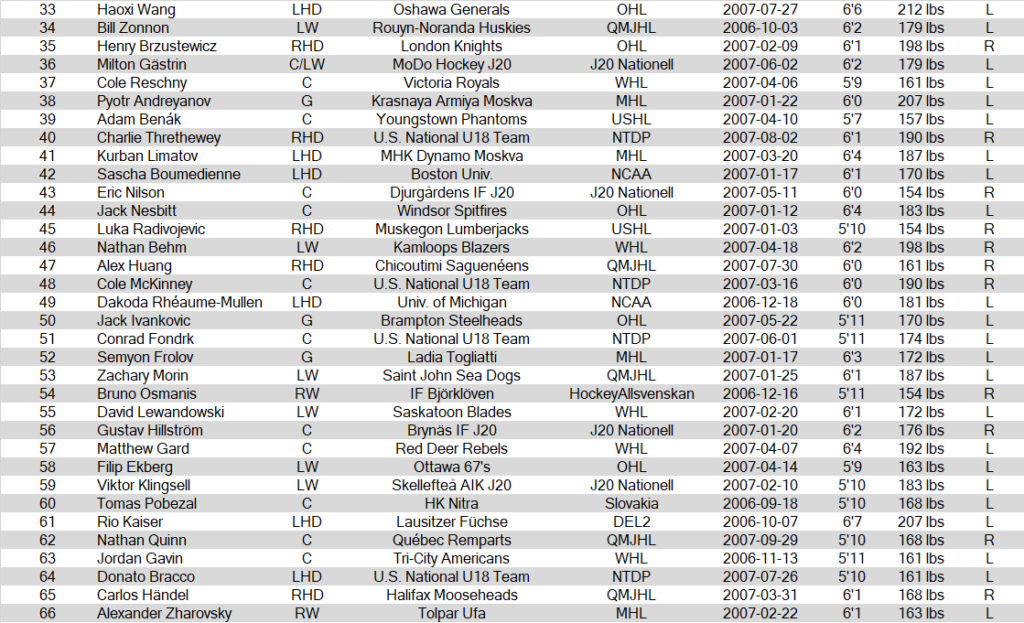
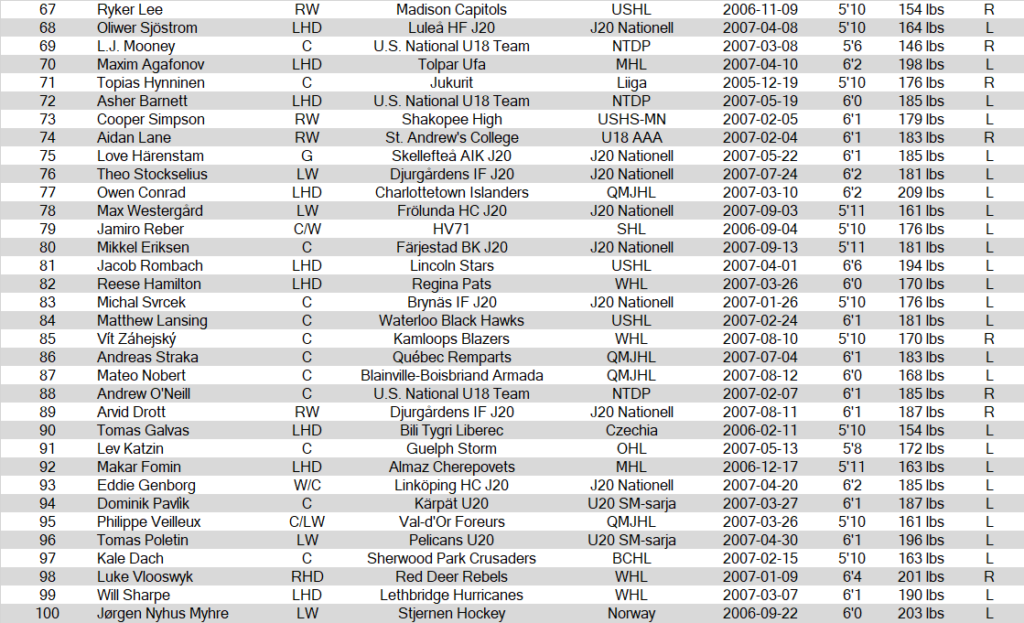
Vaclav Nestrasil is one of the most fascinating prospects in this draft class. He has first-round talent in our eyes—more in line with Elite Prospects’ rankings than the consolidated rankings, which have him around 60th overall.
Yes, there’s work to do—adding muscle, rounding out his defensive game, and staying consistent, but there are few prospects with his blend of size, smarts, skill, and untapped potential.
He’s headed to the University of Massachusetts next year, and we fully expect him to tear it up in the NCAA. Don’t be surprised if Nestrasil becomes a draft-day steal and blossoms into a true difference-maker at the pro level.
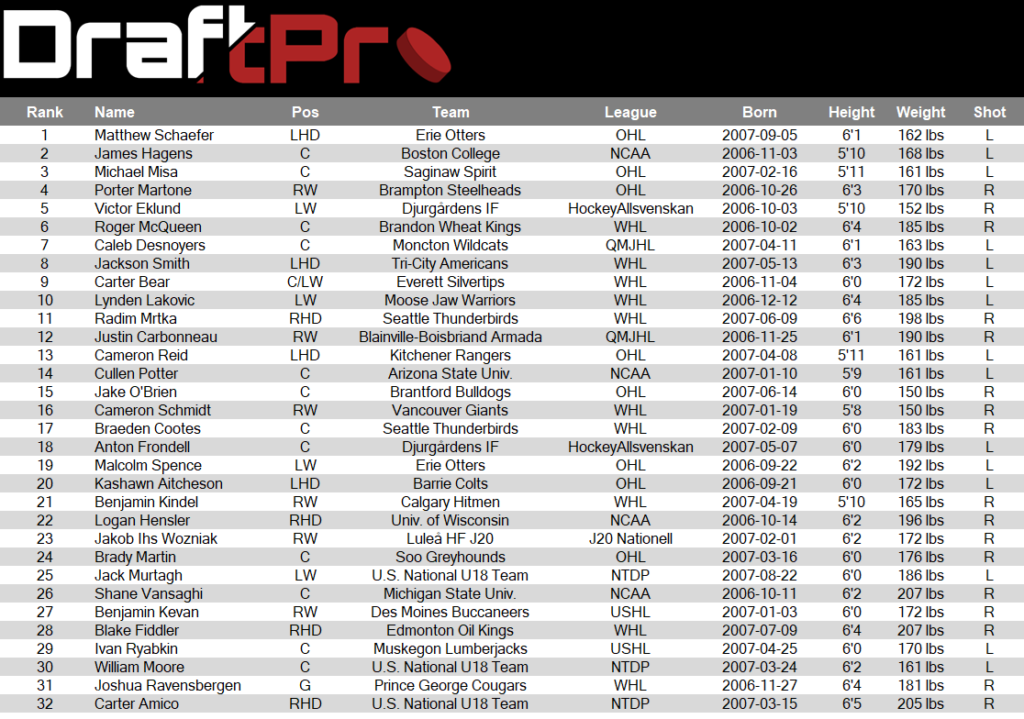
Matthew Schaefer is, without a doubt, one of the most exciting prospects heading into the 2025 NHL Draft. At 6’2″ and 175 pounds, he combines elite skating, high-end hockey IQ, and a complete two-way game that sets him apart from virtually every defenseman in his class. Ten out of ten scouts have him pegged as the projected No. 1 overall pick, and seven of those scouts believe the gap between Schaefer and the next tier—names like James Hagens, Michael Misa, and Porter Martone—is substantial.
His trajectory this season has been electric. With 22 points in just 17 OHL games, he’s crushed last year’s totals, where he recorded 17 points in 56 games. His goal count has more than doubled—from 3 to 7 in a fraction of the games. And while a broken collarbone at the U20 World Juniors will sideline him for around three months, it has done nothing to diminish his stock. If anything, it only magnified his resilience.
I had the privilege of speaking with Matthew for about 20 minutes, and in that time, it became abundantly clear that his maturity and mindset are just as elite as his on-ice play. When I asked him who his NHL comparison would be, he answered without hesitation: “It would probably be Cale Makar, that’s pretty easy. He is a great skater, really good hockey IQ, so I like to watch bits and parts of his game and try to put it in my game.”
But what struck me even more came when I asked what the biggest lesson he’s learned during his recovery process was. He responded, “I think the biggest thing I’ve learned is when you lose someone you love you don’t really expect it and life can throw so much stuff at you. I am just happy to be here everyday… after I lost my mom it made me look at life so much differently.” That kind of perspective, from a 17-year-old, tells you everything you need to know about his character.
On the ice, Schaefer’s skating defines his game. His stride is powerful, fluid, and efficient, letting him close gaps in the defensive zone or lead rushes up the ice. His edgework is elite—smooth pivots, agile turns, and the ability to evade pressure with ease make him a nightmare for forecheckers. This blend of speed and balance makes him dominant in transition.
Offensively, he’s a weapon. Schaefer thinks the game at a high level, processes plays in real-time, and delivers pinpoint passes whether he’s springing a forward on a breakaway or navigating a tight power play setup. At the Hlinka Gretzky Cup, he showcased his dynamic skill set, dancing through defenders before setting up a crucial goal. He also owns a heavy, accurate shot that he’s not afraid to unleash from the point or in transition.
Defensively, Schaefer is as responsible as they come. He maintains strong positioning, closes gaps quickly, and uses his frame effectively to protect the front of the net. He blocks shots with conviction—a skill he credits to his older brother Johnny—and shows the kind of poise that usually belongs to veteran defensemen. He rarely overcommits, plays with a calm intensity, and brings a steadying presence in high-pressure moments.
Physically, there’s still room to grow. But even now, Schaefer holds his own in puck battles, isn’t shy about contact, and knows when to deliver a timely hit. As he continues to add muscle, he’s going to become an even bigger problem for opposing forwards.
When I asked him how he sees the role of a top-tier defenseman evolving, he said, “It could be a Cale Makar role or someone who shuts down… you’re gonna need your top line, hopefully if they are more offensive to create points and be able to shutdown, but I think you’re gonna have your top line that can do both then your second line is gonna be the shutdown line for sure.”
On the topic of his own game, Schaefer said, “I want to be a two-way defenseman, I want to be known to go out on the PK, block shots, and save the lead… Whether it’s with a minute left to protect a lead or gain one, I want to be out there. I want to be a big two-way defenseman that’s not afraid to block shots, score goals, make big hits, make big plays. Just want to be an all-around player.”
And that’s exactly what he is.
Matthew Schaefer is the full package: a franchise-caliber defenseman who can lead a blue line, quarterback a power play, shut down opposing stars, and step up in the biggest moments. His elite skill, unmatched poise, and high character make him not only the safest pick in the draft—but potentially the most impactful one. Any team that lands Schaefer in 2025 isn’t just getting a top-pairing D-man. They’re getting a cornerstone for the next decade and beyond.
Game Report – November 27, 2024 USANTDP 2 VS CHL 3 Venue: Tribute Communities Center (Oshawa)
#8 F, Justin Carbonneau Team: CHL: Armada (QMJHL, Canada) Height/Weight: 6’1”, 190 lbs Shoots: Right DOB: November 25, 2006
Overview:
When discussing top forward prospects for the 2025 NHL Draft from the QMJHL, Justin Carbonneau is hard to overlook. Carbonneau’s game is best described as explosive—he’s constantly in motion, with a quick, powerful, but most importantly, an accurate release that makes him a dangerous goal-scorer. His hands are as quick his foot speed, creating opportunities for him and his teammates. Despite some areas for improvement in defensive positioning, inconsistent physicality in his own zone and his lateral movement, his in-game intensity and electrifying shot make him one of the most exciting prospects to watch from the QMJHL as he makes you stand up because of the unpredictability that he brings to every game. There is no mistake about it that Justin Carbonneau in my eyes is going to be a top 15 pick in the 1st round and may rise similarly to what happened with Beckett Sennecke as Carbonneau is absolutely destined to be a top 6 sniper with 35 goal potential in a weaker draft class.
Strengths:
Shot Release: Carbonneau’s shot is fast and powerful, with a near-instant release.
In-game example: A very quick and heavy one-timer that was used in the mid to late portions of the 1st period which forced the US netminder to make a strong save.
Puck Handling: His quick hands are as agile as his feet.
In-game example: He uses a lot of quick cuts/stride dekes when driving up the rush (seen a lot in the 3rd period).
Compete Level and Offensive Awareness: Carbonneau displays relentless effort each shift and understands deeply where he needs to position himself to retrieve the puck via a pass or broken play.
In-game example: In the third period, he chased down an opposing forward on the backcheck and fights for the puck very hard during board battles, especially in the later stages of the 2nd.
In-game example: Even though he didn’t score on the resulting play, not only he created enough separation for an open cross crease pass which translated into an A scoring chance, he stayed at the front of the net creating a screen on the Cole Reschny wrist shot goal with a minute and 12 seconds left in the game.
Weaknesses:
Defensive Positioning: He can sometimes get out of position defensively, creating openings for the opposition.
In-game example: Majority of it seen in the 2nd period, in his own end, he plays a little too low in the defensive zone, which freed up a lot of space that the US defense take advantage of to walk in with an open shooting lane.
Lateral Skating: Although he has a strong stride, his transitions and crossovers occasionally lack smoothness.
In-game example: This was apparent when he attempted a lateral pivot with the puck and was beaten by an opposing forward entering the zone as he tried to use his explosiveness but wasn’t flexible enough to do so in the earlier stages of the 3rd.
Skater Ratings:
Skating: 6
Puck Skill: 7
Scoring Ability: 8
Playmaking Ability: 5
Hockey Sense/IQ: 6
Character: 7
Physicality: 6
Defensive Play: 4
#19 D, Charlie Trethewey
Team: USA (USNTDP, USHL) Height/Weight: 6’1”, 190 lbs Shoots: Right DOB: August 2, 2007
Overview:
Charlie Trethewey is a well-rounded defenseman for the USNTDP, known for his strong skating, stick positioning, and defensive awareness. His standout skills include excellent puck control, actively defensive stickwork defending the rush, and displaying excellent one-on-one defense, particularly in rush situations. While his backward skating and stride offer power, he needs to improve acceleration. His passing, especially on breakouts, is truly a key asset to offensive game due to how great the transition of play it becomes; however, his shooting accuracy needs quite a bit of work in order for decently offensive chances to come his way due to the fact he shoots high. He is physically pretty solid, Trethewey plays responsibly but could improve his physicality in some areas, like boxing out opponents in-front of the net. Projected as a late 1st round pick to early 2nd round in the 2025 NHL Draft, he has the potential to be a top-pairing or elite 3-4 mobile shutdown defenseman with high end penalty-killing traits with a straight hockey mind playing the game in a simple way, but the right.
Strengths:
Defensive Play: Extremely strong in positioning, stickwork, and defending the rush, making him difficult to beat in one-on-one situations.
Example: Neutralized opponents with smooth, gradual positioning while defending the rushes generated by CHL in most of his shifts that he was on during the game (A lot of the rushes coming in the 3rd).
Passing: A strong passer, particularly on breakouts, with the ability to make accurate and quick passes under pressure.
Example: Connected on a long breakout pass to Moore early in the later stages of the 1st, leading to smoother offensive zone entry.
Skating: Smooth backward skating and solid stride extensions, giving him the ability to transition effectively on the ice.
Example: Used a lot of his transitional lateral movement to stay square in position on the opposing rushes created by team CHL.
Weaknesses:
Shooting: Needs to improve accuracy and intelligence on his shots, particularly from long-range.
Example: His shots tend to go way too high and wide, missing the net, which can be improved by shooting lower for deflections which was seen during the times he was trying to create havoc in-front of the net which then avoids waisted chances.
Physicality: Could be more consistent in using his body to box out opponents and prevent screens.
Example: Needs to be a little more aggressive when positioning in front of the net and boxing out the opposition to prevent crucial screens for his goaltender.
Skater Ratings:
Skating: 6
Puck Skill: 5
Scoring Ability: 3
Playmaking Ability: 5
Hockey Sense/IQ: 7
Character: 5
Physicality: 6
Defensive Play: 8
#94 F, Porter Martone
Team: CHL: Brampton Steelheads (OHL)
Height/Weight: 6’3”, 196Ibs
Shoots: Right
DOB October 26th, 2006
Overview:
Porter Martone is the definition of an offensive dynamo for the Steelheads—a player who’s hard to stop and a true leader on the ice. When Martone has the puck, it stays on his stick until he’s ready to let it fly or make a pinpoint pass. He’s an agile, dynamic centerman with a full arsenal of moves, playing with poise and a nearly unmatched awareness, like he’s got eyes in the back of his head. His passing is elite, with each one flat and crisp, and up the ice, he maneuvers with the puck as if he’s surfing through defenders. He’s not the fastest skater, but his stride mechanics and agility shine through, allowing him to fend off opponents with strong edgework—impressive for someone at 6’3. While known as a playmaker with great anticipation, his powerful wrist shot makes him a serious dual threat. Defensively, he’s solid too, strong at intercepting passes and protecting the puck, making it tough for opponents to regain control. By improving his consistency however at throwing the body, with the skill set that he has with the size that he brings, Martone is absolutely destined to become top-three NHL draft pick in the making and a future superstar playmaking/power forward.
Strengths:
Offensive Tactics: Highly versatile in offensive zones; quick, smooth stick handling with excellent passing accuracy.
In-game example: On the very first play of the game, after chasing down the puck in the offensive zone and retrieving it, he confidently controls it and displays the right instinct of throwing one on net with a screen in-front which led to Desnoyers easily deflecting it.
Shooting: Accurate and quick wrist shot; intelligent shot selection to create rebounds and catch goalies off guard.
In-game example: In the early parts of the 3rd period, he let a rocket go after walking in with a simple toe-drag which created some confusion.
His toe-drags on the powerplay allow him to easily walk in and put his shot short side which causes the goaltender to make some difficult saves.
Skating Agility: Agile, able to pivot quickly to create space in the offensive zone.
In-game example: On the powerplay in the 3rd period, he made an in-tight adjustment with his footwork which allowed him to position himself a between the legs shot which made it quite difficult for the goaltender to react, similarly to how Matthew Tkachuk does it.
Weaknesses:
Physicality: Shows grit in battles and improvement in physicality due to his great leadership but sometimes does not fully use his size to his advantage as his body is still maturing.
In-game example: Mid-to late portions in the 2nd period, where there was a scrum in the boards for a puck battle, Martone gets outmuscled by an opposing player while trying to protect the puck.
Skating Explosiveness: Quick feet and acceleration involving his strides.
In-game example: When there were 2-on-1s generated by the US players in the 3rd, period, he looks like a slug as he can’t keep up with the play very well due to his short stride mechanics.
Defensive Awareness: Sometimes overcommits on defense, losing position.
In-game example: His latest shifts in the 1st period, he got a little too engaged in board battles and played really up on the defense when he should have played a little higher by covering the point from a respective distance, which would have allowed him to control the play a little more effectively.
Skater Category Summarization:
Skating: 5
Puck Skill: 8
Scoring Ability: 7
Playmaking Ability: 6
Hockey Sense/IQ: 7
Character: 7
Physicality: 5
Defensive Play: 5
#77 D, Kashawn Aitcheson
Team: Barrie Colts (OHL)
Height/Weight: 6’1”, 200
Shoots: Left
DOB September 21th, 2006
Overview:
Kashawn Aitcheson is easily one of Barrie’s most promising defensemen, thanks to his intense tenacity and aggression. On the ice, he’s a true physical force like non-other in the OHL—like a lion ready to strike to say the very least. A very tough, and reliable two-way defenseman, Aitcheson brings an underrated offensive game along with his trademark grit. When he lines up a hit, he’s like a freight train, often taking down opponents with powerful reverse hits. His strength shines when boxing out players in front of the net, delivering punishing blows to those who try to stir up trouble in-front of his goaltender, and he does it in a manner that does not cross the lines of the rulebook. While he’s not known for being a proficient puck handler at high speeds, he controls the puck well, keeping it steady and protected. His passing can be a quite a hit-or-miss situation, but he has a heavy wrist shot from the point that’s effective at getting through traffic for rebounds. Though his straight-line speed is good, his edgework and quick starts in reverse need some refining, especially which will help him defend the rush better. Overall, Aitcheson has the makings of a solid shutdown defenseman who can unleash his shot from the second pairing—projected to be a middle second-round pick.
Strengths:
Defensive Play: Very active stick against the rush and does not fall for fakes very easily.
In-game example: In the 16-minute mark of the 2nd period, Team USA had a 2-on-1 chance involving McKinney in the play with Aitchesion defending the rush in the offensive zone. He successfully managed to use his stick efficiently and caused McKinney to miss high in the slot.
Physicality: Aggressive and effective at hitting, consistently finishing checks.
In-game example: Used reverse hits to maintain puck control mainly in the 3rd period and wears down opposition players very easily in every scrum that he enters which in over 85% of the scrums in-front of the net, the US players did not get very close due to his strong presence at playing a fine-line in the game.
Shooting: Very heavy wrist shot from far out that creates rebounds and far wrist shots that are hitting the net.
In-game example: Late in the 1st, he generated a wrist shot from far out which the goaltender had to make a tough save due to the amount of power he generated which could have led to strong rebound chances.
Weaknesses:
Lateral Mobility: Lateral movements and pivots are choppy, impacting his edgework.
In-game example: In the 3rd period, there are moments where he is defending from far out around the net and with faster players around him, he has difficulty of using his pivots to adjust back, and he displays a little bit of discomfort turning towards his forehand side in a reverse position so he could make himself open for an easier pass.
In-game example: On occasion he sometimes would have difficulty skating reverse as well regarding to defending 2-on-1 rushes that were seen throughout the 2nd and 3rd period.
Passing Consistency:
In-game example: Good cases where he would make a decent breakout pass over 70% of the time but there are stretches, he misses badly. When he’d miss a stretch pass in the 3rd period, his passes are so hard that one of the occasions, was called icing.
Skater Category Summarization:
Skating: 5
Puck Skill: 4
Scoring Ability: 5
Playmaking Ability: 5
Hockey Sense/IQ: 6
Character: 6
Physicality: 7
Defensive Play: 7
#19 F, Cameron Schmidt
Team: Vancouver Giants (WHL, Canada)
Height/Weight 5’8”, 152Ibs
Shoots: Right
DOB: January 19th, 2007
Overview:
Cameron Schmidt is no questioned to be one of Canada’s fast and agile marksmen. When Cameron is on the ice, he looks like he is a race car due his agility. Schmidt is the definition of a fast and electrifying winger who seems to never miss a scoring chance whether it’s a goal or an assist while maintaining a grit portion of his game. His shot is just a laser beam locked on to one target from anywhere on the ice. His agility seems to give him a huge advantage over the opponent as he is one of the best at maneuvering with the puck in tight. He has tremendous offensive awareness as he seems to always be at the right place at the right time to either stop a player from making a play, or if its even creating his own scoring chance. He is considered average defensively as he will make a good poke check, however, he plays a little too high up. He is really good at making the close quarter passing plays, but he does need to work on the accuracy of his long passing. He has very smooth hands and can use his reach to even deke over a player. One thing to be admired is that he is quite fisty in puck battles. That being said, he is no tank as he is only 5’8 and only 150 pounds. If all pans out, Cameron Schmidt no doubt about it can become a crucial pick for a team who could just pan out to be an underrated top line forward with crucial powerplay minutes picked in the 10-20 range of the 1st round similar to a Cam Atkinson who displays a grittier game and has a more deceptive shot to become a consistent 35-40+ goal scorer.
Strengths:
Versatile Shot Release: Schmidt’s shot is fast and powerful, with a near-instant release, both forehand and backhand.
In-game example: On one occasion, he was given a pass wide open in the 2nd, even though he didn’t score, he let a shot go so quick to the point where if you didn’t even look for a second, you wouldn’t have known he had it for a second.
Puck Handling: His quick hands are as agile as his feet.
In-game example: A play in the 3rd he demonstrated his elite puck skills was when he dangled out 2 plays and then one final cut on the rush to the outside which allowed him to get off a very powerful backhand shot which ultimately was on goal.
Compete Level and Offensive Awareness: For a player only 5’8, displays relentless effort each shift and understands where he needs to be to force the opposition to make a mistake.
In-game example: Throughout the whole game, he demonstrated his tenacity and his engine by always digging in as hard as he could in board battles in the offensive zone and being as responsible as he could be in his own end at playing his defenseman at a respective distance.
In-game example: A play in the 2nd period in his own end, he was aware enough that there was a shot that was going to be blocked and he launched himself open with his tremendous speed which then Jake O’Brien sprung him the puck on a breakaway.
Weaknesses:
Lack of Size: Even though he engages very well physically, he really needs to build on muscle.
In-game example: Even though he displays the heart of a lion by playing like he’s 5’11 and not 5’8, at the end of the day, he’s still 5’8 and 150 pounds and when he is in the board battles against the bigger players, he does get muscled off the puck more often.
Defensive Positioning: He can sometimes get out of position defensively, creating openings for the opposition.
In-game example: Overall does a good job on the penalty kill, but with Schmidt, he doesn’t play as reserved as he should be and sometimes can get caught out of position, he needs to become more consistent at playing his side of the ice.
Skater Category Summarization:
Skating: 7
Puck Skill: 7
Scoring Ability: 8
Playmaking Ability: 5
Hockey Sense/IQ: 6
Character: 6
Physicality: 4
Defensive Play: 5
#66 F, Michael Misa Team: Saginaw Spirit (OHL, Canada) Height/Weight: 6’1”, 185 lbs Shoots: Left DOB: February 16, 2007
Overview:
Michael Misa undeniably an incredible talent and the main offensive engine for the Saginaw Spirit. With his elite hands, tremendous hockey IQ, and exceptional poise in the offensive zone, he consistently finds ways to make an impact on both ends of the ice. His passing ability is his biggest stand out, with quick, accurate, and soft feeds that often thread the needle under pressure. Though not the fastest skater when it comes to using his full strides, Misa uses his agility and edgework to remain elusive which then allows himself to open up opportunities that were not available prior. His shot is quite accurate, and he knows how to manipulate goalies with deceptive timing which in-fact, he’s been using more often which is a positive sign which allows himself to become less predictable. Defensively, Misa excels at disrupting plays, particularly on the penalty kill, where his “patient aggression” forces turnovers. However, he could improve his faceoff timing and physical engagement in board battles. Misa’s durability, vision, and offensive creativity make him a surefire top-5 pick in the 2025 NHL Draft, with the potential to be a first-line center who displays great reliability.
Strengths:
Playmaking Ability/Offensive Awareness: Elite-level passing and vision make him an offensive catalyst.
Example:Generated an amazing cycle/give and go play with Martone and Schaefer on the powerplay which demonstrates his high-end ability to cycle the puck.
Parked himself in the perfect position for Desnoyers to absolutely thread the needle to him for a wide-open tap-in goal in the 2nd period.
Agility and Edgework: Exceptional mobility helps him evade defenders and create space.
Example:Used his tomahawk like edges to make him a little more effective with his puck-handling ability in the 1st period to separate himself from the opposition and begin cycles.
Defensive Awareness: Consistently disrupts plays.
Example:Forced turnovers and shut down the Americans chances in the offensive zone by forcing them to use a lot of their time on the outside, not allowing them to have a strong scoring chance from in-tight.
Weaknesses:
Faceoffs: Needs to refine timing and technique for consistent success in the draw.
Example:Lost some critical defensive-zone draws in the third period, leading to sustained offensive pressure from the US.
Physicality: Avoids board battles at times, limiting his impact in tighter situations. (Note: HUGE IMPROVEMENT)
In-game example of improvement:He became a lot more engaged physically as he threw a lot of heavy hits, especially one of them in the 2nd period where he dropped an US in open ice.
In-game example of improvements needed: He however becomes less engaged in the board battles as Desnoyers takes in charge while he plays center when it should be Misa getting the puck for Desnoyers and act as an active winger when he plays wing.
Skater Ratings:
Skating: 6
Puck Skill: 8
Scoring Ability: 6
Playmaking Ability: 8
Hockey Sense/IQ: 7
Character: 6
Physicality: 4
Defensive Play: 6
#44 F, Brady Martin Team: Soo Greyhounds (OHL, Canada) Height/Weight: 6’0”, 175 lbs Shoots: Right DOB: March 16, 2007
Overview:
Brady Martin no doubt about it is the most skilled two-way forward for the Greyhounds who combines great grit with unique creativity to contribute at both ends of the ice. He excels in board battles for the puck, using his strong puck-handling and awareness to maintain possession and create opportunities for his teammates. Where it was seen was around the 13-minute mark of second period, where he made a small chop on the puck into open space under pressure, which really enabled a teammate of his to extend the offensive cycle with the puck to generate more pressure. While Martin’s elite passing is his greatest asset, he occasionally tries to force plays that aren’t there, leading to key turnovers which in these cases, he needs to become a little more precautionary with the puck by becoming a little simpler. For example, that was seen was in the first period, where he overcomplicated a solo rush, losing possession when a simpler play would have been more effective by example, dumping the puck for his wingers. His quick-release shot is very accurate and effective in close quarters, but he needs to shoot the puck a little more from far out. He demonstrated this in the third period, scoring a goal with a snap shot from the slot. Martin’s balanced playstyle and strong work ethic make him a middle 1st round prospect, with the potential to develop into a top-six reliable yet creative centerman who can be slotted in any situation acting as a mega Swiss-army knife.
Strengths:
Board Play and Puck Handling: Maintains possession under pressure and creates opportunities.
Example:Chipped the puck into open space during a second-period cycle, leading to sustained offensive pressure, especially when he got pinned in the boards as he demonstrates great footwork with the puck.
Passing and offensive creativity: Keeps plays alive with smart, accurate passes.
Example:In the 1st period, he kept the play alive after making a drop pass in the o-zone to keep sustained pressure after drawing two players to him in the boards.
Defensive Contributions and instant physicality:
Example:Early portions of the 2nd, due to his excellent core strength, absolutely belted a US player with not a lot of difficulty, especially around the US net after his shot.
Example:Even though there is not a pure example, he was so consistent at being in the right place at the right time for his defensemen to easily distribute him the puck to begin easier breakouts for his wingers.
Weaknesses:
Shot: His shot can become quite predictable and needs to be much quicker and slightly needs to improve his accuracy for it to be effective.
Example:On that same play regarding to when he made that huge hit, the shot he displayed, he did not display a lot of energy into his shot as his shooting mechanics seemed a little short which does not allow him to generate as high of a velocity as he would have liked.
Acceleration: Needs quicker first steps to be in better position
Example:Brady lost position on one of the opposing players which Jack Ivankovic was forced to make a great save a early-mid second-period shift due to a little loss of explosiveness in him which could have propelled Brady in tighter positioning to get a stick on the A+ scoring chance
Skater Ratings:
Skating: 4
Puck Skill: 7
Scoring Ability: 4
Playmaking Ability: 7
Hockey Sense/IQ: 6
Character: 7
Physicality: 6
Defensive Play: 5
#18 F, Caleb Desnoyers
Team: Moncton Wildcats (QMJHL, Canada)
Height/Weight: 6’2”, 180Ibs
Shoots: Left
DOB April 11th, 2007
Overview:
Caleb Desnoyers is a dynamic two-way/playmaking centerman with a complete game that blends offensive creativity, physicality, and defensive awareness. His exceptional playmaking and vision on the ice when it comes to understanding the positioning of his teammates is one of, if not his strongest attribute. He demonstrates solid puck skills and persistence, maintaining control under pressure due to him understanding how to use his frame very well. While his shot is powerful but less consistent than his passing, Desnoyers forces goaltenders to stay sharp with his strong pass-to-shot ratio. Defensively, he excels in positioning, faceoffs, and as mentioned, using his size effectively. However, his edgework needs improvement, as slow pivots and transitioning in tight spaces provides him some difficulty when it comes to generating explosiveness. With refinement in his skating and shooting mechanics whether its about being square to where he wants to shoot the puck, or even finding techniques that allows himself to be smoother in transition, he projects as a top-10 pick in the 2025 NHL Draft and a potential top-six forward with a 65-70-point ceiling who can be slotted in any situation given.
Strengths:
Playmaking and Offensive Awareness:Exceptional vision and anticipation make him a key offensive facilitator.
Example: Made an unbelievable thread-the-needle pass to Michael Misa through 3 US players on the powerplay for an easy tap in goal in the 2nd period.
Example: On the 1st period goal, he was aware enough with the use of his body to position himself in-front of the net for him to properly deflect that puck in the net which Boettiger had no chance of stopping.
Defensive Awareness:Consistently positions himself well and disrupts plays with interceptions and shot blocks.
Example: Blocked a cross-ice pass in the 1st period and immediately transitioned play effectively into the offensive zone which allowed his wingers (Martone/Misa) to generate more speed.
Puck Protection and Physicality: Uses his size effectively to shield the puck and deliver impactful checks.
Example: Protected the puck along the boards in the first period, then delivered a hit to force a turnover to startle the opposition.
Weaknesses:
Edgework and Agility:Struggles with quick turns and maintaining momentum, providing himself no assistance in creating himself more space in shorter time periods.
Example: When he gets in-front of the net to try to act as a screen, he doesn’t generate enough quickness in his “tomahawk” edges to get a stronger in-tight position when there’s a defenseman like Maceo Phillips or Charlie Trethewey boxing him out.
Shooting Consistency: While powerful, his shot can miss the net at times and lacks the precision of his passing.
Example: Missed a key shot in the slot in the second period, failing to capitalize on an open look which Boettiger made an easier save than expected.
Skater Category Summarization:
Skating: 4
Puck Skill: 6
Scoring Ability: 5
Playmaking Ability: 7
Hockey Sense/IQ: 7
Character: 6
Physicality: 6
Defensive Play: 7
#48 D, Matthew Schaefer Team: Erie Otters (OHL, Canada) Height/Weight: 6’1”, 175 lbs Shoots: Left DOB: September 5, 2007
Overview:
Matthew Schaefer is one of the most complete defensemen in the 2025 NHL Draft class and is regarded as Canada’s top blue-liner. His game is defined by elite skating, exceptional hockey IQ, and a calm, poised demeanor in all situations. Schaefer excels at reading plays, positioning himself perfectly to neutralize threats, and consistently making the right decisions under pressure. His ability to simplify the game while maintaining a high impact is reminiscent of Jaccob Slavin’s defensive mastery. Offensively, Schaefer is a reliable puck mover with precise passing ability. His shot, while not overly powerful, is accurate and well-timed, making him a threat from the point. Schaefer’s skating is his greatest asset, blending agility and explosiveness with fluid transitions that allow him to evade forecheckers and maintain control. Defensively, Schaefer’s awareness and stickwork make him a formidable opponent. He consistently squashes offensive space and forces turnovers with timely poke checks and interceptions. One notable moment came in the first period when he broke up a cross-ice pass in his zone and quickly turned the play into a counterattack. While not overly physical, Schaefer’s core strength and stability allow him to deliver effective hits when necessary. His poise under pressure and ability to maintain composure make him an invaluable presence on the ice. Schaefer projects as a top-three pick in the 2025 NHL Draft and has the potential to develop into an elite, all-around NHL defenseman, capable of excelling in any situation.
Strengths:
Elite Skating: Combines smooth agility and explosive edgework to dictate pace and evade pressure.
Example:At the 14-minute mark of the 1st period, with confidence in his skating ability, he joined the rush at a high speed due to great extension in his cross overs which allowed him to really drive the play in the offensive zone off an unorganized rush.
Hockey IQ and Poise: Exceptional awareness and calm decision-making in all zones.
Example:In the 3rd period, he saw Martone about to stride outside of the defensive zone and noticed as well that Misa was gaining tons of speed which he had the cognisant mind of starting a simple short pass to Martone which Martone then redirected the pass out to Misa for a decent chance off the rush on that breakout.
Passing Ability: Delivers crisp, accurate passes that spark offensive transitions.
Example:Schaefer all game on the powerplay displayed he’s been the best at bouncing the puck to his wingers on the umbrella formation of the powerplay by redirecting the puck to them smoothly which generated great momentum.
Weaknesses:
Shot Power: While accurate, his shot lacks the velocity to consistently beat goaltenders from the point.
Example:Fired well-placed wrist shot from the blue line early in the second period that was easily saved due to its lack of power behind the shot (Needs to get a bit stronger).
Physicality: Not overly imposing physically, though he holds his own in battles.
Example:Delivered a few solid checks in the corner during the first and third periods but avoided consistent physical engagement when it comes to boxing out players (With time by getting stronger, he’ll be stronger at boxing out).
Skater Ratings:
Skating: 8
Puck Skill: 6
Scoring Ability: 4
Playmaking Ability: 6
Hockey Sense/IQ: 7
Character: 7
Physicality: 5
Defensive Play: 8
#17 F, Malcolm Spence Team: CHL: Erie Otters (OHL, Canada) Height/Weight: 6’2”, 200 lbs Shoots: Left DOB: September 22, 2006
Overview:
Malcolm Spence is one of the most dynamic and physically imposing skaters in the OHL, with a blend of speed, strength, and lateral agility that makes him a consistent offensive threat. He is a very fast and powerful playmaking winger who uses his NHL like skating to deeply pressure opponents and create underrated scoring opportunities from out of nowhere. Spence’s puck skills are refined, with soft hands that allow him to make plays at top speed. His passing is sharp, especially on short plays, but he’s also capable of threading the needle in crowded areas. His anticipation and hockey IQ shine on the penalty kill, where he disrupts passes on the powerplay and uses his speed to transition quickly into odd-man rushes. Offensively, Spence’s shot is accurate with a quick release, though it lacks the power to be a true weapon. Defensively, he’s effective at pickpocketing pucks during rushes and forcing turnovers. However, his overall defensive awareness can improve, as he sometimes plays too high in his zone, allowing opponents to exploit gaps. Spence also has the frame to dominate physically but doesn’t yet consistently throw his body around to disrupt plays. With his elite skating, strong puck skills, and ability to read the game, Spence projects as a top-15 pick in the 2025 NHL Draft. If he continues to develop his physicality and defensive game, he could become a high-end, top-six winger capable of scoring 60+ points per season.
Strengths:
Elite Skating: Combines high-end speed, balance, and lateral agility to dominate in transition.
Example:Showcased his tremendous edgework and balance when he shoots the puck, especially in the 3rd period where there was a situation where he wasn’t facing the front of the net, and with his flexible lateral ability, he was able to pivot himself facing the net in a nick of time which allowed him to let one go while maintaining great stability.
Puck Skills and Passing: Soft hands at top speed and crisp short-area passes make him a playmaking threat.
Example:Noticed a lot on the powerplay when he plays down low, he is very good at following through on his passes which the majority of the time, his passes come smoothly on the tape which helps regrouping the play for the PP quarterback.
Offensive Awareness: Great positional awareness in the offensive zone and is effective at becoming a center of attention.
Example:On the Michael Misa goal from the Desnoyers pass, he drove to the net in a way that the defensemen forgot he was there, placed himself, and when Desnoyers made that pass, Spence jumped up in-front of Boettiger acting as a screen as if a shot was taken which made Boettiger clueless of where the puck was.
Example:On the Cole Reschny wrist shot goal, he acted as a pylon for a split second which made separation between Reschny and the US forward chasing him which then equaled to more time for Reschny to absolutely let it fly.
Weaknesses:
Defensive Awareness: Plays too high in his own zone at times, on occasion cheating for offensive
Example:On the powerplay, he played too high up behind and did not anticipate quickly enough that a shot was going to be blocked which led to Jack Murtagh using his rockets, noticing that behind the play, Malcom was the last guy back which he should have put a little more effort to getting back.
Physical Engagement: Needs to use his size more consistently to impose himself on opponents.
Example:In the 3rd period, after a nice shot he did which was saved, it rebounded to the corner which instead of using his size by powering by the opponent, he instead just tried gaining position by using his great feet to his advantage which ultimately, the puck was distributed out with no punishment.
Skater Ratings:
Skating: 8
Puck Skill: 7
Scoring Ability: 5
Playmaking Ability: 6
Hockey Sense/IQ: 6
Character: 5
Physicality: 5
Defensive Play: 5
#7 D, Jackson Smith Team: CHL: Tri-City Americans (WHL, Canada) Height/Weight: 6’3”, 190 lbs Shoots: Left DOB: May 13, 2007
Overview:
Jackson Smith is one of the most versatile defensemen in the 2025 NHL Draft, excelling with his mobile skating, high hockey IQ, and calm presence on the ice. He thrives as a puck-moving defenseman, with precise passing and strong playmaking ability, making him a reliable threat from the point. While his shot lacks power, it is accurate and used effectively to create scoring opportunities. Smith’s greatest strength lies in his passing, whether initiating breakouts from his own zone or quarterbacking the power play with creative setups. Defensively, Smith is adept at reading plays, using his stick effectively to disrupt opponents, particularly in two-on-one situations. However, he can struggle in one-on-one matchups against quicker players due to overextension. His smooth lateral skating is a strength, but his acceleration needs vast improvement, as he often loses footraces. Enhancing his lower-body strength would improve his explosiveness and overall skating efficiency. At 6’3”, Smith has a solid frame but tends to rely on his range rather than physicality. Increasing his use of core strength to deliver checks would elevate his defensive presence. Despite these areas for improvement, his composure under pressure and offensive reliability which makes him a standout prospect. Projected as a top-15 pick, Smith has the potential to become an all-around, puck-moving defenseman capable of excelling as a second or third defenseman on an NHL team.
Strengths:
Lateral Skating Mechanics: Allows him to transition with/without the puck very smoothly
Example:In the 13–14-minute mark of the 1st period, Smith used his smooth back skating mechanics to his advantage and lined himself up perfectly to make a clean hit on a US player to create separation with the puck so he could then transition to chipping the puck out of harm’s way.
Hockey IQ and Poise: Great offensive awareness and calm decision-making.
Example:Great offensive activation consistently throughout the game as he created himself a lot of separation from the opposition to generate great scoring chances. (Early in the 1st period notably crossing over to a side that had nothing covered and let go a quick shot up high which was difficult to stop).
Example:In the 11-minute mark of the 2nd period, Smith had the puck in the offensive zone which a US forward came slowly chasing towards Smith, which then he used a small head fake to then cut to the outside which generated great separation which led to a wide-open shooting lane for a great shot in tight. (More offensive activation).
Passing Ability: Delivers crisp, and very accurate passes that spark offensive transitions.
Example:Jackson displayed a lot of great breakouts passes throughout the game and in great portions of the 2nd in the offensive zone, he made a lot of hard accurate passes which generated great momentum in the offensive zone.
Weaknesses:
One-on-one defending: While great at reading 2-on-1s, he has some difficulty with fast players on 1-on-1s.
Example:When defending the rush, he sometimes commits too much on one side instead of trying to stay square with the player with his stickwork and following through with the player with physicality.
Skating Acceleration: While good mechanics, does not generate a lot of power/explosiveness in his strides due to lack of lower-body strength. (Note*: CAN be fixed by building muscle)
Example:When he was behind the 2-on-1s with Cameron Reid defending it, even though showed good intent to get back, the lack of muscle did not allow him to generate strong acceleration to get back into the play and interfere with any stick actions.
Physicality: Although good size, he does not use it enough to his advantage by throwing impactful hits (In this game, displayed great improvement by getting involved physically).
Example of Improvement:Mainly getting active in board battles at trying to power through the forwards holding the puck on the boards, but especially lining up very well with that hit generated early in the 1st.
Skater Ratings:
Skating: 5
Puck Skill: 6
Scoring Ability: 5
Playmaking Ability: 7
Hockey Sense/IQ: 7
Character: 6
Physicality: 5
Defensive Play: 5
#11 F, Cole McKinney
Team: USNTDP (USHL, USA) Height/Weight: 6’0”, 190 lbs Shoots: Right DOB: March 16, 2007
Overview:
Cole McKinney is a versatile two-way forward for the USNTDP, excelling on both ends of the ice. At 6 feet and 190 pounds, his solid frame and agility make him highly effective in puck protection, board battles, and transitions. McKinney’s physicality and positional awareness are key strengths, as seen in the first period when he outmuscled a defender to set up a high-quality scoring chance with a quick bump pass. Offensively, he shows strong positional awareness and playmaking ability, thriving in give-and-go situations. However, he can overcomplicate plays with excessive deking, and his shot, while accurate, lacks power, limiting his scoring impact. Defensively, McKinney is a true 200-foot player with an active stick and excellent faceoff ability, making him a reliable presence in his own zone. His grit and commitment on the forecheck further enhance his all-around game. With continued refinement of his offensive instincts, McKinney projects as a later 1st to early 2nd round NHL Draft pick, with the potential to become an elite second-line center and a great penalty killer.
Strengths:
Defensive Awareness: Exceptional understanding of positioning and active stick work.
Example: After overhandling the puck and getting knocked off with ease in his own zone early in the 1st, he still somehow got back up rapidly and stayed square where he needed to be and blocked an “A” scoring chance by kneeing down to block the shot.
Example:When he plays the box on the penalty kill, he is very good at being square with the puck handler which forces them to play to the outside and he supports his defenseman in puck retrieval only when he needs to which he then knows where to get the puck out.
Playmaking Ability: Strong give-and-go plays create dynamic offensive rushes.
Example: Quite diverse on the powerplay down low which he’s very good at not being predictable with his passing from down low, but even on the Jack Murtagh goal, if he didn’t score, McKinney was ready to slide a rebound in the net with ease which displays improvement in his positional awareness.
Faceoffs: Dominates in the circle, providing his team with critical possession opportunities.
Example: Wins many key defensive-zone faceoffs, especially late in the third period to help secure a lead on the puck to easily help the USA defenders to try to break out.
Weaknesses:
Shot Power: He lacks heaviness in his shot, limiting his scoring potential, making it easier for the goaltender to read.
Example: Missed a scoring chance in the second period due to insufficient shot velocity even though the shot was on goal.
Overcomplicated Plays: Occasionally tries to do too much with the puck, leading to turnovers.
Example: Early in the 1st period on that amazing recovery by blocking an “A” scoring chance, to get to that, he overhandled the puck trying to make the perfect play which he should have regrouped it back to his defenseman behind the goal-line for a regroup.
Offensive Consistency: Needs to increase offensive engagement to add depth scoring. (Improvements in this game)
Example: With more engagement on the forecheck that was well done on Blake Fiddler which forced him to perform a weak backhand clear which was easily intercepted, McKinney used that to his advantage and separated himself clear on a breakaway which he made a backhand forehand goal through the 5-hole to tie the game at 1s.
Skater Ratings:
Skating: 6
Puck Skill: 5
Scoring Ability: 5
Playmaking Ability: 5
Hockey Sense/IQ: 7
Character: 6
Physicality: 6
Defensive Play: 7
#14 F, William Moore
Team: USA (USNTDP, USHL) Height/Weight: 6’2”, 160 lbs Shoots: Left DOB: March 24, 2007
Overview:
William Moore is a forward with a high offensive ceiling, defined by his powerful shot and playmaking ability. His quick, accurate release is a hallmark of his game, consistently creating scoring opportunities. In the second period, he demonstrated his marksmanship by unleashing a deceptive shot on the power play that generated multiple rebounds, disrupting the opposing defense. While Moore’s shooting stands out, his passing is an underrated strength, enabled by his reach and creativity. However, his puck handling and passing accuracy need greater consistency, as seen in the first period when he overhandled the puck and missed an opportunity to capitalize on a rush. Moore’s offensive awareness and skating are key assets, with his efficient north-south movement and powerful crossovers enabling him to break through defensive coverage with pace. His skating style, reminiscent of Jack Eichel, drives his offensive game but would benefit from improved explosiveness in tight turns to enhance agility. Physically, Moore is embracing a power-forward role, actively contributing on the forecheck, but he needs to build more muscle to increase his effectiveness in puck battles and checks. Defensively, Moore’s awareness is an area for growth. He often lacks focus in his own zone, failing to consistently cover his man or engage with intensity. With improvements to his defensive mindset and agility, Moore’s combination of offensive skill and physicality positions him as a middle-of-the-first-round pick in the 2025 NHL Draft, with the potential to become a dynamic scorer and power forward at the NHL level.
Strengths:
Scoring Ability: Powerful and accurate shot with quick release, capable of creating high-dangerous scoring chances.
Example: Created multiple rebound opportunities on the power play with his quick, deceptive shot (I’d argue its NHL ready due to the way he uses it in multiple ways).
Offensive Awareness: Strong understanding of zone coverage, allowing him to navigate through the neutral zone with ease.
Example: Easily walked through the neutral zone, makes himself as a ghost on occasion on purpose so he can gain position in-tight with some ease.
Skating: Strong, north/south skating ability with powerful crossovers to generate speed up the ice.
Example: Attacked the offensive zone at full speed involving full strides and great extensions on his crossovers, leading a rush that put major pressure on the defense which somehow used his speed to then cut a short backhand shot off.
Weaknesses:
Puck Handling Consistency: Needs to work on handling the puck and passing with greater accuracy.
Example: Improvements throughout the game, there are moments where he needs to improvements in receiving passes more smoothly from his defensemen during breakouts.
Defensive Awareness: Needs to show more effort and attention to detail in his defensive game.
Example: Showed lack of focus on covering his man at the point, and skates around too much as he chases a lot even when he plays center when he should play more reserved as a zone coverage type player. (Note: Surprisingly underrated in the faceoff dot).
Physicality/Strength: Will need to build more muscle to make his hits more effective and utilize his speed better.
Example: Failed to deliver a strong hit along the boards due to his lack of strength and size even though displaying great intensity. (Worse enough, not strong at all in any scrum which shows his lack of balance “lack of lower body/core strength”.)
Skater Ratings:
Skating: 7
Puck Skill: 6
Scoring Ability: 8
Playmaking Ability: 5
Hockey Sense/IQ: 5
Character: 5
Physicality: 5
Defensive Play: 3
#44 C, Jake O’Brien Team: Team CHL (Brantford Bulldogs (OHL, Canada)) Height/Weight: 6’2”, 170 lbs Shoots: Right DOB: September 25, 2007
Overview:
Jake O’Brien is the definition of a cerebral playmaker with elite vision and on-ice awareness. As the first-line center for the Brantford Bulldogs, his ability to anticipate plays and deliver precise passes under pressure sets him apart from the group. O’Brien’s offense revolves around his high-end passing, though he needs to better balance his pass-to-shoot ratio (currently 8/2) to become less predictable (Which he’s been shooting the puck much more this season). His smooth stickhandling and his ability to protect the puck under pressure allows him to become a reliable play-driver and someone who can be relied upon for his teammates. His skating features strong speed and acceleration in transitions but lacks the agility and explosiveness to consistently threaten the o-zone when it comes with battles in-front of the net. Physically, O’Brien is effective but would benefit from added strength to improve his durability and impact in board battles. Defensively, he excels in a 200-foot game, demonstrating frequent support for his defensemen and forcing turnovers with an active stick, kind of like acting as a sponge for his teammates. His faceoff skills further bolster his value as a dependable two-way center. Projected as mid to late 1st round selection, Jake O’Brien has the tools to develop into a key second-line center at the NHL level who can be key in any situation given, kind of a Swiss-army knife once he full fills into his size.
Strengths:
Vision and Playmaking: Exceptional awareness allows him to anticipate plays and deliver precise passes.
Example:After blocking a shot, he immediately noticed Cameron Schmidt letting his rocket like speed take off and just absolutely sprung him on a breakaway with a feather of a pass.
Example: In the 6 minute mark of the 3rd period, where it looked like O’Brien was caught at the blue line, made a very hard and flat pass to Ben Kindel which led to a tic-tac-toe type play which resulted in a dangerous scoring chance from the top of the circles.
Puck Protection and Patience: Uses his size and poise to make smart offensive plays.
Example:On that same play after Schmidt missed his breakaway, O’Brien got the puck back and displayed great body positioning as he drew two US players in to chase him, only for O’Brien to position himself to chip the puck into the corner to provide continuity in offensive pressure.
Defensive Support: Effective in a 200-foot game, providing solid backchecking and defensive-zone coverage.
Example:Even though McKinney scored his breakaway goal, O’Brien was the second guy back, closely behind Fiddler so that if Fiddler was able to retrieve the puck after the breakaway, with O’Brien’s support, they could have began a breakout or at the very least, dump the puck back out.
Weaknesses:
Skating Agility: Needs to improve edgework and explosiveness to be more effective in tight spaces.
Example: Struggled to generate separation in offensive-zone cycles during the third period as even though he draws himself well and creates puck separation from his teammates, he isn’t the most agile in tight when somewhat pinned due to lack of explosiveness in his feet.
Physicality: Lacks strength and full intention to consistently win board battles and impose himself physically. Note: This will improve with time as his body matures by developing more muscle.
Example:Was outmuscled along the boards in the third period, losing puck possession. Displays lack of consistency in being intentional physically as instead of just bouncing off the opposition, he should use his size to his advantage and power through on occasion.
Shot Utilization: Relies too heavily on playmaking ability, which makes his offense utilization more predictable. Note: Throughout the season, he has shown more intention of shooting the puck balancing his shot/pass ratio, which for shooting more, more goals are coming.
Example:Passed up several shot opportunities during great offensive situation as he favored setting up teammates which shows that he can become too passive on situations where he just needs to let his shots fly.
Skater Ratings:
Skating: 5
Puck Skill: 6
Scoring Ability: 4
Playmaking Ability: 7
Hockey Sense/IQ: 7
Character: 5
Physicality: 4
Defensive Play: 6
#13 D, Quinn Beauchesne
Nationality: Canada Team: Guelph Storm, OHL Height/Weight: 6’0″, 183 lbs Shoots: Right DOB: March 1, 2007
Overview: Beauchesne is a confident two-way defenseman with strong puck-handling under pressure. He showcases poise in challenging situations in his own zone with the puck and has a solid passing game, though decision-making consistency needs improvement. He’s not overly physical but is willing to sacrifice his body for the team which shows his leadership. Where he needs to truly improve is his lackluster defensive awareness as he doesn’t pay attention very easily. By improving on his focus regarding his defensive awareness by letting the game come to him and shot precision would enhance his NHL potential. Beauchesne is projected as a reliable likely 3rd pairing (sheltered role) defenseman, likely a mid-late 3rd-round pick.
Strengths:
Poise Under Pressure: Very calm and precise in high-stress situations with the puck, freezing defenders to open up plays.
In-game example: In the early part of the 3rd period, calmly handled pressure with the puck in his own zone, allowing him to execute a controlled breakout set up which was key.
Passing Skills: Flat and hard passes, adding pace to the game.
In-game example: Good breakout passes throughout the game which led to decent offensive transition for his wingers to become more active.
Weaknesses:
Decision-Making Consistency: Tendency to dump pucks prematurely or overcomplicate plays.
In-game example: Not one concrete example but sometimes, where he positions himself defensively on the ice, it seems confusing, because there are occasions where he plays too high up, but the majority of the time, he plays quite low which leaves his forwards a little more open around the net with ease this game.
Defensive Awareness: Not focused defensively as he could get caught defensively whether it is not knowing where the puck is. Note: Minor improvements are showing.
In-game Improvement but still improvements needed: In a 1st period chase where Aitcheson was going to lose a race for the puck in his own zone, Beauchesne used his great strides to win the race and getting the puck out of harms way which instead of the Americans attacking with a lot of speed, they had to enter the zone at a slower pace which even then, Quinn should even run back to cover the slot instead of being stale focusing on a US player in front of him.
Skater Category Ratings:
Skating: 6
Puck Skill: 5
Scoring Ability: 4
Playmaking Ability: 6
Hockey Sense/IQ: 4
Character: 7
Physicality: 4
Defensive Play: 5
#9 F, Jack Murtagh
Team: USA (USNTDP, USHL) Height/Weight: 6’0”, 185 lbs Shoots: Left DOB: August 22, 2007
Overview:
Jack Murtagh is an underrated forward in this draft class, known for his subtle but effective goal-scoring ability. His skating, while occasionally choppy, is deceptively fast due to his high pace and excellent lateral movement. Murtagh’s crossovers generate significant speed, though improving his stride length would enhance his overall skating efficiency. His balance and lateral agility make him an effective rover on the ice. A natural sniper, Murtagh possesses a quick and deceptive shot that challenges the goaltender, complemented by strong offensive awareness and anticipation, allowing him to find scoring opportunities. While his passing is solid, his long-range passes can lack consistency. Murtagh’s smooth hands and reach allow him to protect the puck and maneuver through defenders effectively. Defensively, Murtagh has areas to improve. He tends to play too high in the defensive zone, leaving coverage gaps, and needs to engage more consistently in board battles to support breakouts. Despite his modest size, Murtagh brings energy to the forecheck, using his intensity to force turnovers and sustain offensive pressure. With improvements to his defensive play and consistency in his passing, Murtagh projects as a solid second-round pick. He has the potential to develop into a versatile middle- or top-six forward, capable of contributing on the power play and penalty kill with great grit which may be valued as 1st round potential.
Strengths:
Scoring Ability: Quick, deceptive shot with a high release; a constant goal-scoring threat.
Example: Scored a heavy one-timer which muscled through Ivankovic in the halfway mark of the 3rd period, but what was key was that he only did a third to a half of a windup, and he still got that puck off rapidly.
Example: On an odd break that he created off a board pass, he intentional shot five-hole on Jack Ivankovic which he is quite intelligent of where he shoots the puck and it almost went in as Ivankovic somewhat froze.
Offensive Awareness: Strong anticipation and ability to create space with his hands but most importantly his quick feet, leading to scoring opportunities.
Example: In the 9-minute mark of the 1st period, he saw an open lane which he became quite opportunistic about it as he displayed great intention and quick feet to generate a lot of momentum off the rush which led to him getting the puck at high speed and get a shot off.
Physicality: High intensity on the forecheck, generating turnovers and creating pressure.
Example: No concrete example as he displayed great consistency physically in the offensive zone as he was quite hard on the forecheck which created some decent pressure to handle from Team CHL’s end.
Weaknesses:
Defensive Awareness: Plays too high in the defensive zone at times, leaving gaps and missing key defensive responsibilities.
Example: He left a Jackson Smith wide open to generate a decent shot by failing to cover his side of the ice and play a zone coverage type of defense as he instead decided to somewhat look/chase after the puck in the first minute and a half of the 2nd.
Consistency in Effort: Needs to put a lot more effort into defensive play and board battles in his own zone, but most importantly, be a support guy for his defenders who get him the puck. Note: Character off-the-ice is quite the positive as he’s decently optimistic.
Example: Just as the Cameron Schmidt breakaway was happening in the 2nd period, behind the play, Jack basically showed very little intention to somewhat get back into the play so that he can act as somewhat of a support system for his defensemen which in Murtagh’s case, cheats a lot for offense.
Game Report – January 15, 2025 OHL East 5 VS OHL West 4 OT Venue: Brantford Civic Center
#77 F, Michael Misa Team: OHL West (Saginaw Spirit, OHL) Height/Weight: 6’1”, 185 lbs Shoots: Left DOB: February 16, 2007
Overview:
Michael Misa undeniably an incredible talent and the main offensive engine for the Saginaw Spirit. With his elite hands, tremendous hockey IQ, and exceptional poise in the offensive zone, he consistently finds ways to make an impact on both ends of the ice. His passing ability is his biggest stand out, with quick, accurate, and soft feeds that often thread the needle under pressure. Though not the fastest skater when it comes to using his full strides, Misa uses his agility and edgework to remain elusive which then allows himself to open up opportunities that were not available prior. His shot is quite accurate, and he knows how to manipulate goalies with deceptive timing which in-fact, he’s been using more often which is a positive sign which allows himself to become less predictable. Defensively, Misa excels at disrupting plays, particularly on the penalty kill, where his “patient aggression” forces turnovers. However, he could improve his faceoff timing and physical engagement in board battles. Misa’s durability, vision, and offensive creativity make him a surefire top-5 pick in the 2025 NHL Draft, with the potential to be a first-line center who displays great reliability.
Strengths:
Playmaking Ability/Offensive Awareness: Elite-level passing and vision make him an offensive catalyst.
Example:With 2 minutes left roughly in the 1st, on the powerplay, Misa displayed great confidence handling the puck and taking advantage of open space on the left side, this allowed him as well to perfectly thread the needle to Jack Nesbitt for a wide-open net tap in for a 3-2 lead for OHL West.
Example:Each offensive zone entry Misa performed, he was very precise on his cross ice passing as the majority of the time, Misa would connect it on the tape.
Agility and Edgework: Exceptional mobility helps him evade defenders and create space.
Example:Used his tomahawk like edges to make him a little more effective with his puck-handling ability in the 1st period to separate himself from the opposition and begin to open himself some space to really walk in and shoot.
Excellent bottom-hand activation on his shooting mechanics.
Example:2 minutes and 40 seconds left in the 1st, while falling down and being tied up, Misa displayed excellent strength and rotation with his bottom hand to get under a lot with a dangerous rebound chance that Nansi generated for OHL West. This notably drew a powerplay as well for OHL West.
Weaknesses:
Faceoffs: Needs to refine timing and technique for consistent success in the draw.
Example:Lost some critical defensive-zone draws in the third period, leading to sustained offensive pressure from the East.
Physicality: Avoids board battles at times, limiting his impact in tighter situations.
In-game example:On the play that Czata had a dangerous scoring chance early in the 1st, Misa wasn’t urgent enough for the puck and Martone forechecked well which Misa to lose balance easier than normal and ultimately, lost possession of the puck.
In-game example of improvements needed: He however becomes less engaged in the board battles as Desnoyers takes in charge while he plays center when it should be Misa getting the puck for Desnoyers and act as an active winger when he plays wing.
Skater Ratings:
Skating: 6
Puck Skill: 8
Scoring Ability: 6
Playmaking Ability: 8
Hockey Sense/IQ: 7
Character: 6
Physicality: 4
Defensive Play: 6
#44 F, Brady Martin Team: OHL West (Soo Greyhounds, OHL) Height/Weight: 6’0”, 175 lbs Shoots: Right DOB: March 16, 2007
Overview:
Brady Martin no doubt about it is the most skilled two-way forward for the Greyhounds who combines great grit with unique creativity to contribute at both ends of the ice. He excels in board battles for the puck, using his strong puck-handling and awareness to maintain possession and create opportunities for his teammates. While Martin’s great passing is his key traits, he occasionally tries to force plays that aren’t there, leading to key turnovers which in these cases, he needs to become a little more precautionary with the puck by becoming a little simpler. His quick-release shot is very accurate and effective in close quarters, but he needs to shoot the puck a little more from far out. When it comes to his defensive play, he’s a very supportive player which displays his great commitment to be a jack of all trades, blue collar type of player. What is very underrated about Brady Martin is that although he may not be the biggest guy, he certainly plays big as for players at his size, he is one of the most impactful when it comes to throwing the body clean and effectively (Highly translatable to the NHL).Martin’s balanced playstyle and strong work ethic make him a middle 1st round prospect, with the potential to develop into a top-six reliable yet creative centerman who can be slotted in any situation acting as a mega Swiss-army knife who can do anything asked of him, and perform it 100%.
Strengths:
Board Play and Puck Handling: Maintains possession under pressure and creates opportunities.
Example:Chipped the puck into open space during a second-period cycle, leading to sustained offensive pressure, especially when he got pinned in the boards as he demonstrates great footwork with the puck.
Passing and offensive creativity/Hand-eye: Keeps plays alive with smart, accurate passes.
Example:In the 1st period, he kept the play alive after making a drop pass in the o-zone to keep sustained pressure after drawing two players to him in the boards.
Example:Deflected a readable shot from Cameron Reid which ultimately was the 2nd goal of the game for the West
Defensive Contributions and instant physicality:
Example:30-second mark of the game, Brady not only wins a faceoff cleanly, but performs it in a manner in-which he can control the puck and distribute it closely to one of his defensemen.
Example:In 10-and-a-half-minute mark of the 2nd, while OHL East was putting on the pressure, because of his great motor, Martin backchecked hard to knock his man off the puck and gain possession and ultimately, counter attack the play.
Weaknesses:
Shot: His shot can become quite predictable and needs to be much quicker and slightly needs to improve his accuracy for it to be effective.
Example:2.5-minute mark of the 2nd, Martin didn’t display the greatest hand placement when it came to providing torque on his short snap shot which made it readable for the goaltender to stop.
Acceleration: Needs quicker first steps to be in better position
Example:Brady lost position on one of the opposing players which Jack Ivankovic was forced to make a great save a early-mid second-period shift due to a little loss of explosiveness in him which could have propelled Brady in tighter positioning to get a stick on the A+ scoring chance
Skater Ratings:
Skating: 5
Puck Skill: 6
Scoring Ability: 4
Playmaking Ability: 7
Hockey Sense/IQ: 6
Character: 7
Physicality: 7
Defensive Play: 5
#29 F, Travis Hayes Team: OHL West (Soo Greyhounds, OHL) Height/Weight: 5’11”, 170 lbs Shoots: Right DOB: September 3, 2007
Overview:
Travis Hayes is the definition of a player who brings energy and versatility to every shift, making him a key contributor for the Soo Greyhounds alongside of the gritty and creative Brady Martin. His quick bursts of speed and decent hockey IQ allow him to create offensive opportunities while maintaining a strong defensive presence by maintaining that offensive zone pressure. Hayes excels at applying pressure on the penalty kill and in positioning himself to support his teammates, especially in puck battles near the boards in which he becomes like a sponge for his defensemen. Offensively, Hayes demonstrates confidence and puck control on the rush, though he really needs to add more variety to his moves to make himself less predictable with the puck. In the first period, he created a scoring chance by using his speed to split two defenders but relied too heavily on stride dekes, which the goaltender anticipated with ease, making it look like a one-trick pony type play. Defensively, Hayes excels in reading plays and maintaining pressure but struggles physically against larger opponents due to his height. His relentless work ethic, adaptability, and strong awareness make Hayes a likely third-fourth-round pick, with potential to develop into a J.T. Compher-style forward who displays an all-around 200ft game.
Strengths:
Explosiveness and Offensive Activation: Very high-effort player with quick bursts of speed and setting the pace of play to a high standard.
Example:Right after the 2nd West goal, Hayes received a breakout pass and dropped it to his teammate in Brady Martin which led to him creating some separation from him and the defense so that Nesbitt could swiftly cross-crease it to Travis in-tight for a dangerous scoring chance.
Puck Skills and Confidence: Strong handling and deking abilities in high-pressure situations.
Example:Maintained possession under pressure during a zone entry in the second period as he helped Martin and Nesbitt create a very dangerous odd man rush.
Defensive Awareness: Reads plays well and applies effective pressure in his own zone.
Example:Intercepted a pass during a highly pressured situation in the third period and cleared the puck down the ice.
Weaknesses:
Physicality: Struggles to win board battles against larger players.
Example:Lost a board battle in the second period, to a taller defender, allowing OHL East to retain possession of the puck and recreate the offensive pressure.
Creativity in Transition: Needs to diversify his rush tactics to keep opponents guessing.
Example:Relied too heavily on stride dekes in a rushes up the neutral zone, making his plays too predictable to get fooled by while defending it, even with the energy in which he brings in every play.
Note* Needs to be mindful about his aggression due to occasions where he takes penalties.
Skater Ratings:
Skating: 6
Puck Skill: 5
Scoring Ability: 5
Playmaking Ability: 4
Hockey Sense/IQ: 5
Character: 7
Physicality: 4
Defensive Play: 6
#17 F, Malcolm Spence Team: OHL West (Erie Otters, OHL) Height/Weight: 6’2”, 200 lbs Shoots: Left DOB: September 22, 2006
Overview:
Malcolm Spence is one of the most dynamic and physically imposing skaters in the OHL, with a blend of speed, strength, and lateral agility that makes him a consistent offensive threat. He is a very fast and powerful playmaking winger who uses his NHL like skating to deeply pressure opponents and create underrated scoring opportunities from out of nowhere. Spence’s puck skills are refined, with soft hands that allow him to make plays at top speed. His passing is sharp, especially on short plays, but he’s also capable of threading the needle in crowded areas. His anticipation and hockey IQ shine on the penalty kill, where he disrupts passes on the powerplay and uses his speed to transition quickly into odd-man rushes. Offensively, Spence’s shot is accurate with a quick release, though it lacks the power to be a true weapon. Defensively, he’s effective at pickpocketing pucks during rushes and forcing turnovers. However, his overall defensive awareness can improve, as he sometimes plays too high in his zone, allowing opponents to exploit gaps. Spence also has the frame to dominate physically but doesn’t yet consistently throw his body around to disrupt plays. With his elite skating, strong puck skills, and ability to read the game, Spence projects as a top-15 pick in the 2025 NHL Draft. If he continues to develop his physicality and defensive game, he could become a high-end, top-six winger capable of scoring 60+ points per season.
Strengths:
Elite Skating: Combines high-end speed, balance, and lateral agility to dominate in transition.
Example:10-minute mark of the first, because he was stable on his feet and be able to be mobile on his edges in one single spot, this forces a tripping penalty on OHL East to occur.
Puck Skills and Passing: Soft hands at top speed and crisp short-area passes make him a playmaking threat.
Example:Smooth controlling and possession of the puck consistently throughout the game, especially one play early in the 2nd where he smoothly dropped it to Michael Misa so that he can effectively one touch toe-drag around the defense to rapidly shooting.
Offensive Awareness: Great positional awareness in the offensive zone and is effective at becoming a center of attention.
Example:On chances that OHL West has generated which created a lot of havoc around the net, Spence does an excellent job losing his man in a way that is he was fading like a ghost, next thing that happens he enters the scrum and acts as a screen which is key.
Weaknesses:
Defensive Awareness: Plays too high in his own zone at times, on occasion cheating for offensive
Example:On the powerplay in the 2nd, he played too high up behind and did not anticipate quickly enough that a shot was going to be blocked which led to a counter attack, noticing that behind the play, Malcom was the last guy back which he should have put a little more effort to getting back.
Physical Engagement: Needs to use his size more consistently to impose himself on opponents.
Example:In the 2rd period, while Carson Cameron was carrying the puck up the neutral zone, Spence was the guy backchecking and the only thing that he did was trying to reach in to poke the puck away, instead he should have really been imposing physically, driving his body onto Cameron’s shoulder.
Skater Ratings:
Skating: 8
Puck Skill: 7
Scoring Ability: 5
Playmaking Ability: 6
Hockey Sense/IQ: 6
Character: 5
Physicality: 5
Defensive Play: 5
#18 D, Cameron Reid Team: OHL West (Kitchener Rangers, OHL) Height/Weight: 6”, 174 lbs Shoots: Left DOB: April 8, 2007
Overview:
Cameron Reid is one of the most dynamic defensemen with the puck in the 2025 NHL draft class, excelling with elite skating, high hockey IQ, and composure under pressure. His game is defined by strong positional play, the ability to read plays effectively, and making consistently smart decisions in all zones. Offensively, Reid is a dependable puck mover with patient and accurate passing. He prioritizes finding the perfect play, but his shooting needs improvement. What is key is that along with the skating and poise with the puck, he can be quite unpredictable when it comes to his patterns of handling the puck in the o-zone. To be effective at the NHL level however, Reid must add more power and quickness to his shooting mechanics, especially if he hopes to score from the point. Reid’s skating is his strongest asset. He blends agility and a powerful stride, creating smooth transitions that allow him to evade forecheckers and maintain control of the puck. However, improving his explosiveness would help him reach top speed more quickly. Defensively, Reid’s awareness and stickwork is considered average but he needs to really develop an understanding of gap control on the rush as when defending it, isn’t the most proficient at understanding his distance from him to the opposing player trying to beat him. While not overly physical, his core strength and stability allow him to effectively rub opponents off the puck along the boards. To elevate his game further, Reid could benefit from developing more muscle, which would improve his ability to box out opponents and deliver punishing hits. With his skating, hockey sense, and poise, Reid has the potential to become a key transitional, puck-moving top-four defenseman. He is projected as a late 1st- or early 2nd-round pick in the NHL Draft.
Strengths:
Great Skating: Combines smooth agility and explosive edgework to dictate pace and evade pressure.
Example:At the 14-minute mark of the 1st period, with confidence in his skating ability, he joined the rush at a high speed due to great extension in his cross overs which allowed him to really drive the play in the offensive zone off an unorganized rush.
Example:No concrete example as he displays continuous fluidity in his skating while carrying the puck up the neutral displaying also his unpredictability when carrying.
Offensive IQ: Great awareness in the offensive zone and not being predictable in his actions with the puck.
Example:In the 3rd period, he saw Martone about to stride outside of the defensive zone and noticed as well that Misa was gaining tons of speed which he had the cognisant mind of starting a simple short pass to Martone which Martone then redirected the pass out to Misa for a decent chance off the rush on that breakout.
Passing Ability: Delivers crisp, accurate passes that spark offensive transitions.
Example:Schaefer all game on the powerplay displayed he’s been the best at bouncing the puck to his wingers on the umbrella formation of the powerplay by redirecting the puck to them smoothly which generated great momentum.
Weaknesses:
Shot Quickness and Power: While accurate, his shot lacks the velocity to consistently beat goaltenders from the point.
Example:Fired well-placed wrist shot from the blue line early in the second period that was easily saved due to its lack of power behind the shot (Needs to get a bit stronger).
Example of Improvement: On the 1st OHL West powerplay, Reid let a shot rip after Nesbitt won the draw immediately at a readable height for Martin to deflect it.
Physicality: Not overly imposing physically, though he holds his own in battles.
Example:Delivered a few solid checks in the corner during the first and third periods but avoided consistent physical engagement when it comes to boxing out players (With time by getting stronger, he’ll be stronger at boxing out).
Defensive IQ:
Example:Right after the 1st goal for OHL West, Amidovski put a lot of pressure already which Cameron wasn’t the squarest defensively in his position which made Cameron get flat footed by Amidovski which he almost scored on a breakaway.
Skater Ratings:
Skating: 7
Puck Skill: 6
Scoring Ability: 4
Playmaking Ability: 6
Hockey Sense/IQ: 6
Character: 6
Physicality: 4
Defensive Play: 5
#86 F, Luca Romano
Team: OHL West (Kitchener Rangers, OHL)
Height/Weight 5’11”, 168Ibs
Shoots: Right
DOB: June 25th, 2007
Overview:
Luca Romano is no questioned to be one of OHL’s fast most explosive marksmen. When Luca is on the ice, he looks like he is a race car due his agility. Romano is the definition of a fast and electrifying winger who seems to never miss a scoring chance whether it’s a goal or an assist while maintaining a grit portion of his game. His shot is just a laser beam locked on to one target from anywhere on the ice. His agility seems to give him a huge advantage over the opponent as he is one of the best at maneuvering with the puck in tight. He has great offensive awareness as he seems to always be at the right place at the right time to either stop a player from making a play, or if its even creating his own scoring chance. He is considered average defensively as he will make a good poke check, however, he plays a little too high up. He is really good at making the close quarter passing plays, but he does need to improve his consistency of when he passes the puck. He has shifty hands which allows him deke through a player on the rush. One thing to be admired is that he is decently thirsty to win puck battles. That being said, he is no tank as he is about average size but what doesn’t help is that although he’s very hungry, it looks like he plays like someone who’s 5’9 which he will definitely need to get stronger in order to withstand the differential in size. If all pans out, Luca Romano no doubt about it could become an goal scoring winger who can play in the middle 6 due to his great engine he possesses.
Strengths:
Versatile Shot Release: Romano’s near instant release from any spot, especially off the rush.
In-game example: On the 1st goal of the game, by beating his man to the puck with his great explosiveness, allowed him to come in with a lot of speed which backed the goaltender into his net which allowed him to his deceptive shot off the rush low blocker.
Puck Handling: His quick hands are as agile as his feet.
In-game example: A play in the 3rd he demonstrated his elite puck skills was when he dangled out 2 plays and then one final cut on the rush to the outside which allowed him to get off a very powerful backhand shot which ultimately was on goal.
Compete Level and Offensive Awareness:
In-game example: Throughout the whole game, he demonstrated his tenacity and his engine by always digging in as hard as he could in board battles in the offensive zone and being as responsible as he could be in his own end at playing his defenseman at a respective distance.
Weaknesses:
Physicality/Lack of Size: Even though he engages very well physically, gets muscled off easily.
In-game example: Even though he displays the heart of a lion by being ferocious in the corners and trying to use his explosiveness, most puck battles he’s in; he gets knocked off the puck due to his lack of core stability.
Defensive Positioning: He can sometimes get out of position defensively, creating openings for the opposition.
In-game example: Overall does a good job sacrificing the body, but with Romano, he doesn’t play as reserved as he should be and sometimes can get caught out of position, he needs to become more consistent at playing his side of the ice.
Skater Category Summarization:
Skating: 6
Puck Skill: 6
Scoring Ability: 7
Playmaking Ability: 5
Hockey Sense/IQ: 5
Character: 6
Physicality: 3
Defensive Play: 5
#71 F, Jack Nesbitt
Team: OHL West (Windsor Spitfires, OHL)
Height/Weight 6’4”, 183Ibs
Shoots: Left
DOB: January 12th, 2007
Overview:
Jack Nesbitt is a promising power forward who excels in all three zones, showcasing the tools to be an effective second-line centerman. Standing at 6’4”, Nesbitt combines his size with a versatile skill set. His skating shows good acceleration and sturdy edges, making him difficult to knock off the puck. However, his lateral movement needs improvement, particularly during breakouts, as quickness in tight spaces can sometimes pose a challenge. Offensively, Nesbitt displays excellent awareness, consistently reading plays and positioning himself effectively. His smooth hands enhance his ability to execute dekes, but he would benefit from slowing the game down at times to improve precision and puck control. Nesbitt’s passing is a standout feature, with feather-light touches and crisp backhand saucers that consistently find their target. His shooting, while showing promise, requires better timing and a focus on getting pucks on net from further out to maximize scoring opportunities. Physically, Nesbitt effectively uses his size to gain leverage in puck battles and create space in front of the net, though he could increase his physicality by throwing more intentional hits. Defensively, he is sound in his positioning and excels at intercepting passes, but greater involvement in blocking shots and engaging in defensive plays would round out his game. With his size, skill, and versatility, Nesbitt has the potential to develop into a reliable second-line center and key contributor at both ends of the ice. By refining his lateral movement, shooting, and physicality, he could become an indispensable part of any NHL team’s lineup playing on the 2nd line.
Strengths:
Awareness in all 3 zones: Being a dependable player who lure’s his opponents in which creates support for his teammates by generating more open ice.
In-game example: On the 2nd goal for the West, Nesbitt not only won a key offensive zone faceoff, he really understood the assignment by going to the front of the net and really making it difficult for the goaltender to see the puck, which ultimately went in.
In-game example: Right after the 2nd goal 30 seconds later, the Soo Greyhounds line and Nesbitt came into the offensive zone, Nesbitt lured a defensive player in with his puck handling to then perform a swift backhand pass to a wide-open Travis Hayes which he was very close to getting a 3rd goal for the West.
The understanding and usage of his size on the opposition:
In-game example: On the 3rd goal for OHL West, on the powerplay, Nesbitt really used his 6’4 frame to his advantage to not only gain separation from Aitcheson but really plant himself in-front of the net for Misa to really thread it to him on the tape for an easy tap in goal.
Weaknesses:
Lateral Movement/Agility: Doesn’t generate enough quickness in his turns and crossovers.
In-game example: No concrete example but throughout the game, when there are moments where players would use that moment to finish their checks, he’s not someone striking to really finish his checks off in those moments as he even avoids rubbing someone as much as he could.
Consistency in his decision making with the puck:
In-game example: When in his own end, he occasionally rushes plays with the puck which his defenders in this game had somewhat of a difficulty time receiving the puck.
Skater Category Summarization:
Skating: 4
Puck Skill: 5
Scoring Ability: 4
Playmaking Ability: 6
Hockey Sense/IQ: 6
Character: 5
Physicality: 7
Defensive Play: 5
#13 D, Quinn Beauchesne Team: OHL West (Guelph Storm, OHL) Height/Weight: 6’0″, 183 lbs Shoots: Right DOB: March 1, 2007
Overview: Beauchesne is a confident two-way defenseman with strong puck-handling under pressure. He showcases poise in challenging situations in his own zone with the puck and has a solid passing game, though decision-making consistency in all three zones needs a lot of refining. He’s not overly physical but is willing to sacrifice his body for the team which shows his leadership and a key trait for him to be an impactful player at the NHL level. Where he needs to truly improve is his lackluster defensive awareness as he doesn’t pay attention very easily whether it is chasing an opposing forward when he shouldn’t be. By improving on his focus regarding his defensive awareness by letting the game come to him and shot precision would enhance his NHL potential. Beauchesne is projected as a reliable likely 3rd pairing (sheltered role) defenseman who can be a key part on a penalty killing unit, likely a mid 3rd to early 4th round pick.
Strengths:
Poise Under Pressure: Very calm and precise in high-stress situations with the puck.
In-game example: In the early part of the 3rd period, calmly handled pressure with the puck in his own zone, allowing him to execute a controlled breakout set up which was key.
Passing Skills: Flat and hard passes, adding pace to the game.
In-game example: Good breakout passes consistently throughout the game which led to effective offensive transitioning for his wingers to become more active when entering the o-zone.
Weaknesses:
Decision-Making Consistency: Tendency to dump pucks prematurely or overcomplicate plays.
In-game example: Not one concrete example but sometimes, where he positions himself defensively on the ice, it seems confusing, because there are occasions where he plays too high up, but the majority of the time, he plays quite low which leaves his forwards a little more open around the net with ease this game.
Defensive Awareness: Not focused defensively as he could get caught defensively whether it is not knowing where the puck is. Note: Minor improvements are showing.
In-game example: Consistently throughout this game, although displayed great physicality, he wasn’t the most understanding when it came to knowing what his assignment is, that is by being positionally sound.
Skater Category Ratings:
Skating: 6
Puck Skill: 5
Scoring Ability: 4
Playmaking Ability: 5
Hockey Sense/IQ: 4
Character: 7
Physicality: 4
Defensive Play: 5
#2 D, Henry Brzustewicz Team: OHL West (London Knights, OHL) Height/Weight: 6’1″, 194 lbs Shoots: Right DOB: February 9, 2007
Overview: Henry Brzustewicz is arguable one of the most well-rounded defensemen in the OHL regarding the 2025 NHL draft. Known for his strong skating, stick positioning, and defensive awareness, every time he is on the ice, the game happens at a high pace, yet Henry is very good at handling that pressure making his defensive play seem very smooth and transitional which is quite a trait for a young defenseman developing to the NHL. His standout skills include excellent puck control, actively defensive stickwork defending the rush, and displaying excellent defending on the rush, especially developing a strong knowledge of gap control. While his smooth backward skating and stride offer power, he needs to improve acceleration as although he may be cutting off a lot of angles, the pace of play is a key factor in which he needs to develop. His passing, especially on breakouts, is truly a key asset to offensive game due to how great the transition of play it becomes; however, his shooting accuracy needs quite a bit of work in order for decently offensive chances to come his way due to the fact he shoots high. He is physically pretty solid by being a player who can rub out the opposition smoothly, Henry plays responsibly but could improve his physicality in some areas, like boxing out opponents in-front of the net and throwing the boom at a consistent pace. For that to happen, he does need to get stronger around his lower core which will allow him to be more imposing physically in any given situation.
Strengths:
Defensive Play: Extremely strong in positioning, stickwork, and defending the rush, making him difficult to beat in one-on-one situations.
Example: Neutralized opponents with smooth, gradual positioning while defending the rushes generated by the East in most of his shifts that he was on during the game (A lot of the rushes coming in the 3rd).
Passing: A strong passer, particularly on breakouts, with the ability to make accurate and quick passes under pressure.
Example: No concrete example as throughout this game because Brzustewicz was very consistent in this game at performing breakout passes as it either generate easier entry for his wingers to carry in the puck, or perhaps his wingers then deflecting the puck in for a dump and chase.
Skating: Smooth backward skating and solid stride extensions, giving him the ability to transition effectively on the ice.
Example: Used a lot of his transitional lateral movement to stay square in position on the opposing rushes created by team OHL East.
Weaknesses:
Shooting: Needs to improve accuracy and intelligence on his shots, particularly from long-range.
Example: His shots tend to go way too high, missing the net, which can be improved by shooting lower for deflections which was seen during the times he was trying to create havoc in-front of the net which then avoids waisted chances.
Example of Improvement:Just passed the 1st minute of play in the offensive zone, when the puck was in no man’s land, Brzustewicz decided to really walk in with a mechanically hard slapshot which he displayed great control on it as he tried looking for a rebound.
Skating: Explosiveness and pace need to be ramped up by a decent mark.
Example: Although does a good job at being square with the shooter and being agile at cutting off angles, but every time when he himself carries the puck, he doesn’t display this sense of urgency in his skating as his quickness in his footwork isn’t lightning quick.
Physicality: Could be more consistent in using his body to box out opponents and prevent screens.
Example: Needs to be a little more aggressive when positioning in front of the net and boxing out the opposition to prevent crucial screens for his goaltender.
Skater Ratings:
Skating: 5
Puck Skill: 5
Scoring Ability: 3
Playmaking Ability: 5
Hockey Sense/IQ: 6
Character: 5
Physicality: 5
Defensive Play: 7
#12 F, Ethan Czata
Team: OHL East (Niagara Icedogs, OHL)
Height/Weight: 6’1”, 172
Shoots: Left
DOB May 29th,2007
Overview:
Ethan Czata is a dependable two-way forward for the Niagara IceDogs, showcasing exceptional awareness and stickwork that make him a valuable defensive asset for his club. At 6 feet and 172 lbs, Czata has improved his physicality and stability, though he still needs to further develop his strength. Despite not being a naturally imposing player, he demonstrates a willingness to throw clean, effective checks, including an impressive open-ice hit in the second period that highlighted his growing physical maturity. Czata’s agility is a key strength, as his quickness and flexibility on his edges allow him to disrupt plays and create opportunities. However, his lighter frame can sometimes be a disadvantage in physical battles. Offensively, Czata displays solid positional awareness and quick hands, but he occasionally overcomplicates plays by trying to do too much with the puck. His passing is reliable for flat setups, though his saucer passes could use refinement, and he excels in give-and-go rushes. His shot, while accurate, lacks power, and Czata would benefit from becoming more active offensively to increase his scoring contributions. On the defensive aspect, Czata’s understanding of the 200-foot game is his most defining trait. He consistently supports his defensemen, playing low in his own zone to aid in breakouts. His active stick and excellent faceoff skills make him particularly effective in defensive and penalty-killing situations. Projected as a 3rd round pick, Czata has the potential to develop into a dependable middle- or bottom-six two-way forward in the NHL, capable of excelling on the penalty kill and contributing as a depth point producer.
Strengths:
Skating: Explosive and agile, able to shift momentum with quick bursts.
In-game example: Consistently push his legs to the maximum with hard heavy strides throughout the game and in the 2nd, he created an odd-man rush which gave the opposition quite the discomfort.
Defensive/Positional Awareness:
In-game example: 7-minute mark of the 1st, with Spence having a little difficulty handling the puck, Czata used his positional awareness to his advantage and be active about it by forechecking Spence on the blueline, which translated to an odd-man rush.
Character:
In-game example: Consistently provided puck support around the boards and took responsibility in defensive situations on the penalty kill they had in the 2nd which he is always willing to sacrifice the body to make a play for the club.
Weaknesses:
Physicality: Needs to add muscle to handle physical play better.
In-game example: Late in the 2nd, although displayed his strong grit to win a puck battle in the d-zone, he then gets outmuscled by a 6’4 Jack Nesbitt.
Shot Accuracy: Occasionally misses target and needs improvement in shot power, requiring minor adjustments.
In-game example: Moments in the 2nd where he was open in the slot to use his drag release, he keeps shooting way too high. The times that he does shoot on goal, his shot is easily readable for the goalie to make a save.
Consistency in his decision making in the offensive zone and with the puck in general:
In-game example “Improvement”: 3-min and 30 second portion of the 1st, Czata slowly walked into the offensive zone towards the front of the net which he created separation from him and the defense which gave Jake O’Brien to slide a crisp pass from downlow for a dangerous scoring chance.
Skater Category Summarization:
Skating: 6
Puck Skill: 5
Scoring Ability: 5
Playmaking Ability: 5
Hockey Sense/IQ: 6
Character: 5
Physicality: 4
Defensive Play: 8
#34 F, Filip Ekberg Team: OHL East (Ottawa 67’s, OHL) Height/Weight: 5’10”, 165 lbs Shoots: Left DOB: April 14, 2007
Overview: Ekberg is an offensive tactician with diverse skills who balances playmaking with defensive responsibility. His main defensive challenge is over-committing to plays, which could be refined by shifting him to the wing in the NHL. Ekberg demonstrates very high hockey IQ, effective and accurate stick-handling, and solid passing accuracy. His shot, while heavily accurate and does not waste much time by just ripping it in lease than milliseconds, he will definitely need a slight power increase. Physically, even though his smaller frame can be a disadvantage, especially in board battles, but his willingness to engage adds tremendous amounts grit to his game. His skating is agile, with strong offensive zone cycling abilities allows him to be a very easy player to play with while transitioning over from Sweden to North America which has larger ice. Projected as a potential mid-3rd to early-4th round pick, if he can really get stronger without any negative regarding his skating ability, Ekberg has the offensive tools to develop into a playmaking forward with power-play utility as an effective middle 6 forward.
Strengths:
Offensive Tactics: Highly versatile in offensive zones; quick, smooth stick handling with excellent passing accuracy.
In-game examples: On the power play or even coming in on an odd-man rush, positioned on the left side of the umbrella, he displays his offensive vision by consistently getting pucks on net whether it is finding a simple pass for a cross-crease play, or it is simply just using his shifty/tomahawk like skating to walk in and use his nifty toe-drag release.
Shooting: Accurate and quick wrist shot; intelligent shot selection to create rebounds and catch goalies off guard.
In-game example: 4.5-minute mark of the 1st, Ekberg walked in and displayed great hip rotation mechanics into his toe-drag wrist shot which was labelled for the top left corner, a good save made at the end of the day.
His toe-drags on the powerplay allow him to easily walk in and put his shot short side which causes the goaltender to make some difficult saves.
Skating Agility: Agile, able to pivot quickly to create space in the offensive zone.
In-game example: Behind the net retrieving the puck 12 minutes left in the 1st, his low but wide stance allowed him to turn sharply, giving him extra time to assess options with the puck and allowed him to also become proactive at throwing the puck and generate a dangerous scoring chance.
Weaknesses:
Physicality: Shows grit in battles but struggles due to size disadvantage, gets beaten physically in board play similar to someone like Cole Caufield Needs to bulk up to handle physical play more effectively.
In-game example: Early in the 3rd period, while trying to maintain possession of the puck, he gets rubbed off of it very easily which leads to a counter attack from OHL West.
Defensive Awareness: Sometimes overcommits on defense, losing position.
In-game example: Late in the 3rd, he gets too engaged in board battles when he should have supported from a better position or cover the point from a respective distance, which would have allowed him to control the play a little more effectively.
In-game example: When forced in the draw, he doesn’t perfect his timing very well which also shows that he doesn’t always dig in to win the draw.
Skater Category Ratings:
Skating: 6
Puck Skill: 7
Scoring Ability: 5
Playmaking Ability: 6
Hockey Sense/IQ: 5
Character: 6
Physicality: 3
Defensive Play: 4
#96 F, Owen Griffin Team: OHL East (Oshawa Generals, OHL) Height/Weight: 5’10”, 160 lbs Shoots: Right DOB: April 14, 2007
Overview: Owen Griffin is a dependable two-way player with diverse skills in-which balances his playmaking and his defensive responsibility in all three zones on a Oshawa team that is trying to make a key push. His main defensive challenge is over-committing to plays, which could be refined by shifting him to the wing in the NHL. Griffin demonstrates great hockey IQ, especially at being a sponge on breakouts, average puck handling traits, and solid passing accuracy, most notably, he’s very good at give and go plays. His shot, while heavily accurate and does not waste much time by just ripping it in lease than milliseconds, he will definitely need a slight power increase. Physically, even though his smaller frame can be a disadvantage, especially in board battles, but his willingness to engage adds tremendous amounts grit to his game. His skating is agile, with strong offensive zone cycling abilities allows him to be a very easy player to play with whether it is moving around a lot in the offensive zone providing himself some open ice, or down low in his own zone regrouping the play for a clean and effective breakout. Projected as a potential as a late round draft selection, if he can get much stronger and pose a defensive threat by getting himself in proper position to block a shot and counter the opposing team’s decisions, then he may be given an opportunity to play on the 4th line.
Strengths:
Awareness and support for his teammates: Highly versatile in all 3 zones which is seen from the breakouts performed.
In-game example: Just past the 8-minute mark of the period, Aiden Young put a lot of pressure on the attack which allowed Griffin to jump in. This then generated an odd man rush as Young and Griffin were giving and going, this then led to Griffin receiving the puck on his off wing, he then accurately saucers it on the tape to Lirim Amidovski and absolutely ripped it for the 2nd East goal.
In-game example: 2-minute mark of the 2nd period, Owen took the puck up through the neutral zone, drove the play up and dropped it to Amidovski and split through the defense, received the pass and performed a snapshot low blocker for a 3-3 game.
Skating Agility: Agile, able to pivot quickly to create space in the offensive zone.
In-game example: Behind the net retrieving the puck 12 minutes left in the 1st, his low but wide stance allowed him to turn sharply, giving him extra time to assess options with the puck and allowed him to also become proactive at throwing the puck and generate a dangerous scoring chance.
Weaknesses:
Physicality: Shows grit in battles but struggles due to size disadvantage, gets beaten physically in board play.
In-game example: Late in the 2nd period, where there was a scrum in the boards for a puck battle, Griffin gets outmuscled by a taller defenseman which ultimately, was a lost puck battle.
Defensive Awareness: Sometimes overcommits on defense, losing position.
In-game example: Late in the 3rd, he gets too engaged in board battles when he should have supported from a better position or cover the point from a respective distance, which would have allowed him to control the play a little more effectively.
Skater Category Ratings:
Skating: 6
Puck Skill: 5
Scoring Ability: 4
Playmaking Ability: 5
Hockey Sense/IQ: 6
Character: 6
Physicality: 3
Defensive Play: 5
#91, F, Tyler Hopkins
Team: OHL East (Kingston Frontenacs, OHL)
Height/Weight: 6’1”, 180Ibs
Shoots: Left
DOB 01.23.2007
Overview:
Tyler Hopkins is a great playmaking winger renowned for his strong vision and patient offensive awareness. With his “spider senses,” Hopkins demonstrates a unique ability to anticipate plays, delivering pinpoint accurate passes with the use of just his peripheral vision. His skating is a significant asset, characterized by long, powerful strides, though his lateral movement off the rush could be improved to enhance his momentum. Hopkins’ shot is quick and accurate, but his lack of poise at times leads to rushed and less effective attempts, reflecting areas where experience and composure could elevate his game. While not the most physical, Hopkins can hold his own and would benefit from adding strength to increase his physicality and effectiveness in puck battles. His puck-handling skills are outstanding; he maintains control as if the puck is glued to his stick until he decides to pass or shoot, showcasing his mastery as a skilled and creative winger. Defensively, Hopkins has a lot of room for growth. Although he uses his reach effectively, he often plays too high in the defensive zone, chasing defensemen and losing the ability to support his centerman. His lack of consistent defensive engagement limits his impact without the puck. Despite these defensive shortcomings, Hopkins projects as a highly desirable 3rd round pick in the 2025 NHL Draft due to the great offensive traits in-which he brings to the table, especially his vision.
Strengths:
Skating: Agile, able to shift momentum with quick bursts.
In-game example: Consistently push his legs to the maximum with hard heavy strides throughout the game and in the 2nd, he created an odd-man rush which gave the opposition quite the discomfort.
Offensive Awareness:
In-game example: Approaching the 3-minute mark of the 1st, while being the guy covering the blueline in the offensive zone allowed himself to be in position to intercept a fanned pass so that he can then softly lob the pass to Jelsma in open space to shoot.
Character:
In-game example: Consistently provided puck support around the boards and took responsibility in defensive situations on the penalty kill they had in the 2nd which he is always willing to sacrifice the body to make a play for the club.
Weaknesses:
Physicality: Needs to add muscle to handle physical play better.
In-game example: Not a huge example in the game but small examples are his consistency in his board play as similar to Ekberg, even though he has a speed advantage, he gets muscled out very easily in the boards.
Consistency in his decision making/Positional Awareness in Defensive End.
In-game Improvement: In the 9-min mark of the 2nd, because Hopkins put in a decent amount of effort to backcheck the play, he actually was in position to not only perform an interception closely and maintain possession of the puck, but he was poised enough to smoothly pass it behind the net to his defenseman for a possibility of exit.
Consistency in using his explosiveness to his advantage.
In-game example: Moments when there are puck battles to be won in any given situation, he doesn’t consistently use his explosiveness to his advantage which allows the opposition to muscle him out easier than normal.
Skater Category Ratings:
Skating: 5
Puck Skill: 6
Scoring Ability: 4
Playmaking Ability: 6
Hockey Sense/IQ: 5
Character: 5
Physicality: 4
Defensive Play: 4
#44 C, Jake O’Brien Team: OHL East (Brantford Bulldogs, OHL) Height/Weight: 6’2”, 170 lbs Shoots: Right DOB: September 25, 2007
Overview:
Jake O’Brien is the definition of a cerebral playmaker with elite vision and on-ice awareness. As the first-line center for the Brantford Bulldogs, his ability to anticipate plays and deliver precise passes under pressure sets him apart from the group. O’Brien’s offense revolves around his high-end passing, though he needs to better balance his pass-to-shoot ratio (currently 8/2) to become less predictable (Which he’s been shooting the puck much more this season). His smooth stickhandling and his ability to protect the puck under pressure allows him to become a reliable play-driver and someone who can be relied upon for his teammates. His skating features strong speed and acceleration in transitions but lacks the agility and explosiveness to consistently threaten the o-zone when it comes with battles in-front of the net. Physically, O’Brien is effective but would benefit from added strength to improve his durability and impact in board battles. Defensively, he excels in a 200-foot game, demonstrating frequent support for his defensemen and forcing turnovers with an active stick, kind of like acting as a sponge for his teammates. His faceoff skills further bolster his value as a dependable two-way center. Projected as mid 1st round selection, Jake O’Brien has the tools to develop into a key second-line center at the NHL level who can be key in any situation given, kind of a Swiss-army knife once he fully fills into his body.
Strengths:
Vision and Playmaking: Exceptional awareness allows him to anticipate plays and deliver precise passes.
Example:3 and a half minutes into the 1st, by recouping the puck from the forecheck performed by Martone on Misa, O’Brien saw Ethan Czata which allowed Jake to distribute the puck quickly and accurately to him from down low, right to the slot.
Example: In the 4-minute mark of the 3rd period, O’Brien crisply distributed the puck to an active defenseman so he could absolutely wire it pass the tendy for a 4-4 game.
Puck Protection and Patience: Uses his size and poise to make smart offensive plays.
Example:In the 7.5-minute mark of the 1st, O’Brien did a great job not only protecting the puck and weaving his way up the neutral zone, he dumped it in at the right to continue the forecheck, which resulted him to then be a sponge and protect the puck to then redistribute it to the point.
Defensive Support: Effective in a 200-foot game, providing solid backchecking and defensive-zone coverage.
Example:No concrete example because he displayed great consistency in his positional awareness as a centerman, whether it is being a sponge for a teammate in a puck battle, or being square with the opposition and using his stick play effectively.
Weaknesses:
Skating Agility: Needs to improve edgework and explosiveness to be more effective in tight spaces.
Example: Struggled consistently throughout the game to generate separation in offensive-zone with the puck as he isn’t the most explosive on his edges, especially while performing pump fakes and isn’t the most agile in tight because he lacks that pure pop in his footwork.
Physicality: Lacks strength and full intention to consistently win board battles and impose himself physically. Note: This will improve with time as his body matures by developing more muscle.
Example:Was outmuscled along the boards in the third period, losing puck possession. Displays lack of consistency in being intentional physically as instead of just bouncing off the opposition, he should use his size to his advantage and power through on occasion.
Shot Utilization: Relies too heavily on playmaking ability, which makes his offense utilization more predictable. Note*: Throughout the season, he has shown more intention of shooting the puck balancing his shot/pass ratio, which for shooting more, more goals are coming.
Example:Passed up several shot opportunities during great offensive situation as he favored setting up teammates which shows that he can become too passive on situations where he just needs to let his shots fly.
Skater Ratings:
Skating: 5
Puck Skill: 6
Scoring Ability: 5
Playmaking Ability: 7
Hockey Sense/IQ: 7
Character: 5
Physicality: 4
Defensive Play: 6
#94 F, Porter Martone
Team: OHL East (Brampton Steelheads, OHL)
Height/Weight: 6’3”, 208Ibs
Shoots: Right
DOB October 26th, 2006
Overview:
Porter Martone is the definition of an offensive dynamo for the Steelheads—a player who’s hard to stop and a true leader on the ice. When Martone has the puck, it stays on his stick until he’s ready to let it fly or make a pinpoint pass. He’s an agile, dynamic winger with a full arsenal of moves, playing with poise and a nearly unmatched awareness, like he’s got eyes in the back of his head. His passing is elite, with each one flat and crisp, and up the ice, he maneuvers with the puck as if he’s surfing through defenders. He’s not the fastest skater, but his stride mechanics and agility shine through, allowing him to fend off opponents with strong edgework—impressive for someone at 6’3. What knocks off some points regarding to Martone’s skating is that although he’s agile, he’s not explosive as he doesn’t have the same quickness in his footwork compared to others. While known as a playmaker with great anticipation, his powerful wrist shot makes him a serious dual threat. Defensively, he’s solid too, strong at intercepting passes and protecting the puck, making it tough for opponents to regain control. By improving his consistency however at throwing the body, with the skill set that he has with the size that he brings, Martone is absolutely destined to become top-three NHL draft pick in the making and a future superstar playmaking/power forward.
Strengths:
Offensive Tactics: Highly versatile in offensive zones; quick, smooth stick handling with excellent passing accuracy.
In-game example: In the 8-minute mark of the 2nd, Martone retrieved the puck and saw Carson Cameron entering the offensive zone; by doing so, he crisply feathered it to Cameron perfectly on the tape for Carson to obtain a chance to walk in and shoot.
Shooting: Accurate and quick wrist shot; intelligent shot selection to create rebounds and catch goalies off guard.
In-game example: In the early parts of the 3rd period, he let a rocket go after walking in with a heavy shot leaning on just the one leg and display great hand rotation, although it was saved.
In-game example: Although all alone in OT, Martone displayed great accuracy and not telegraphing his snapshot by going five hole in and winning the game for OHL East .
Skating Agility: Agile, able to pivot quickly to create space in the offensive zone.
In-game example: On the powerplay in the 3rd period, he made an in-tight adjustment with his footwork which allowed him to position himself and try to go top ched.
Weaknesses:
Physicality: Shows grit in battles and improvement in physicality due to his great leadership but sometimes does not fully use his size to his advantage as his body is still maturing.
In-game example “Improvement”: In 3 and a half min stage of the 1st, Martone did an excellent job at using his size to his advantage by outmuscling Michael Misa to get the puck free for O’Brien.
Skating Explosiveness: Quick feet and acceleration involving his strides.
In-game example: Consistently in puck battles is where it was seen as when there is no speed generated in advance, he loses his quick footwork to his advantage and becomes vulnerable to being pinned.
Defensive Awareness: Sometimes overcommits on defense, losing position.
In-game example: His latest shifts in the 1st period, he got a little too engaged in board battles and played really up on the defense when he should have played a little higher by covering the point from a respective distance, which would have allowed him to control the play a little more effectively.
Note*: Has developed muscle from 196Ibs to 208Ibs.
Skater Category Summarization:
Skating: 5
Puck Skill: 8
Scoring Ability: 7
Playmaking Ability: 6
Hockey Sense/IQ: 7
Character: 7
Physicality: 5
Defensive Play: 5
#77 D, Kashawn Aitcheson
Team: OHL East (Barrie Colts, OHL)
Height/Weight: 6’1”, 200
Shoots: Left
DOB September 21th, 2006
Overview:
Kashawn Aitcheson is easily one of Barrie’s most promising defensemen, thanks to his intense tenacity and aggression. On the ice, he’s a true physical force like non-other in the OHL—like a lion ready to strike to say the very least. A very tough, and reliable two-way defenseman, Aitcheson brings an underrated offensive game along with his trademark grit. When he lines up a hit, he’s like a freight train, often taking down opponents with powerful reverse hits. His strength shines when boxing out players in front of the net, delivering punishing blows to those who try to stir up trouble in-front of his goaltender, and he does it in a manner that does not cross the lines of the rulebook. While he’s not known for being a proficient puck handler at high speeds, he controls the puck well, keeping it steady and protected. His passing can be a quite a hit-or-miss situation, but he has a heavy wrist shot from the point that’s effective at getting through traffic for rebounds. Though his straight-line speed is good, his edgework and quick starts in reverse need some refining, especially which will help him defend the rush better. Overall, Aitcheson has the makings of a solid shutdown defenseman who can unleash his shot from the second pairing or serve as a great complimentary 1st pairing player for someone who is an absolute star—projected to be a middle first-round pick.
Strengths:
Defensive Play: Very active stick against the rush and does not fall for fakes very easily.
In-game example: In the 16-minute mark of the 2nd period, Team USA had a 2-on-1 chance involving McKinney in the play with Aitchesion defending the rush in the offensive zone. He successfully managed to use his stick efficiently and caused McKinney to miss high in the slot.
Physicality: Aggressive and effective at hitting, consistently finishing checks.
In-game example: In the 7-min mark of the 1st, 10 seconds later after having a decent scoring chance, Misa had his head low and lost the puck, Aitcheson absolutely hammered him in open ice from shoulder to shoulder.
Shooting: Very heavy wrist shot from far out that creates rebounds and far wrist shots that are hitting the net.
In-game example: 6-minute mark of the 1st, Dietsch gave Aitcheson a crisp pass which not only Aitcheson put his full weight into his one-timer cleanly, he also hit the net low which is key for a young defenseman when it comes to generating traffic in-front.
Weaknesses:
Lateral Mobility: Lateral movements and pivots are choppy, impacting his edgework.
In-game example: In the 3rd period, there are moments where he is defending from far out around the net and with faster players around him, he has difficulty of using his pivots to adjust back, and he displays a little bit of discomfort turning towards his forehand side in a reverse position so he could make himself open for an easier pass.
In-game example: On occasion he sometimes would have difficulty skating reverse as well regarding to defending 2-on-1 rushes that were seen throughout the 2nd and 3rd period.
Passing Consistency:
In-game example: 11-minute mark of the 2nd, Aitcheson received a pass from Griffin, then there was a lot of traffic across and he tried to be too perfect with his soft saucer pass which was quite readable.
In-game improvement: 7-minute mark of the 2nd, with the puck settled, Aitcheson performed a short but crisp breakout pass so the play could transition immediately out of the defensive end, up the neutral zone.
Nicole Gosling is one of the top defenseman this year for the PWHL entry draft, she is twenty-two years old and has a pretty impressive hockey career so far, with one U18 world juniors Gold medal with Canada, one gold medal in the women’s world champion, and one silver medal in the World Juniors with Canada. After she was done bringing the Gold home for Canada she went on to play for Clarkson University in the NCAA, where in her first year she played nineteen games, and put up fourteen points. Andy Miller said “She is able to move the puck well and open up shooting and passing lanes, particularly on the power play”, and “She is not afraid to stand players up at the blueline”. In Nicole’s second year playing for Clarkson University she played thirty seven games and racked up an impressive thirty points, twenty-two of them being assists. Nicole has been a consistent point per game player every season. Andy Miller also states in his scouting report “She opens up well for her defense partner and keeps her head up so she knows what to do when she gets the puck and can get it off quickly or be patient.”. Nicole is projected to be selected in the mid to late first round of the upcoming PWHL draft. Joshua Bartell the Assistant Athletic Director said “Nicole will leave Clarkson as the leader in Games played, which she passed PWHL Rookie, Brooke McQuigge for that distinction this year, and the leader in all time points by a defence, which she passed PWHL Defender, Erin Ambrose”
I was able to reach out to Nicole and get to know her a bit better with the help of Joshua Bartell the Assistant Athletic Director for Clarkson. When asked about her favorite player growing up she immediately said “I don’t have an answer” with a smile, but she did say growing up but she liked Crosby and Marc-Andre Fleury, which is a very Canadian answer. As a Canadian myself, I appreciated the next answer to my question, which was what is her favorite road trip snack, to which she replied “Chips, I am a big chip girl”. She mentioned she likes all dressed chips which is a staple of Canadian snack food, but she unfortunately can not get them in the United states. Now every snack food comes with a favorite Television series, and Nicole is a Greys Anatomy fan, which I have been told is a good series. Nicole is also a big Animal documentary fan, she likes her animal planet, which I can confirm from personal experience, that is a fantastic show.
Getting back to the hockey side of things Nicole did not know there would be a pro league coming for womens hockey and was asked what kept her love of the game going despite no pro league, and she said “I dreamed of playing for team Canada in the olympics, and being Canadian that was my dream to strive for and it still is even with the draft” Nicole is passionate about the game of hockey and loves to compete. I asked her what it takes to be apart of a championship team as she has been apart of three, which she replied “Team chemistry is a big one, and being able to open up and be a good teammate will help you be successful on and off the ice” Hopefully we can see Nicole play for Team Canada in the next winter Olympics.
The PWHL draft is coming up and every year it seems to be more and more popular. Nicole was asked what she was most excited about for the upcoming draft and she said “Being able to be a part of it. When I was growing up watching the NHL draft I was like I wish the females had a draft. I am also excited to take it all in, and to be there is an accomplishment” Her parents have also attended most, if not all of her games so far and she said is excited to have them there as they have supported her throughout the years. Nicole does not have a specific team she wants to be drafted to, she said “Any team that will want me, will make me excited to be there” She did state she would like the PWHL to expand to the West coast, specifically Vancouver so she can live there. She also wouldn’t mind a nice hot location on the United States west coast either. Nicole was asked what she hopes for the future of Women’s hockey, and she said “Continuous growth, having passionate fans and players.Tthat will help grow the league and I hope one day the PWHL can have the same growth as the NHL” Considering the attendance numbers for PWHL games, the PWHL will continue to grow and become a popular league.
Joshua Bartell helped with setting up the questions and interview with Nicole and he was nice enough to throw in some great questions. Joshua asked Nicole, “You have some teammates that play in the PWHL have you had any conversations with them to see what it’s like?” Nicole responded “Yeah the person I talk to the most is Definitely Brooke [Brooke McQuigge], I have been asking her questions about her day to day life and how the transition is. It’s helpful to have people to reach out to and could make my transition easier. I’m excited to be done with school and not worry about it, so I can just focus on hockey”. Nicole also mentioned she is excited to see the difference in structure when it comes to playing in the PWHL rather than college where she only plays games on the weekends.
I have saved the best question for last, and it’s by far my favorite answer. I asked Nicole what she would tell her younger self and she responded with “To have fun, we get caught up in the moment to be so competitive with ourselves and others and forget hockey is fun, and when I am having fun that’s when I’m playing my best hockey”. Nicole only has a few more games left this season with Clarkson but has already broken records. I am excited to see where Nicole ends up in the PWHL draft, as well as watching her in the next olympics.
The IIHF U17 World Hockey Challenge just wrapped up last week in Sarnia, Ontario, Canada. It was a scouting hotspot as one of the first big events for NHL staffs charged with evaluating the next wave of NHL talent.
There were some bright spots for the upcoming 2025 NHL draft that stood out and some future draft eligibles that grabbed the spotlight.
Canada White (Gold)
Canada White has won the all-home-team matchup to close out the 2024 World U-17 Hockey Challenge, beating Canada Red 3-1. It’s the second time in a row Canada White won the title for the third time in tournament history. The club had some issues in the round-robin, winning one and losing one in overtime to the eventual bronze medal winners, Sweden. This loss came after allowing a late goal against, letting Sweden get the game into overtime. Canada White got its revenge in the semifinals as they beat Sweden to earn a berth in the gold medal game.
Canada was able to assemble two strong lineups. Both were hard-working, highly driven and competitive. Both teams had strong goaltending, and a mobile, yet physical defence. The only real difference between these teams was how one team was able to take advantage of some opportunities in a winner-take-all event. The first half of the game was quite quiet, with neither team generating many high-danger opportunities. The goaltending at both ends was the story early, with neither keeper seemed to lose focus. That all changed in the second period, when Canada Red seemed to lose a step to an aggressive Canada White who, in a short two-minute span, then took a 2-0 lead, and never looked back.
Notable Players:
Adam Valentini, C (2026):
Valentini finished with the tournament lead with nine points (4 goals, 5 assists). He was dominant for Canada as of day one. He is a highly creative player, and it was on full display. Primarily as a puck distributor, Valentini does boast a hard and accurate shot, however, he uses it more as a tool that forces defenders to respect his shooting option. This provides him with a split-second extra to identify a passing lane to make an accurate pass if that option is available. What is most impressive is that he can make these plays while going at top speed. His ability to shield the puck, allows him to retain possession even when pressured, pairing that with his vision and high IQ, allows him to slow the game to the pace he dictates. He also uses his skating as a weapon as he uses edgework to speed up or slow the pace, generating a slightly larger gap from his checkers allowing him to that extra moment to make a play. Valentini showed that he is capable of being a top center at this tournament among his age peers and is worth keeping an eye on going into his draft year.
Jean-Cristoph Lemieux, C/RW (2026):
Lemieux had to battle his way onto a Canada roster and was added as a 13th forward. Because of this, not much was expected from the Windsor Spitfires’ 2024 second-round pick. But his impact far outweighed the expectations. He finished third on the team in scoring with seven points (2 goals, 5 assists) in five games. All of his offence stemmed from some intelligently crafted plays. His shot had good velocity and accuracy. His passing was quick and accurate. He had a soft touch in pass receptions. The difference for him was his compete level, which caught opponents off guard early on in games, and allowed some added space for him as games wore on. Anytime he was on the ice, he consistently attacked the puck with aplomb, making life difficult for his opponents, and easier for his teammates, which helped him jump up the lineup quickly, and put himself on the map for future international camps for Canada.
Mathis Preston, C (2026):
The 5’11’’ Preston ended the tournament with the scoring lead with six goals (7 points). He became more confident as the tournament wore on. He did battle consistency earlier in the tournament, but he showed up when the games counted most. He is lightning-fast in straight lines, using that speed in transition to force defenders to pivot early, giving him more time and space to make a play. He isn’t the biggest or heaviest player on the ice, but his wide base and high compete level make him hard to knock off balance or beat in a one-on-one battle. Preston is a creative offensive player, consistently skating with his head up, scanning the ice and showing no stress when under pressure. While this does allow him to identify open teammates and his passing is accurate at speed and through a crowd, he uses his ability to read developing plays to find open space and shoot from anywhere he sees a lane. With an outstanding shot selection, he can rip a seemingly effortless, and highly accurate one-timer or a catch-and-release wrister.
Keaton Verhoeff, RD (2026):
The 6’4’’, 212 lbs KeatonVerhoeff was brought in to add a physical aspect to the blueline, and solid defensive play. He was excellent defensively, and highly reliable, as he was used in every critical situation. He blocked shots fearlessly, understood his defensive assignments, boxed out the crease with a disciplined physicality, and communicated effectively with teammates on the ice, marshalling the defence and guiding them to make high-percentage plays quickly. His speed, mobility, effective pivots and his large wingspan made him difficult to beat, especially in 1-on-1 situations.
His puck distribution skills became relied upon as the tournament wore on. His solid defensive positioning along with his ample shoulder checks allowed him to have a vision of the entire ice surface, and make for quick breakouts. His passing is quick and accurate as well. He does have a very heavy shot that could be a weapon from the point, but he does need to use it more often. He already has NHL size, and a very mature defensive game, a focus on improving his offensive skills could make him a high draft pick in 2026.
Canada Red (Silver)
Canada Red came up short in the all-home-team matchup to close out the 2024 World U-17 Hockey Challenge, losing to Canada White 3-1. Red has never won gold at this event, this was their third silver medal, their second in three years.
The gold medal game marked the first time that Canada Red lost a game and the first time anyone was able to keep them to less than three goals in a game. Canada was able to assemble two strong lineups. Both were hard-working, highly driven and competitive. Both teams had strong goaltending, and a mobile, yet physical defence. The only real difference between these teams was how one team was able to take advantage of some opportunities in a winner-take-all event. The first half of the game was quite quiet, with neither team consistently generating high-danger opportunities. The goaltending at both ends was impressive early on, and despite any goals scored, neither goaltender lost focus or let in any weak goals. What changed was that Canada White took advantage of an ability to get pucks deep, and keep them there on the cycle, demonstrating an upward shift in intensity that it took Canada Red a couple of minutes to adjust to. Yet in that short two-minute span, White took a 2-0 lead and never looked back.
Notable Players:
Landon Dupont, RD (2027):
He is just the second player in WHL history to be granted exceptional status to play Major Junior hockey as a 15-year-old, joining Connor Bedard. He will be a player to watch in this tournament. His ability to not only play at the pace dictated but to dictate the pace of play will be crucial to Canada Red’s success and was on display on Day one. There are many strengths to his game, such as skating, he is an elite skater with superb edgework, agility, mobility and speed. But one area that makes him seem like a future star is his Hockey IQ. His awareness and anticipation are second to none. There is no panic in his game because he has already read, and deciphered all the possible outcomes. His creativity on offence was on full display as well as his role as a power-play quarterback. Teams will need to be disciplined or he will help Canada punish them. Despite his age and slightly smaller stature, no one should overlook his defensive abilities. He’s a more than capable defender with excellent gap control, a very high compete level and an underrated physical edge.
Cameron Chartrand, RD (2026):
With a roster constructed of nearly all CHL-based players, Chartrand, who is a Saint John Sea Dogs first-round pick in 2024, is the only one not in major junior hockey. Having the Saint John GM and Head coach in charge of Canada Red doesn’t hurt his chances of getting significant ice time as he did against Finland. He didn’t disappoint his coach either. There will be more fanfare for other defenders at this tournament, but after all the medals are handed out, the Boston College commit will be front and center on every scout’s must-watch list. His smooth skating is what stood out immediately. He has excellent speed, but it is his edgework that sets him apart as he uses it to retain that speed while going in any direction. His defensive gap control is impeccable, coupled with his speed and mobility, make him a difficult defender to beat one-on-one. His ability to scan and read the play allows for an accurate first pass, he can also choose to adeptly carry the puck up ice in transition. His offensive skills are another strength, while his shot is good, it is his playmaking skill that stands out as he can spot and hit an open man through traffic, and place an accurate pass while in motion, regularly providing high-danger chances to score.
Lucas Ambrosio, LD (2026):
Canada Red’s blueline is geared toward shifty, puck-moving defencemen and it lacks a defender with some size and strength, Lucas Ambrosio will provide that. He is a big, strong, shut-down defenseman for the Erie Otters of the OHL. His 6’4’’, 190 pounds frame makes him a dominant physical player at this level. He is a robust skater with good mobility who has a wide wingspan that he uses to his advantage to angle players away from dangerous areas. He is very physical in front of his own net and along the boards, punishing anyone who will go to his side of the rink. He actively places himself in shooting and passing lanes, cutting off offensive plays. He isn’t going to rush the puck end-to-end, but he can be responsible in his own zone, which is still a skill set every team needs someone to fill on its roster to be successful.
Joe Iginla (RW):
Yes, Joe is one of those Iginla’s, he is the son of Hockey Hall of Famer Jerome Iginla and the brother of the Utah HC’s first-ever draft pick Tij (6th overall). He has a lot of his father’s attributes, he is a rugged scoring winger, but he takes fewer penalties than his father. He is a gifted shooter, with a fully stocked toolbox of shot selections. His one-timer is hard and accurate, and his snapshot on the rush is a weapon, but it is his quick release while posted up tight in the slot that will make goaltenders frustrated. His defensive play will help keep him at the top of the lineup but it is his work ethic and elite compete level that set him apart. All of this made him a leader on the ice for Canada Red.
Sweden (Bronze)
The U17 World Hockey Challenge event has traditionally been the best place to see all the world’s future talent compete head-to-head and get a baseline idea of the next couple of NHL drafts’ potential and depth.
Sweden has been churning out top prospects and this cohort (2008, 2009) is no exception. In Sweden, the focus is more on skill and less on physicality, not that the Swedish team was unable to play physical hockey. The larger ice rinks in Europe allow for the time and space to be creative, with emphasis on passing and strategic plays along with a focus on skill and puck control. This leads to producing players with exceptional skating skills and hockey sense.
After losing to Canada White in the semifinals, in a game that showcased a Swedish team with no quit, scoring a goal with one second remaining to make the final 6-4, they went into the bronze medal game versus the USA with a chip on their shoulders. They were on their heels, with the Americans in control of the pace of play for the first 40 minutes of play. Yet, they exchanged scoring chances and goals with the US squad. In the third, however, Sweden began to push the Americans back, and took control of the pace, taking a one-goal lead late into the period. With less than four minutes remaining, team USA seemed to find new life, attacking Sweden relentlessly. With under two minutes left, and the goaltender pulled, Casey Mutryn was able to tie the game for the USA, taking it into overtime. Despite the late push by the Americans, Sweden made short work of them in overtime, as Elton Hermansson played the hero scoring the bronze medal-winning goal 16 seconds into the extra frame.
Notable Prospects:
Marcus Nordmark, RW (2026):
Nordmark was one of the biggest standouts for Sweden, he finished the tournament with two points per game pace with 5 goals, and 8 points in 4 games. It was his controlled puck movement on the power play that allowed Sweden to be one of the most dangerous offensive teams. The 6’0’’ winger is a shoot-first type of player, while his puck distribution abilities are on par with most of his peers, his strongest asset is his shot, and ability to get to the high danger areas of the ice to employ that weapon. He boasts a powerful and accurate snapshot, but he relies heavily, almost exclusively on his slap shot. He is strong on his skates and has an explosive first few strides. He maintains a wide base, making him hard to push off of the puck and allowing for more control, and he uses hip movements to maintain glide speed while keeping his head up looking for a shooting lane or to make a short pass, especially in a give-and-go scenario. His wide base is just one aspect of his puck protection abilities, he uses body position and reach to protect the puck. He is also highly capable of corralling passes, even in stride. When a pass is off the target he can adjust his feet and stick placement to receive the errant pass on his backhand or off his skates then quickly reset to take a shot in one fluid motion.
Axel Elofsson, RD (2026)
Elofsson fits the mould of a prototypical Swedish puck-moving defenseman. He is a defenseman blessed with excellent hockey sense and confidence. He never looks pressured when he has the puck, he looks like he is in his natural habitat. His shot isn’t overpowering, but he does get it on net through traffic regularly. His ability to lead the transition and his playmaking is what he excels in. He can make a no-look pass through tight seams, and use his skillful skating techniques, such as tight turns and pivots, to generate the openings he needs to get the puck to a teammate in motion with an accurate pass. He can take over a game in the offensive zone. The knock on Elofsson is his defensive game and size. He gets caught up ice at times and works hard to get back to his position as quickly as possible. He does well in one-on-ones as he uses his feet and stick positioning to maintain a good gap and angle forwards to the outside where he isn’t usually beat with speed. But his size is an issue as he does get knocked off pucks by larger opponents and he has difficulty defending the net front as well, two areas of his game that will need improvement.
Elton Hermansson, RW (2026):
The 6’1’’ 176lbs Elton Hermansson is one of the top scorers in Sweden in his age group. His skating lacks an explosive pop in the first few steps, but his top speed is excellent once he gets going. He is strong on his skates, making it difficult on defenders to knock him off the puck, he also has good edgework, and he can make direction changes, or stop-ups quickly to create space for himself. He is an exceptional puck handler, as he makes plays at top speed, is a threat in any one-on-one and can deftly corral any pass that comes within reach. He is creative with the puck as well, using deceptive body language and no-look passes to place an accurate pass through tight seems. But it is his shot that is his biggest weapon. He has a heavy and accurate shot. His shot toolkit is well stocked with catch and release, one-timers and a deceptively quick release on his snap and wrist shots. His hockey IQ is on display with an entrenched ability to separate from his checker, and then reappear in an open space in a high-danger area ready to accept a pass. Defensively he can position himself well and does backcheck, but there is room to develop this aspect of his overall game.
Viggo Bjorck, C (2026)
Viggo Bjorck is a prototypical playmaking center. The 5’9’’ 165 lbs forward is clearly a pass-first player, as evidenced by his team lead of five assists (and no goals) at the tournament in as many games. He is a competitive and intelligent playmaking pivot and has the skill set to be projected as a strong middle-six contributor at the NHL level. He will need to add size and start to shoot more often to keep defenders from seeing him as a one-dimensional offensive player.
He’s a cerebral player that can make reads at a high pace, and also predict a defender’s reaction so as to take advantage of any weakness in their game. He can make passes at a high pace of play and showcases some slick puck-handling skills. He’s a strong skater with good technique, and with some added strength can become even more dangerous. He can also be a power play quarterback as he directs traffic from the half-wall and makes efficient use of his time and space to generate scoring chances regularly.
USA (4th)
Team USA entered the tournament with six first-place finishes, nine second-place finishes, and three third place finishes, and has placed in the top three in seven of the last 10 appearances at the Under 17 World Hockey Challenge. Now that the tournament has come to an end it is no surprise that the top hockey powers continued their elite play with Canada White (gold), Canada Red (silver) and Sweden (bronze) medaling, and Team USA finishing fourth. But there were standouts on every roster. Finland was heavily reliant on defence and goaltending; Czechia had a small core of forwards they could lean on. But the top four had an embarrassment of riches at every position.
The USNTDP has become well known for developing high-quality hockey prospects while also being highly competitive, especially internationally, and this roster is no exception. Team USA used a more wide-open system than one would expect. This led to them giving up more goals than they scored over the five games played over the week-long tournament. The team was constructed to generate a quick strike offence, but that came at the expense of a suffocating defensive scheme that we have seen from previous US National teams internationally. Yet, as one of the youngest teams on average, it isn’t surprising to see that their defensive game is still more raw than their opponents.
After losing a one-sided game in the semi-finals to Canada Red, they went into the bronze medal game versus Sweden with a chip on their shoulders. They had control of the pace of play for the first 40 minutes of play, but exchanged scoring chances and goals with the Swedes. In the third, however, Sweden began to push the Americans back, and took control of the pace, taking a one-goal lead late into the period. With less than four minutes remaining, team USA seemed to find new life, attacking Sweden relentlessly. With under two minutes left, and the goaltender pulled, Casey Mutryn was able to tie the game, taking it into overtime. Unfortunately, as is usually the case, a missed opportunity at one end, leads to a goal at the other, and in this case, it was Sweden that was the beneficiary as they scored the bronze medal-winning goal 16 seconds into the extra frame.
Notable Prospects:
Casey Mutryn, RW (2026)
Casey Mutryn has excellent size at 6’1’’ and 172 lbs which he uses to his advantage. His skating has power and explosiveness in straight lines, but he also has excellent footwork and is strong on his skates. He has high-end awareness, using frequent shoulder checks, he sees open ice well, allowing him to read developing plays, and make decisions at high speeds. He is versatile, as he can play up and down the lineup, he is athletic, so he can play at a high pace consistently, and he has a high level of competitiveness, willing to battle for every inch of the ice. Sometimes, that compete does cause him to take penalties. He does use this to get into the high-danger areas where he can exploit any seams.
The 16-year-old right-shot winger is an effortless puck carrier. His awareness on the ice gives him a great vision, spotting linemates through traffic where he can dish an accurate pass to them in motion. His ability to penetrate the high-danger areas allows him to use different shooting techniques. His shot is a strength, as he can shoot without his feet being set, adding deceptiveness with his quick release. But he can also be a threat from the outside as he has a potent and accurate shot that he can release on the rush.
Victor Plante, LW (2026):
Plante is a versatile offensive player, he led Team USA in points at this tournament with 2 goals and nine points in five games. He has a tool kit of accurate and heavy shots to choose from that he tailors to the situation, but he prefers a snapshot, especially in the slot, where he seems most comfortable. His playmaking skills are solid as well, he is highly capable of timing his passes to get through traffic accurately, and he can place saucer passes flat and in the path of teammates in motion. He is difficult to play against as he is consistently in motion and competing, especially along the boards and the front of the net where he seemed to enjoy the physical play. Defensively he can be relied on to backcheck and his speed allows him to get into an advantageous defensive position quickly. He is undersized at 5’6’’ and 125 lbs and will need to take inspiration on how to adjust defensively from undersized American defensemen such as Lane Hutson and Quinn Hughes.
Lucas Zajic, RW (2026):
Lucas Zajic is a 5’11’’ and 163lbs skilled forward. He will need time to gain size and strength, and with his current decision to commit to the University of Wisconsin in 2027, he will have time to get both. He shines when playing with his peers thanks to his smooth skating skills. He has an ability to separate himself from defenders in his first few strides. He is agile, uses crossovers to gain speed and his edgework is strong as he is highly effective in using stop-ups to open space on zone entries. He is highly skilled with the puck, his hands are lightning quick, handling pucks nearly effortlessly at his top speed, and in tight spaces. He needs more strength to add velocity to his highly accurate shot, but he can fire it while in stride, he can shoot even when his feet aren’t set, and his release is fast, which helps to offset the lack of velocity. His hockey IQ demonstrates an awareness of his surroundings, and an ability to read emerging plays and decipher the best path to generating a scoring opportunity for himself or a teammate. He works hard and is competitive. He has all the skills to be projected as a potential top-six forward.
Luke Schairer, RD (2026?):
At 6’3’’ and 187 lbs, Luke Schairer already has NHL size. He is big, and mobile, he has the wing span and speed to cover a lot of territory quickly, using quick pivots, and solid backward skating to maintain and close gaps in attacking players. He is a two-way defenseman whose heads-up play allows him to read the play and select lanes to launch the transition attack. He demonstrates a strong work ethic and high compete in his own zone, which helps him in one-on-one battles, especially down low. He is rarely if ever caught watching a play, he is consistently keeping in motion and actively covering teammates when the defensive system looks to be breaking down. While he isn’t overly physical, he never shies away from finishing a hit, especially to defend or gain puck control. He has enough creativity with the puck to run a secondary unit power play. He can be a playmaker, making long, accurate passes in transition, or, finding teammates around the net with a quick and accurate pass for a tip, or a one-timer. He has to avoid the temptation to try to do too much with the puck. As his game matures, he has the potential to be a minute-munching top-four defenseman.
Finland (5th)
Finland, as a nation, produces players well known for their two-way ability, physical play, work ethic and compete level. All of it is similar to any North American development program. However, they add some hybridization due to being Sweden’s neighbours, they need to add a focus on individual skills they can exploit on the larger ice surfaces.
Finland, as expected, was one of the top defensive teams at the tournament, finishing by allowing the second least number of goals (12). However, they finished with the least number of goals scored (7). They lacked the scoring punch of the other nations but did all they could to make up for that problem through sheer will and hard work.
After a winless round-robin, and a loss in the quarterfinals, they faced off against Czechia in the fifth-place game. It was a 1-0 win for Finland, but it wasn’t a slow, boring game, on the contrary, it had some great plays and great saves. This matchup was a goaltending duel Finland was able to come out on top thanks to a goal by Vilho Vanhatalo early in the second period. While this was the only win in the tournament for Finland, they were highly competitive and do have some good quality prospects worth watching.
Notable Players:
Pyry Lammi, G (2026):
Lammi is a smaller statured goaltender at 5-foot-10. He had several moments in the game where he was overcompensating for that smaller stature by moving more than necessary. Technically, he is a sound goaltender but be it the size issues or adrenaline, he was pushing laterally harder and further than necessary. Despite this, his athletic approach allowed him to recover quickly from any gaps he left the Canadians. When Finland was playing flat, giving up far too much zone time to Canada, Lammi made several excellent saves, keeping his team in reach, and was inspired to step up in support. Despite the inspirational play, Finland’s skaters weren’t much of a match to Canada Red’s, and without Lammi’s stellar play, the score could easily have been as high as 7-1.
Vilho Vanhatalo, LW (2026):
Vilho Vanhatalo is a big-bodied winger with speed. He isn’t draft-eligible until 2026 and could be one of the top Finnish talents for that draft class. The 6’3’’ 176lbs forward is a highly intelligent Finn who can play the role of scorer or playmaker but prefers to shoot first. He has a killer instinct as soon as he enters the offensive zone, like a shark, he circles the zone waiting for his opportunity to strike. He is capable of playing either wing effectively. Has a very high hockey IQ with incredible awareness and anticipation. His shot can be lethal in the slot as he gets it off in a flash and can score from the perimeter as his shot has accuracy and velocity. Like most Finnish-trained players, he is a capable two-way player with a great work ethic and a high compete level. He can be relied upon defensively but is best used in a top-six role and on the power play.
Juho Piiparinen, RD (2026)
At 6’1’’ and 196lbs the 16-year-old Juho Piiparien has a large frame to build upon. He is a smooth skater, who does need to add explosiveness to his first few steps, but has strong footwork and edgework that allows the two-way defender the mobility to cover a large area quickly. Offensively he has a heavy and accurate point shot but it is his play in transition that has a large impact. He is good at picking his spots when it comes to joining the play, and his big shot can be a weapon on the power play. With some speed, pushing the pace in transition, he identifies high-percentage plays to break out of his own zone and retain puck possession, or to release pressure quickly. He has shown flashes of game management ability where he can dictate the pace, showing some offensive upside that, if unlocked, could make him an impact player. Defensively, he is risk-averse so he does also rely on a hard dump if his forwards are tightly covered on the breakout. He can also play a physical style, but he uses his size more to fill lanes, angling forwards to the outside using athletic transitions, smart stick placement and excellent gap management.
Czechia (6th)
The U17 World Hockey Challenge event has traditionally been the best place to see all the worlds future talent compete head-to-head and get a baseline idea of the next couple of NHL drafts’ potential and depth.
As one of the smaller hockey nations in the top tier, the Czechian squad was behind the eight-ball from the start of the tournament. That isn’t to say they don’t have their own rich hockey history as a nation, they simply don’t boast the depth of skill seen from Canada, Sweden or the USA. Despite lacking the scoring punch of most of the other nations, they did display some dynamic play from the wings.
They faced off against Finland in the fifth-place game. It was a 1-0 win for Finland, but it wasn’t a slow, boring game, on the contrary, it had some great plays and great saves. This matchup was a goaltending duel that placed Czechia was on the wrong side of the ledger. While they didn’t win any of their five games, they were highly competitive and do have some good-quality prospects worth watching.
Notable players:
Vojtech Svancar RW (2026):
Even for this age group, Svancar is an undersized forward, however, he has the drive and grit to not play with fear. He adjusts his approach to one-on-one battles due to his size, but is consistently on the defensive side of the puck, even when going in hard on the forecheck. At times, he is in the middle of the action, forechecking effectively, other times, he seems to disappear at times when he is on the ice as if he is floating, but that is by design, he is assessing the play and deciding his next step. The forward likes to play on his off-wing and use that position to help tee up his one-timer, but it is his catch-and-release snapshot that is his main weapon. While he does shoot from anywhere, his favourite location is from the high slot. He isn’t afraid of paying the physical price to go to the dirty areas, but he finds ways to disappear in the crowds,and then reappear for a quick strike.
Simon Katolicky, LW (2026):
On the other end of the size spectrum is Katolicky. The 6’4’’, 187lbs winger looks to be a man among boys. He is a strong skater for a player his size and still adjusting to his own growth. He plays more of a straight-line north-south style but combines commanding first-step acceleration with fluid crossovers that allow him to build speed quickly through the neutral zone that he uses to beat defenders one-on-one. He has been Czechia’s best forward in this tournament, standing out for his consistent play as much as for his size. He uses his frame and reach to pressure opponents into turnovers, but also to protect the puck where he can then combine his speed with quick hands, creating open space for himself by attacking the high danger areas to release an effective and accurate shot.
David Huk, C (2027):
Huk was a bright spot for an outmatched Czechian team. He factored into 50% of all Czechia’s goals at this tournament scoring two goals and two assists in four games. His effort and skill allowed him to generate a few other scoring opportunities. At 15 he is already 6’1’’ and 187 lbs, and he uses that size and reach to his advantage. Playing in the U18 league in Sweden, he produces 2 points per game, so Czechia expected him to be the offensive catalyst for this club, and on Day one, he was.
Even though he is one of the youngest players in the tournament, Huk was Czechia’s top line and was consistently one of their best skaters. While he boasts a powerful shot, good playmaking vising and a strong hockey sense that allows him to impact play over the full 200 feet of the rink, it is his tireless work ethic and relentless compete that will help him to lead his team in this tournament.
Welcome to our second draft ranking of the 2025 NHL Draft!
The preliminary ranking was released in our 2024 NHL Draft Guide back in April. Back then we had James Hagens, Porter Martone, Michael Misa, Anton Frondell, and Roger McQueen all ranked #1-#5, today only three of those names remain in the top five. Hagens sits second overall after be usurped by Eris Otters smooth-skating two-way defender Matthew Schaefer who is now our top ranked prospect. Martone drops down to fourth overall while Misa remains third overall. Frondell tumbles from fourth all the way down to eighteenth.
The 2025 draft crop as a whole has plenty to be excited about and we can say that with confidence after our team has spent the first seven months of this season heavily scouting and tracking the development of these youngsters. There will be some NHL players come out of this class from the first round right through the seventh. While some draft classes have many obvious future NHLers, the 2025 Draft will be a little bit trickier for NHL teams to find those players as the skill levels might not be as high end after the first couple of tiers come off the board.
So we give you our second ranking release of the 2025-26 season.
Normally the gang at DraftPro has been hard at it producing content for consumption on our website and in an early December release of the annual DraftPro Preview Magazine, but this year has been a bit of a struggle.
Our impressive crew of scouts have remained hard at work getting to the rinks around the world and watching on video those who we have not been able to see play live, but our editorial side has seen some challenges that have made it difficult to keep up. Some personnel change this summer and then some personal life struggles have caused a bottleneck that we have not been able to get around until now.
Our new Director of Scouting Seth Ditchfield has done a great job making sure our talent hounds are seeing all the talent in this 2025 draft crop and the many new faces we have added to the editorial side have done a great job creating draft content, but that content unfortunately never made it to you.
So, with that precursor, this is the official launch of our content this season and we hope you enjoy what our team will produce and offer as we head toward June 27.
No generational guy, but 2025 NHL Draft holds plenty of talent.
The 2025 NHL Draft is lacking in that franchise saving generational talent we have seen a few times already this past decade with no Connor Bedard, Jack Hughes, Auston Matthews, or Connor McDavid up for grabs this year.
This current crop is a wide-open race as far as our inter company debates have been concerned. During our November draft ranking meetings our group had upwards of eight names that were brought forth as potential top three selections this season.
The early favorite for #1 overall going back to August 2023 was dynamic American center James Hagens who is putting up solid production in his true freshman season with Boston College, but early consensus this year is that there are plenty of talent that has caught up to the skilled playmaker making it a true race.
The top options to take over the pole position come June 2025 include Erie Otters puck moving defender Matthew Schaefer, who most now see as the drafts top prospect, Saginaw Spirit skilled two-way center Michael Misa, Brampton Steelheads power winger Porter Martone, towering offensive center Roger McQueen, and hard-working offensive winger with Djurgardens IF Victor Eklund.
Besides those few marquee names that the NHL standings bottom dwellers will no doubt be keeping their focus on, there is also a plethora of other talent at all positions and many different styles of play to choose from that will fill the rest of the first two rounds of selections.
You need a physical defender? A puck moving or two-way defender? Looking for a big power forward winger or maybe a slick super-skilled offensive winger? How about a monster sized tender? Or quick highly athletic goaltender? A playmaking center or maybe two-way center? Whatever you might want this class has it.
And beyond the top couple of rounds there seems to be a good amount of depth for all NHL teams to select and build up their prospect stables up with.
Stick with DraftPro all season.
Over the next little while we hope to publish regular draft related content and draft rankings for our followers as well as get that popular DraftPro Preview Magazine in your hands ASAP.
On top of that we will be starting a membership content side of the website that will provide DraftPro subscribers with access to hundreds upon hundreds of our scouting reports, exclusive content, and discounts on our flagship publications as they are released.
So, stay tuned and check back often as we get this thing ramped up.
A few of our scouts from this season have been asked to give us what they think are some ‘hot takes’ on the 2024 NHL draft as we are just hours away from the first round.
‘Hot Takes’ are draft thoughts or even opinions that might be a bit of a shock to the public consensus but what they believe could or will happen. Thoughts from our evaluators after two years watching these prospects develop and seeing the NHL talent hounds following their every move.
We know many of these will not happen, but this is a fun little exercise that will hopefully give our readers some entertainment, even discussion points, as you wait for the first pick to be announced in mere hours.
Draft Picks
”Mikhail Yegorov will be a perennial Vezina candidate in about 6 or 7 years. He will be one of the top two or three players selected in this draft in re-drafts in 2034. He will spend a few years developing and likely have a setback or two but overall his development will be on an upward trajectory. He is a physically fit goaltender who will be a top five goaltender for the majority of his career and when he arrives there looking back it will be obvious to all. Fans will wonder how he slipped as far down he did and what the scouts were thinking about.” -Andy Miller
“Madison Capitols defender James Mackey goes undrafted and signs as a free agent with an NHL team. On a playoff stacked USHL team he seemed overshadowed a little bit during the regular season. The Villanova, PA native shows that he can be a very physical yet scary presence on the Capitols blueline. There aren’t many old school type defenders out there and James is the kind of guy that oozes high reliability in his own zone. He is not going to contribute much offensively, but will chip in every now and then. This 6’6, 229lb sasquatch of a defenseman goes on to have a strong 10+ year career in the NHL.” – Joseph Stanislau
“William Zellers will be a steal from this year’s draft. He will put up points well beyond his draft spot due to his speed and skill with the puck. He needs to improve his play away from the puck and ensure that he is a good all-around player. He is likely selected as a mid-third rounder to a fourth-round selection and could be a deal though he will take likely four years to get to the NHL but if a team develops him properly and puts him in the right position with the right players they could have a second liner.” -Andy Miller
“The best defenseman from the draft will get picked outside the first round – There are heavy expectations on the defenseman going early in the first round and it can be expected that there will be several more taken after the first batch comes off the board. However, there are several defensemen that have a sneaky chance at being the best in the class when we look back years from now. Leo Sahlin Wallenius, Timur Kol, Alfons Freij, Colton Roberts are all high upside defenders that could figure into a top three role. Possible fallers such as Kiviharju, Hutson, Mews could develop into high caliber players as well.” – Colin Johnson
“San Jose moved up to the 11th pick just a day before the draft with a plan to reunite longtime friends and former Shattuck St. Mary’s teammates in BU center Maklin Celebrini who they take at No.1 overall, and US NTDP goal scoring winger Cole Eiserman who they scoop up at No.11 overall. The combo go on to become a dynamic offensive duo for years to come in teal town.” – Dan Stewart
“Jake Fisher will be a player who is around for years and an effective one on possibly a few teams who need him for their deep playoff run. He is a trustworthy versatile player who understands the game and does what is needed. He goes on the ice and fills his role in a way that will lead others to follow and ensure that they leave it all out there on the ice. He could become a Justin Williams type player if all goes well in his development and teams are patient.” -Andy Miller
Demidov falls further than Michkov did last year – Michkov was a generational prospect last year and the worries about him leaving Russia caused him to fall all the way to the 7th pick. Demidov didn’t play any KHL games of recent note, dealt with injuries, while also being a slight frame winger. He plays for the same Russian Franchise as Michkov, why would it be any different this year. It wouldn’t be a shock to see him fall out of the top 7. – Colin Johnson
Cayden Lindstrom will be the top power forward for many years and has an outside shot of being a similar player to Rick Nash. He will drive the play and command the ice and the puck when he develops and becomes a full time NHLer in about 2-3 years. He will be a player who doesn’t need much space to release a rocket of a shot but is able to buy time and space due to his size and strength. He will terrorize defenders and goaltenders for years to come. – Andy Miller
Trade Frenzy
“Calgary trades up to 4 and drafts Iginla- The Flames are very infatuated with bringing the next generation of the Iginla family back to where it all started. The worry is Montreal has shown interest in Iginla and could be a serious threat to draft him. With the Flames not too far behind at 9 and having a bunch of similar styled assets, they move in front of Montreal to make the pick the team and the city so desperately desires.” – Colin Johnson
“The Leafs begin to change direction a bit by trading up in the draft and acquiring a first and a second for Mitch Marner. With a first, three seconds and two thirds in the upcoming draft the Predators convince Mitch Marner to come and be the new face of Nashville and allow him to be a consistent top ten scorer for 4-5 more years in the NHL. This allows the Leafs to prepare for the future and opens up cap space for the present, a win-win for both organizations.” -Andy Miller
“Columbus trades Laine – The Blue Jackets were dealt a major blow, having Superstar Patrik Laine requesting a trade seeking a fresh start after entering the player assistance program earlier this year for mental illness. Columbus and new GM Don Waddell have said they will work together to facilitate a deal. What better way to make a splash in Vegas at the Sphere than trading for one of the best young goal scoring talents in the league.” – Colin Johnson
“Okay, stay with me here. There is a major blockbuster 3-way trade that takes place early in the draft and throws the whole proceedings off for NHL personnel shocked at the assets changing sides. Stanley Cup runner up Edmonton Oilers trade Jack Campbell (5 Million 25% retained) and a fifth-round pick in 2024 to the Utah Hockey Club for future considerations. Utah then trades Campbell to the Stanley Cup Champion Florida Panthers (50% retained) for seventh-round pick in 2024. Florida and Edmonton then complete the meat of the deal sending top defender Aaron Ekblad, gritty center Sam Bennett, and goalie prospect Spencer Knight to Edmonton for superstar center Leon Draisaitl, winger Dylan Holloway and Campbell at 1.875M leaving everyone to pick up their jaws on the Sphere draft floor.” – Dan Stewart
Get your hands on the comprehensive DraftPro 2024 Draft Guide now!
In the 2024 Draft Guide our team ranks the top 224 NHL Draft eligibles, provides well-written profiles on the top 224 names for this year, includes in-depth prospect features, looks at the NHL’s top 50 drafted prospects coming down the pipe, dives into what each NHL team has in the prospect cupboard and what their draft needs are, provides a comprehensive look at the 2025 NHL Draft with profiles on the top 32, provides a top 32 ranking on the 2026 NHL Draft with profiles on the top 10, and so much more.
The team at DraftPro was able to get together last week and make some best guesses at what NHL teams will do come the 2024 NHL Draft this month. It is a fun little exercise as we pull out our crystal balls and makes all seven rounds worth of selections for the NHL teams we represented.
Trades were allowed for the first round but even with a ton of discussion no one felt comfortable pulling the trigger on a deal. Each participant was asked to make picks using any inside information gathered from the rink, gut feelings based off what they observe, and balance that with team tendencies and team needs.
Picking for this mock are the below DraftPro contributors:
Dan Stewart – Director & Managing Editor Andy Miller – NA Regional Scout Colin Johnson – NA Regional Scout Seth Ditchfield – NA Regional Scout Zach Morris – NA Regional Scout Samuel Laplante – NA Regional Scout Murray Caldwell – NA Regional Scout Joseph Stanislau – NA Regional Scout Brogan Houston – NA Regional Scout Tyler Willard – NA Regional Scout Isaiah Bouchard – Editorial Content
As always, we want our content to be interactive so please feel free to post your thoughts using the hashtag #2024DraftProMock on your socials and let’s see who you would like in that spot for your favorite NHL team.
1. San Jose Sharks – Macklin Celebrini, C, Boston University (NCAA)
SUMMARY: With a deep forward prospect pool of William Eklund, Will Smith, Thomas Bordeleau, Filip Bystedt, and many others, the addition of Macklin Celebrini has firmly placed the San Jose Sharks a cut above the rest in terms of offensive prospects. Celebrini adds a very crucial piece of offensive reliability, confidence, and versatility that every GM wants as a part of their organization. His high IQ play is going to mesh greatly with the already sharp William Eklund. And his steady hand is going to blend perfectly with Will Smith’s flashy style. With the coveted #1 overall pick the Sharks forward depth is looking golden, and with the rest of their picks they can focus on defense and goaltending. Two categories the Shark’s depth is sadly lacking in. – Isaiah Bouchard
2. Chicago Blackhawks – Ivan Demidov, RW, SKA 1946 St. Petersburg (MHL)
SUMMARY: Like the Sharks the Hawks have a deep talent pool and many draft picks in this draft. Clearly with last years selection of Bedard they put the rebuild on the potential fast track. With Demidov on Bedard’s wing the line would be incredibly hard to cover and in a year or two when he arrives would improve Bedard’s point production. Demidov will have the ability to play with Bedard due to his speed, IQ and high end skill set. While tempting to select a defender they do have some good young ones, Korhcinski, Rinzel and Del Mastro in the pipeline and some excellent options for their next selection. He has the potential to be a game breaking forward which is one are the Blackhawks need to attempt to fill at this draft. – Andy Miller
3. Anaheim Ducks – Artyom Levshunov, RD, Michigan State University (NCAA)
SUMMARY: After trading RD Jamie Drysdale for Cutter Gauthier, and bulking up a forward core of Leo Carlsson, Trevor Zegras, Mason McTavish, and co, Pat Verbeek has been open about wanting to strengthen the right side, and what better way to start than with Artyom Levshunov? A truck on the ice, he powers through opponents, using his pure power and skill to get the results he wants. Levshunov’s game shines in transition, with an ability to win races that is simply unbelievable. Despite his size, he still moves shockingly well; his acceleration surprises opponents, and he’s a force on the offensive side, seamlessly jumping into plays. With his knack for activating offensively and delivering quick, powerful shots, Levshunov adds the potential impact the Ducks need, and they can afford to be patient. – Seth Ditchfield
4. Columbus Blue Jackets – Cayden Lindstrom, C/RW, Medicine Hat (WHL)
SUMMARY: Ideally the Jackets would look to trade down and regain the 2nd rounder they lost in the Provorov deal last summer, but with their pick they will look to sure up the lack of Center depth and size within the organization. The abundance of high end and high expectation Defence prospects makes it difficult to fit in another. Lindstrom is 6’4, 216lbs and offers the Jackets a high upside player with both his physicality and goal scoring prowess. He dealt with injury, missing nearly the entire second half of the season yet still managed 27-19-46 in 32 GP. Lindstrom’s skill, size, and aggressiveness exhibits a Power Forward game that any team would want and he will be a great 1-2 punch with Fantilli. – Colin Johnson
5. Montreal Canadiens – Berkly Catton, C, Spokane (WHL)
SUMMARY: Montreal already has a huge prospect pool on defense with last year’s selection of David Reinbacher, Lane Hutson, Logan Mailloux and Kaiden Ghule. It was clear that their choice this year was a forward. They could have looked at selecting Lindstrom if he was still available, but they chose the player with the most skills in this draft. Catton is a dynamic player who can bring a lot of offense, which is exactly what Montreal need to complete their top 6 and drive the offense. He can do everything offensively, which is why he could certainly play alongside players like Caufield and Slafkovsky. – Samuel Laplante
6. UTAH NHL –Zayne Parekh, D, Saginaw Spirit (OHL)
SUMMARY: Utah’s prospect pool is full of big, physical guys. Although Parekh doesn’t fit that bill, he’ll certainly have the protection he needs to be able to do what he does best: Move the puck. Parekh is an excellent two-way defender, scoring the 12th-most goals by a defenseman in OHL history this year. Many have compared him to Erik Karlsson, although his play in the defensive zone is leaps and bounds ahead of EK65. Parekh ended his OHL days on the best note possible: winning the Memorial Cup with the Saginaw Spirit. Now he moves on to the NHL. – Brogan Houston
7. Ottawa Senators –Sam Dickinson, D, London (OHL)
SUMMARY: Ottawa should be looking for a defenseman for this selection. With the top-6 core forming at forward, as well as the likely departure of Chychrun, Ottawa will have a very talented defenseman with their 7th pick. Dickinson is a very good two-way defenseman who can move the puck very well. Very good in his zone and supports the attack very well. Has great offensive skills, which is what Ottawa needs. Even though he’s a left-handed defenseman, he’s already played on the right side in London this season. He’s a very complete defender. An excellent one-two punch with Sanderson and can learn a lot from Chabot. – Samuel Laplante
SUMMARY: The Seattle Kraken needed a big defenseman for the long-term that will help them for many years to build up their farm system on the defensive end who can bring a bigger presence. The Kraken desperately need to build up their defensive presence in the pipeline as they build a great foundation that can potentially push them over the regular season and become a wild card team. They already have drafted Matty Beniers, and Shane Wright. It’s time to build that Emerald Blue Line. – Joseph Stanislau
9. Calgary Flames – Tij Iginla, C, Kelowna
SUMMARY: Calgary is in a position where they need a little bit of everything. For this selection, they’ll be going with a dynamic, competitive player who has the potential to score a lot of goals in the NHL. This is the choice that fans in Calgary want most in drafting Jerome Iginla’s son. With the U-18 championship, he has confirmed that he belongs in the top 10 for this draft. He already has the ethics of an NHL player. – Samuel Laplante
10. New Jersey Devils – Michael Brandsegg-Nygard, RW, Mora IK (HockeyAllsvenskan)
SUMMARY: The Devil’s already have a plethora of defenseman and they need a forward who has really good shooting capabilities. Someone who plays very physical and can absolutely be a beast and not a regular season and the playoffs Michael brings that RH Timo Meier strong forechecker who can score big too. The New Jersey Devils have Dawson Mercer, who has already been very reliable center winger to a player, and the New Jersey Devils could use a more physical version of him who can also score goals. – Joseph Stanislau
SUMMARY: The Sabres have amassed a plethora of offensive talent up front and built one of the strongest young defensive corps in the NHL during this long stretch outside of the NHL Playoffs. They are looking to get a little bigger in their prospect pool as the high-skill names they have added recently have been average or less in physical stature. They opt for the bigger bodied yet not overly physical goal scorer from the OHL with their first pick in the 2024 NHL Draft with Oshaws’s Sennecke who also fills a need for an injection of skill on the right side. – Dan Stewart
12. Philadelphia Flyers – Trevor Connelly, LW, Tri-City Storm (USHL)
SUMMARY: Having one of the most dynamic skating skillsets in his draft class, Connelly’s speed and smart skating will allow him to fill a versatile role on the Flyers roster. His elite level skating and playmaking abilities will pair nicely with a hard-hitting Cutter Gauthier or highly dangerous Matvei Michkov. He will also pair well defensively with the speedier defensemen in the Flyers prospect pool such as Oliver Bonk. Overall Connelly is a very safe selection for a Flyers roster who is looking to add depth to their pool of forwards, As well as be a constantly present name on Philidelphia’s roster no matter what line he plays on. – Isaiah Bouchard
13. Minnesota Wild – Zeev Buium, D, University of Denver (NCAA)
SUMMARY: The Wild have truly diversified their prospect pool when it comes to drafting Charlie Stramel, Liam Ohgren and Danila Yurov, they are looking to add more depth and mobility as their veteran blueliners are aging bit by bit and the main Dman of the future is Brock Faber. Not only the Wild solve a positional need, Zeev Buium at 13th is considered to be the best player available as he is arguably the most mobile defenseman of this draft class. He was the main catalyst of why Denver won the Frozen Four. – Tyler Willard
14. San Jose Sharks (From PIT) – Carter Yakemchuk, RD, Calgary Hitmen, WHL
SUMMARY: Yakemchuk is a player who offers excellent offensive pressure for his team, and his play at the blueline will make him a highly suitable Sharks defensemen in the near future. Many praise Yakemchuk’s two-way style, his puck protection, and excellent playmaking and sniping abilities. Had it not been for consistency and confidence issues, Yakemchuk could have very well been a top 5 pick in this draft. But with highly confident players in William Eklund, Will Smith, and now the new star power in Macklin Celebrini, Yakemchuk’s biggest weakness becomes nullified within the Shark’s roster. That coupled with exciting defensive prospects in Henry Thrun and Mario Ferraro, Yakemchuk will slot in quite nicely on a future Sharks opening night roster. – Isaiah Bouchard
15. Detroit Red Wings – Cole Eiserman, LW, U.S. National U18 Team (NTDP)
SUMMARY: With the Wings close but no cigar to making the playoffs this past year there is starting to look like signs of life once again in Motown. GM Steve Yzerman is at that point where he can explore trades to get the team back into the playoffs faster or continue to add young assets like this in an effort to continue growing the depth of the future roster. They have lines in the water for some trades but ultimately love the goal scoring potential Eiserman brings. They feel he can learn to add missing two-way elements as he progresses in his development. – Dan Stewart
16. St. Louis Blues – Konsta Helenius, C/RW, Jurkurit (Liiga)
SUMMARY: At 16 there are plenty of ways the Blues can go, reacting to the Draft board will be key. With arguably the most Pro-Ready player in the Draft falling to #16, it is a no brainer the Blues go “best player available” and select Konsta Helenius. He is a slightly undersized forward that plays a tremendous 2-way game and has a future as a stable 200ft Centreman in a middle/top-6 role. He put up the 4th highest point per game season of any Draft eligible player to come out of the Liiga. The Blues make the no brainer selection and add another high upside forward to their already growing crop of future forward talent. And he fits nicely with his IQ and playmaking abilities alongside the likes of Snuggerud, Dvorsky, and Stenberg. – Colin Johnson
17. Washington Capitals – Liam Greentree, RW, Windsor (OHL)
SUMMARY: The Capitals have limited prospects in the pipeline and need to restock the cupboard that began last year with nabbing Ryan Leonard and Andrew Cristall. Greentree is a player with high end skill good speed and a decent shot. He is not Ovechkin but has some good offensive tools that could help the Capitals rebuild after he passes his prime. He is a very talented player who is exceptional in the offensive zone and has great vision and an ability to get the puck to goal scorers or finish the play off himself. He will be a few years away but could become a top six key for years in the US Capital. – Andy Miller
SUMMARY: While they really need RHD, LHD Kiviharju ticks the boxes that they need on the back end. He is a lock to be a top four defender and could be a top two pair if everything goes right. He is a strong puck moving defenseman who makes great reads. He sees the game at a high level and could potentially play on the right side if needed. He will complement other players particularly up front with his ability to exit the zone with one quick pass. He is a player who is quick to decide and works hard too. He is not the strongest at defending but this is certainly an area he can improve. – Andy Miller
19. Vegas Golden Knights – Adam Jiricek, D, HC Plzen (Czechia)
SUMMARY: When looking at the Knights blueline, they certainly seem complete, however it would be very nice to have some stability on the right side as Pietrangelo’s game starts to decrease over time. With Jiricek, you gain a very similar style of player. Even though he had some injury trouble throughout the season, boy he is certainly not a mistake to pass up on as he displays the combination of skating and physicality to a tee with a small offensive touch. When looking at the knights prospect pool, they are definitely lacking as they recently traded many of their picks at the deadline, value wise, Jiricek truly fits the ballot of maximizing draft value. – Tyler Willard
20. New York Islanders (From CHI/TBL) – Sacha Boisvert, C, Muskegon Lumberjacks (USHL)
SUMMARY: The Islanders are needing to refill the cupboard and they can begin this in this draft even at #20 due to the deep draft. Boisvert gives the Islanders a potential top six forward who is dynamic and highly skilled. While he will likely cause Coach Roy to pull out his hair at times with his defensive play, he will also pull the Islander faithful out of their seats. he has great vision and is an excellent skater which is a key in this era of the NHL. He has good vision and makes good decisions with puck offensively. – Andy Miller
21. Los Angeles Kings – Emil Hemming, RW, TPS (Liiga)
SUMMARY: Our scouts feel Emil is the most versatile forward on either side of the ocean…extremely intelligent when it comes to playmaking…a natural puck distributor…has a set of hands not comparable to anyone at this age…tremendously gifted & he is so calm when in control of the puck…confidence written all over him with his body language…can shoot off his back foot with deadly accuracy…great edges that will turn a Dman inside out…from a toe drag to a flip of the puck & retrieval on the other side…doesn’t show off his explosive speed until he has the puck then look out…he makes those decision so incredibly quick…a physical presence that will add the toughness that the Kings need. The versatility he will provide will transfer from up and down a line up…hockey IQ…reads & reacts…hard work ethic…drive…poise…anticipation…creative…competent…stamina of a camel…a very big motor…we see so much potential from his size to his readiness to play at the next level. – Murray Caldwell
22. Nashville Predators – Michael Hage, C, Chicago Steel (USHL)
SUMMARY: The Nashville Predators are open to taking offensive swings, and there are slim to none better than Michael Hage at this stage. His upside is significant, and when he’s healthy, he’s a dynamic force with a potential 2C ceiling. Hage is a dynamic rush attacker, combining inside drives, flashy dekes, and give-and-go playmaking. A crossover burst gets defenders’ feet moving, then he looks for vulnerabilities. He fakes wide, cuts in, and accelerates to the net. Twenty-five of Hage’s goals came in the second half of the season, driven by his ability to create space for his shot. His fakes and angle changes force defenders and goalies to adjust, making his off-the-pass shot just as dangerous. – Seth Ditchfield
23. Toronto Maple Leafs – Henry Mews, D, Ottawa 67’s (OHL)
SUMMARY: The Leafs are looking to improve their defensive prospect pool, lacking a true offensive defensemen in the pipeline. After the playoffs this year it was evident that the team needs more puck-moving defensemen. Mews can check that box and can bring a lot more for the club. He finished the season just under a point-per-game player as a defensemen. His playmaking and passing ability are one of the highlights of his game. He has excellent vision and is a great powerplay quarterback. He is a player who can come in a few years and give a big offensive boost to the blue line while also providing defensive stability. – Zach Morris
24. Colorado Avalanche – Andrew Basha, LW, Medicine Hat Tigers (WHL)
SUMMARY: With the Colorado Avalanche being as dominant as they are, a great way to continue the forward thrive is to draft a highly energetic diverse forward, Andrew Basha fits the ballot to a tee. Playing with Gavin McKenna and Cayden Lindstrom, Basha truly understands what it takes to be fast and diverse for the Medicine Hat tigers. A great value pick who could be a very diverse middle 6 forward who could put up the points. – Tyler Willard
SUMMARY: Another defenseman falls to Ottawa, but this time a right-handed one. With Sanderson, Dickinson and now Elick, Ottawa will have a fine defense for years to come. Elick is a good shutdown defender who can play physical and plays very smart. He may not have the greatest offensive skills and statistics, but his defensive game will enable him to support Sanderson or Dickinson. I’ll now make the selection for Montreal. –
26. Montreal Canadiens (From WPG) – Igor Chernyshov, LW, Moskva (KHL)
SUMMARY: Montreal need it to add some size in their offense. Chernyshov will be able to add that in their roster. Plays a very smart and mature game. Very good at using his physical game to win battles along the boards. A good passer, moves very well, good shot and attacks the game with pace and power. Competes hard on all areas of the ice. May not have the same statistical dominance in the KHL as in the MHL, but he’ll take time to develop his game. Very good value pick, even with the Russian factor. He could very well support Montreal’s top 6. – Samuel Laplante
SUMMARY: The Canes continue to look to add talent in regions and areas around the world that not all NHL teams are comfortable making high selections from. The Canes brass have built solid depth of both wingers and defensemen in the team’s system with a couple of them high end upside prospects. They love the skill and physicality that this talented and feisty left-shot defender brings and are proud to add him to their prospect cupboard. – Dan Stewart
28. Calgary Flames (From VAN) – Cole Hutson, D, U.S. NATIONAL U18 TEAM (NTDP)
SUMMARY: Calgary now has a nice pool of attacking prospects with Iginla, Zary, Coronato and Pelletier. But has nothing exciting on defense. Now, with the selection of Hutson, they’ll have a mobile defenseman capable of supporting the attack. With a very good offensive IQ, he’s capable of being a very good playmaker. He’ll be able to handle the power play well. He doesn’t have the potential to be the number 1 defenseman in this roster, but he could be part of an interesting core in a top 4. – Samuel Laplante
SUMMARY: From the Barrie Colts a player we feel will develop into an F6 power forward for his tenacity on the boards and his effective playmaking. He has the ability to score off the rush from either entry zone. With Jamie Benn and Tyler Sequin here to mentor him, in a few years we feel he will be playing a big role for both our PP and PK. – Murray Caldwell
30. New York Rangers – EJ Emery D (NTDP)
SUMMARY: The Rangers continue to bolster an already strong defense core by adding one of the best rush defenders in the class, EJ Emery. If the Rangers know one thing, it’s how to develop defensemen, and Emery showcased his potential at the U18s. Attackers can’t shake him. A high-end skater, Emery follows every maneuver with perfect footwork. While he occasionally loses his man in the defensive zone, his attention to detail and coachability could make him a rock-solid three-zone defender in time. Although his offensive contributions are limited to simple breakout passes and point shots, his defensive skills are outstanding. Emery absorbs opposing rushes with smooth backward strides and a precise poke check. With his potential to develop further in college, Emery could transition to a top-four NHL role in a few years. – Seth Ditchfield
31. Anaheim Ducks (From EDM) – Dean Letourneau C St. Andrew’s College U18 AAA
SUMMARY: The Anaheim Ducks select Dean Letourneau to continue adding size and strength to their team. While some may question his production against lesser competition, Letourneau’s ability to create plays given his size is remarkable. He blends his hands, incorporates delays, and executes quick give-and-go plays with impressive synchronicity. His power game is already well-developed, using his size to protect the puck and make plays. A monster on the forecheck, Letourneau often overpowers opponents with his physicality. His shooting is a standout feature, generating significant power and hunting high placements. Although his pace can be inconsistent, Letourneau’s high-end tools and projectable sense make him a promising long-term project with significant potential. – Seth Ditchfield
32. Philadelphia Flyers (From FLA) – Tanner Howe, LW, Regina Pats, (WHL)
SUMMARY: Howe is a feisty, hard fighting offensive force that any team would benefit from. His hard-nosed style is perfect for the Philly atmosphere, and his hard work is going to rub off positively with coaches and current Flyers stars such as Travis Konecny. He’s an excellent player to have in front of the net, which meshes well with Philadelphia’s current “team synergy” style of coaching and strategy. On top of all of this, future Flyers forward and teammate Cutter Gauthier is going to love the additional edge that Howe adds, and future stars such as Bonk, Foerster, and Michkov will find no problem meshing with his natural offensive skills. – Isaiah Bouchard
ROUND 2
33. San Jose Sharks – Tomas Lavoie, D, Cape Breton Eagles (QMJHL)
SUMMARY: Lavoie is a big defensemen with excellent shut down abilities. On top of that he has good skating for a big guy and a good eye for passing lanes, letting him be effective on many lines. Him being right handed is also critical for this selection, as he will be able to pair alongside already solid prospects such as Mario Ferraro, Henry Thrun, and Luca Cagnoni.- Isaiah Bouchard
34. Chicago Blackhawks – Matvei Gridin, RW, Muskegon Lumberjacks (USHL)
SUMMARY: He is the finisher the team needs. Next to Eiserman he is arguably the best finisher in this draft. His release is deceptive and quick. The puck jumps off his stick and is hard too. He has improved his pts way from the puck too and appears to want to be a well rounded player. His size is beneficial to and helps him to protect the puck. A finisher in the top six in a few years leaves Chicago’s offensive cupboard near full. – Andy Miller
SUMMARY: The Ducks continue to bolster the right side, adding a 6’3 modern, shutdown defender in Badinka. He compliments the Ducks style well, adding a sense of maturity and reliability on the backend. He transitions the puck extremely well, has a fluid stride despite his size, and can hold his own in one of the best leagues in the world. – Seth Ditchfield
36. Philadelphia Flyers (From CBJ) – Leo Sahlin Wallenius, D, Vaxjo U20 (J20 Nationell)
SUMMARY: After watching a couple players fall out of the first-round the Blue Jackets decide to use their trade option to differ the second round pick that brought in Ivan Proverov from Philly last summer to the 2025 Draft, where they believe their team outcome will be better situated. With their selection they take the highly mobile Sahlin Wallenius, who possesses a great two-way game and could have the ability to fit nicely with Jiricek in the future. His puck skills and ability to impact both ends makes him a high ceiling pick, adding to the crop of CLB blueline prospects. – Colin Johnson
37. Winnipeg Jets (From LAK/MTL)- Adam Kleber, D, Lincoln Stars (USHL)
SUMMARY: Adam Kleber played big role for his team in the USHL he has a very physical game, big body almost 6 foot seven big frame very aggressive. Sasquatch style play does need to prove on his positioning a little bit more but he has that Charlie McAvoy type of size and can shoot the park like a young Colin Miller and definitely has top two pairing potential, the Winnipeg Jets are looking to add to their blue line with a big body who can play big minutes like he did. He will develop well in the NCAA before he takes on a role in NHL. – Joseph Stanislau
38. UTAH NHL – Adam Jecho, RW, Edmonton Oil Kings (WHL)
SUMMARY: Utah places priority on big, strong guys who are hard to play against. That’s exactly what Adam Jecho brings to the table, in addition to a point per game on a struggling Oil Kings team. His shot and puck handling are as good as almost anyone in this draft. He will fit in nicely with Utah when he gets to the NHL. – Brogan Houston
39. Ottawa Senators – Terik Parascak, RW, Prince George (WHL)
SUMMARY: By selecting two defensemen in the first round, Ottawa now turns to a very intelligent player who has exploded in terms of offensive production this season. Ottawa doesn’t have a high prospect on offense with that kind of production. Possessing great playmaking skills and a good shot, his intelligence and competitiveness make him the kind of player Ottawa needs on the top 9. If his skating improves, he could be a support player in the top 6. – Samuel Laplante
40. Seattle Kraken – John Mustard, C, Waterloo Black Hawks (USHL)
SUMMARY: Mustard was a big factor for the Blackhawks this season in the USHL he was a dynamic center this season setting up his teammates and being a goal scorer as well. He also was one of the best centers and forwards in the USHL this season. He has really good skating really good stickhandling second line third line center that would benefit long-term with the Seattle Kraken filling up that center role. It is for the Kraken to build from centered and around them with the Beniers, Wright mixtures. – Joseph Stanislau
SUMMARY: Calgary selects another defenseman for the same reasons as selecting Hutson, but this time a more complete defenseman. Freij has demonstrated with the WJC U18 that he is capable of producing offensively. An excellent skater with great vision. Could be part of a perfect top 4 in Calgary with Hutson on one pair and Freij on the other. – Samuel Laplante
42. San Jose Sharks (From NJD) –Ryder Ritchie, RW, Prince Albert Raiders (WHL)
SUMMARY: A 6 foot scoring winger, Ritchie is an excellent offensive force. With a tremendous floor and ceiling. Being able to score from all angles with his clever release and dangerous accuracy, Ritchie will be a longtime scoring presence for the Sharks. His skill on the ice had his name passed around a lot in the early season, but an unfortunate scoring slump and injury brought his name out of the limelight. But even though he by no means dominated with the Raiders this season, he was able to step up for his team in the playoffs where he scored 7 points in 5 games. Ritchie has all the potential to be an NHL caliber forward, and the Sharks are more than willing to bet on him. – Isaiah Bouchard
SUMMARY: The Sabres go back-to-back with skilled offensive winger this time from Russia with their second selection. They love the offensive upside and are fine waiting a few seasons to add what could be a top six contributor and powerplay mainstay. – Dan Stewart
SUMMARY: Pittsburgh makes their first selection of the 2024 Draft looking to bolster a weak prospect pool and an aging forward core. They take the dynamic 2-way Center Ruohonen who displays all the tools to be a top-6 Centerman at the NHL level. He has the size, skill, and skating to be highly effective, while also bringing a leadership quality and high effort intensity that will be crucial to establishing the next generation of Penguins Hockey. – Colin Johnson
45. Minnesota Wild – Julius Miettinen, C, Everett Silvertips (WHL)
SUMMARY: With the Minnesota Wild already selecting a highly mobile dman in Zeev Buium, they would then now would like to find a diverse forward who could play in the center position behind Prime Joel Eriksson Ek. This is where Miettinen hits the ballot as he shows a very mobile 200ft game like Eriksson Ek, he also displays quite a bit of grit digging for pucks which he would be an amazing fit on the penalty kill, even though he had a little struggle early on transitioning, he absolutely became a huge beneficiary of getting used to the North American ice by becoming one of the hottest players in the 2nd half by being over a point per game player. – Tyler Willard
46. Pittsburgh Penguins – Yegor Surin, C/RW, Loko Yaroslav (MHL)
SUMMARY: Pittsburgh adds to the forward pool by adding a major X-factor player in Surin. Despite his ability to produce at way above a point per game pace in the MHL this season (52P in 42GP), he plays a bit of an unhinged game. Highly physical and highly aggressive, sometimes too aggressive, but that element adds something different to impact the game with. He’s skilled enough to play impact minutes and skates well. Keeping up with Yager or Ruohonen in the future won’t be an issue, and he will be able to provide a level of intimidation and protection for those future star level players. – Colin Johnson
47. Detroit Red Wings – Jett Luchanko, C, Guelph Storm (OHL)
SUMMARY: The Wings love the two-way ability, intelligence, and work rate this projected NHL center brings to the table. While he does not look like a top line high-end offensive point producing prospect, he does look like a middle six two-way, gritty performer that they are looking to add to the roster as they get closer to NHL playoff participation. – Dan Stewart
48. St. Louis Blues – Colton Roberts, D, Vancouver Giants (WHL)
SUMMARY: The Blues go with the towering 6’4” Right shot Defenseman to aid a near non-existent prospect pool on the right side of the Defense. Roberts offers size and strength, playing hard minutes as a defender who physically imposes his will. A decent skater, he does need to improve his mobility but showed signs as the year went on that he was growing his skating, as well as his puck skills and offensive ability. A big shot from the blueline, Roberts should fit nicely into a middle pairing role for the future. – Colin Johnson
SUMMARY: Imagine trying to cut through the middle against a top D pairing of Dmitri Simashev (6’5”) and Jesse Pulkkinen (6’6”). Pulkkinen went undrafted in 2023 due to an uncharacteristically low-scoring draft year. He picked the pace back up this season and showed how valuable he can be. Pulkkinen is excellent with the puck — especially on the rush — and is equally as good in his own end. – Brogan Houston
50. Chicago Blackhawks (From NYI) – Will Skahan, D, U.S. National U18 Team (NTDP)
SUMMARY: Skahan D, USNTDP, he is a stud defender who has some offensive upside and a very high defensive IQ. He is a good skater for his size and a monster on the back end. He clears the net front and will make life easy on his goaltender. He has a good shot and could develop his offensive game over the next few years. He is a great anchor to support the D corps in Chicago moving forward and could work well with Kiviharju or another defender in the top four in a few years. – Andy Miller
SUMMARY: One of the biggest goalies in the draft class at 6’4″, Yegorov is also one of the most hyped goaltenders. His athleticism and high poise makes to be an excellent goalie prospect. Also, his stats behind a struggling Omaha Lancers team speaks for itself, recording a shut out behind one of the worst teams in the league this year. Give Yegorov the proper attention and patience, coupled with his size, competitiveness, and speed, then a future star could be in Philadelphia’s grasp. – Isaiah Bouchard
SUMMARY: Ustinkov is an aggressive defender who has a lot of upside. He is physical a decent skater and has good vision on the ice. He can be a force and typically makes good decisions without the puck. He could learn from Carlsson in DC as to how to play a bit more effectively in the offensive zone. – Andy Miller
SUMMARY: The Nashville Predators add defenseman Leon Muggli, hoping Roman Josi can serve as a good mentor for the young Swiss defenseman. Muggli’s smooth, agile footwork makes him tough to beat wide, and his defensive zone play is marked by attentiveness and strong positional awareness. He boasts significant playmaking potential in the offensive zone. While not the most physical, he protects the slot well and makes precise passes in transition. – Seth Ditchfield
54. New York Islanders (From CHI/LAK) – Maxim Massé, RW, Chicoutimi Saguenéens (QMJHL)
SUMMARY: Masse is a skilled forward who can elevate the game of others around him and seeing the example of players like Brock Nelson or Anders Lee will certainly help round out his effort level. He is a player that will at times draw fans out of their seats and be able to be an offensive weapon for the Islanders. He has an excellent shot and it is very accurate. He is an excellent skater and could be a potential middle six forward in a few years for the NY Islanders. – Andy Miller
55. Nashville Predators – Marek Vanacker, LW, Brantford Bulldogs (OHL)
SUMMARY: The Nashville Predators take another swing on upside with Marek Vanacker. Vanacker is an opportunistic scorer, often unnoticed until he’s skating past the defense for a breakaway pass. He anticipates possession changes and gaps in coverage, excelling in quick possession plays with defense-breaking passes. His well-rounded offensive skills and potential make him a valuable top-9 prospect. – Seth Ditchfield
56. St. Louis Blues (From TOR) – Harrison Brunicke, RHD, Kamloops Blazers (WHL)
SUMMARY: The Blues add another right shot Defenceman to their prospect pool, still a much needed area to improve upon. Brunicke offers NHL size and skating as well as a more offensive style of game with a terrific shot and puck skills used to drive the zone. He still is a work in progress defensively but had a decent showing at the U18’s. He could have probably went higher if not for being a part of one of the worst teams in the CHL this past season, as well as missing a large chunk due to injury. A solid upside pick that could provide more than his expected middle pairing value. – Colin Johnson
57. Montreal Canadiens (From COL) – Sam O’Reilly, C, London Knights (OHL)
SUMMARY: Montreal only improves its top 9 by selecting a two-way center. Capable of producing offensively with his playmaking skills, and defensively he makes good use of his vision to identify threats and anticipate opponents’ passes. Will be a good 3rd-line center for the Canadiens. – Samuel Laplante
58. Anaheim Ducks (From BOS) – Tomas Mrsic, C/RW, Medicine Hat Tigers (WHL)
SUMMARY: The Ducks swing to solve some of their goal-scoring problems by adding a pure sniper in Tomas Mrsic. His shot is among the draft’s elite, firing from tricky positions, in stride, and off the catch. Mrsic’s speed allows him to split defenses and anticipate spaces off-puck. Late-season improvements showed flashes of a more aggressive, inside-driven game. If this continues, he could become a top-nine scorer for the Ducks. – Seth Ditchfield
SUMMARY: The Predators continue to bulk up their defense core with right-handed defender Ben Danford. Danford thinks the game in a more advanced way than most, excelling at in-zone defense and puck movement. Early struggles with execution gave way to improved technical ability and offensive touch. His gap control, retrieval skills, and physical play lead his performance, making him a key player for the Oshawa Generals. Despite playing on his off-side, Danford’s creative plays and defensive stops increased. With continued development, he could become a top-four NHL defenseman, making him a a solid project pick in the second round. – Seth Ditchfield
SUMMARY: The Canes have been watching Saarinen all season and think it will help solidify the goaltender position with this pick of a big-bodied stopper who they hope will be ready in the not-too-distant future to compete with a half dozen other prospects in the system for a share of the crease work. With two veteran NHL stoppers (Anderson and Martin) having their contracts expire after this coming season there is opportunity for a young stopper to step in and seize a spot. – Dan Stewart
61. New York Islanders (From CHI/VAN) – Tomas Galvas, D, Bili Tygri Liberec (Czechia)
SUMMARY: While he is a smaller defenseman he uses his strong skating skills to control the gaps well and is good at defending the rush. He is a modern day defender who is agile and mobile on the backend. He is also able to initiate the breakout with good passes that are accurate and typically easy to receive. He will take a few years to get there but could be a bottom four defender in the Islanders organization. – Andy Miller
62. Calgary Flames (From DAL) – Teddy Stiga, LW, U.S. National U18 Team (NTDP)
SUMMARY: Calgary selects a player that can do it all. A two-way winger who can produce a lot offensively. Very smart and fast player has a great ability to create turnovers. Great positioning. Doesn’t have the potential to be a superstar but he’s the type of player you want on your team. – Samuel Laplante
63. Seattle Kraken (From NYR) – Pavel Moysevich, G, SKA St. Petersburg (KHL)
SUMMARY: The Kraken look to bolster their goalie death in net for the foreseeable future. This young man is playing well ahead of his in one of the highest levels in outside of the NHL. Very bright future ahead of him potential number one starter in net. Makes a lot of brilliant saves very calm in net. With the potential loss of this move near term helps this Seattle goalie depth chart become more and very bright and hopefully to bring a Stanley Cup to the Kraken organization. – Joseph Stanislau
64. Edmonton Oilers – Luke Misa, C, Mississauga Steelheads (OHL)
SUMMARY: The Edmonton Oilers have long been criticized for their lack of depth — although that might change with their success this season. Regardless, having a player like Luke Misa in the system. Misa is a speedy playmaker who puts up a ton of points. He’s also as reliable as anyone in his own zone. Is it too soon to call him Ryan Nugent Hopkins 2.0? – Brogan Houston
SUMMARY: IQ sets Luca Marrelli apart from his peers. He thinks the game at an elite level, which allows him to make the right play much more often than not. He is always in position, which allows him to be a force defensively. On top of all that, he operated a little under a point per game this season as a defenseman. He will definitely play in the NHL and he has the potential to be a top-pairing d-man. – Brogan Houston
SUMMARY: Calling Fischer raw is an understatement. Just seven days off from being 2025 eligible, he’s one of the youngest players in the draft and has yet to fill out his 6-foot-4 frame. Despite struggles this season, his best flashes and toolset hint at significant potential. With his reach, mobility, and punishing defense, Fischer could become a solid No. 4 defenseman in the NHL with proper development. – Seth Ditchfield
67. Chicago Blackhawks – CARTER GEORGE, G, OWEN SOUND ATTACK (OHL)
SUMMARY: At #67 the Hawks need to look at their future in net and with that they move on to that position now. They select Carter George from Owen Sound of the OHL. He is a sound goaltender who can outwait most opponents. He instills confidence in his team and lets them play to their strengths. He is a technical goaltender who has good rebound control and has developed to make few mistakes. He is a very strong skater and is mobile in the net. – Andy Miller
68. Anaheim Ducks – AJ Spellacy C Windsor Spitfires (OHL)
SUMMARY: One of the most intriguing swings outside of the first round, AJ Spellacy chose hockey over D1 football. If Spellacy isn’t the fastest player in the draft, he’s certainly close. Just a couple of strides or a crossover burst separates him from defenders. His game is still developing, but his late-season improvements and overwhelming tools make him a high-upside bet. With patience, Spellacy could become a third-line power forward. – Seth Ditchfield
SUMMARY: After seasons of turbulence in net the Jackets go and take arguably the best goalie prospect to come out of the Draft in recent memory. Yes, he is smaller in stature and at 20yrs old he is much older than his Draft eligible peers. The statistics speak for itself, he played 43 games as the starter for his KHL franchise putting up a .930sv% and improved upon that in the playoffs, having a .942sv% leading his team to the KHL championship and winning playoff MVP (the youngest KHL player to ever do so). He also walked away winning the rookie of the year, having a better season at this age than Sorokin and Shesterkin, both who have found plenty of success at the NHL level. – Colin Johnson
70. Montreal Canadiens – Lucas Pettersson, C, MoDo Hockey J20 (J20 Nationell)
SUMMARY: A good two-way center with good playmaking abilities. Very good all around, smooth skater, very effective on the PK. The type of player you want in your roster. Will need to develop his physical game and add some strength. Montreal needs centers who can help on the top 9. Reminds me a lot of Anthony Cirelli. – Samuel Laplante
71. UTAH NHL – Simon Zether, C, Rögle BK J20 (J20 Nationell)
SUMMARY: The most deceiving thing about Simon Zether is his stat line. 0 goals and 4 assists in 42 games doesn’t exactly scream “third-round pick,” but he’s so much more than the numbers will tell you. Zether earned a spot on Rögle BK’s SHL squad this season, playing against fully grown men. He played a strictly defensive role on the team and excelled in that field. He also showed during his 18 games at the J20 level that he can, in fact, score (1.5 points per game — Is that good?). Zether stands at 6’3”, which would somehow make him one of the smaller prospects in Utah’s system. – Brogan Houston
72. Chicago Blackhawks (From OTT) – Christian Humphreys, C, U.S. National U18 Team (NTDP)
SUMMARY: He is a quick player who sees the ice well and has a creative element to his game. He has good vision on the ice and can put the pluck where it needs to be offensively. While he is not an elite talent he is a player who is in the right spot more often than not with or without the puck. A good strength and conditioning program will certainly help his development too. – Andy Miller
73. Seattle Kraken – James Mackey, D, Madison Capitols (USHL)
SUMMARY: Mackey is a very physical stay at home defender, plays responsible in his own end. Strong competitor plays a lot like Kevin Bahl. He utilizes his big frame very well, and is very agile on the offensive zone exits getting back into position into the defensive zone. The Kraken are building up their defense so they can gain advantage against other teams looking to bully them in a very competitive western conference. Mackey has a very underrated shot he needs to use a little bit more to keep pace of the offense going. – Joseph Stanislau
SUMMARY: Calgary has just picked up a natural goal scorer. He can score from anywhere. With 51 goals this season, he has also improved his playmaking skills as the season has progressed. His defensive game has yet to be developed, but scoring goals is something that can’t be taught. Can form part of a fine forward core with Iginla and Stiga. If he reaches his full potential, he’ll be a top-6 player. – Samuel Laplante
75. New Jersey Devils – Austin Burnevik, RW, Madison Capitols (USHL)
SUMMARY: Burnevik was a big power forward for the Capitols in the regular season and the playoffs. Very reliable shooter who moves really well for a big guy with a strong power skater and has the ability to be a big impact on a Devils team that need a big body to help compete the Devils center core. – Joseph Stanislau
SUMMARY: The Sabres add a safety valve defensive prospect with this pick after going skilled forward with their first couple selections of the 2024 NHL Draft. Vaisanen is the type of responsible, safe and mature minded d-man that you can put with a dynamic puck mover and form a solid pairing inside your teams top four. – Dan Stewart
77. Philadelphia Flyers – Alexander Zetterberg, C, Orebro HK J20 (J20 Nationell)
SUMMARY: Zetterberg started hot and slowly slowed down this season, which forced him to fall a bit in the rankings. His cautious play, his size, and consistency issues are a worry, but his playmaking abilities and stick handling are elite. His small frame will still be an issue, but John Tortorella will have no problem hammering out his other issues, and with so many potential line mates in Philadelphia, Zetterberg will have no problem finding a slot to fit in with the Flyers. – Isaiah Bouchard
SUMMARY: For much the same reasons as Pettersson, here we find a player who skates very well, competes a lot and plays a very good two-way game. Can be used as a winger or center, Villeneuve is very difficult to play against. He can play in a pesty way and can be an agitator. So Montreal gets a player who can do it all. Will be more useful on a third line. – Samuel Laplante
79. Anaheim Ducks (From PIT) – Linus Eriksson C Djurgårdens IF (HockeyAllsvenskan)
SUMMARY: The Ducks balance upside swings with a bit of safety here in Linus Eriksson. A highly intelligent defensive forward, he was a big part of Djurgårdens’ playoff run. With a near-guaranteed bottom-six ceiling due to his fluid skating, high intelligence, positional awareness, and work ethic, Eriksson adds the potential of an untapped offensive ceiling with a quick release in motion. His blend of reliability and potential makes him a valuable addition to a team adding a lot of prospects. – Seth Ditchfield
80. Detroit Red Wings – Spencer Gill, D, Rimouski Océanic (QMJHL)
SUMMARY: The Yzerman and Draper team loves to add skilled, physically blessed, defenders who can skate with early round draft picks and does so again here with the 6’3” right shot blueliner. He uses his size well, makes strong passes both long range and short little breakouts, and has a good shot from the point as well. – Dan Stewart
81. St. Louis Blues – Timur Kol, D, Omskie Krylia (VHL)
SUMMARY: The Blues reach a bit to make sure they select this relatively unknown prospect out of the Russian tier 2 Pro league. His game has size at 6’3” and skating that keeps up with the pro game already. A reliable defender as well as a knack for the offensive side in spurts. He still needs time to grow but offers some of the highest upside in the Draft. The Blues take a risk and swing hard on the young defender hoping that he can put it all together and fortify the left side of the Blueline for years to come. – Colin Johnson
82. Washington Capitals – Ryerson Leenders, G, Mississauga Steelheads (OHL)
SUMMARY: The Capitals have a hole in their Goaltending depth so they will try to fill it in a few years with Leenders from Mississauga of the OHL. Leenders is a strong, reliable goaltender who can make the saves he needs to and pull out big ones too. He is a stabilizing goaltender who in his brief playoff history played very well. He is technically a solid goaltender and is able to read the play well too. He is a solid skater who is mobile with good size in the net too. He has a chance to be a top level goaltender after a few years of development. – Andy Miller
83. Washington Capitals (From TOR/NYI) – Brodie Ziemer, RW, U.S. National U18 Team (NTDP)
SUMMARY: Ziemer a responsible two-way player who could become a solid third liner with some offensive output and good vision on the ice. He is the kind of player a winning team will need. He is a good skater and can translate well to the modern NHL. – Andy Miller
SUMMARY: Niemen is a two-way defenseman who is very mobile with the puck. Solid QB on the PP and a great competitor. He’s long-term project due to his developing game but great value pick at this spot. – Samuel Laplante
85. San Jose Sharks (From TBL) – Kevin He, LW, Niagara IceDogs (OHL)
SUMMARY: A skilled winger with a solid upside. It’s clear with players such as Thomas Bordeleau and Filip Bystedt in San Jose’s top 9 future, speed and skill are going to be the Sharks focus for the future. With a player such as Kevin He in the mix, he may be competing with a lot of other Sharks prospects for a roster spot in the future, but he’s an excellent insurance option. He can certainly make a solid offensive presence in the 3rd/4th lines. With a potential to play up on the 2nd at times. I fully suspect for He to make the NHL eventually, so his value is not in question, which is a nice piece to have in your roster. – Isaiah Bouchard
SUMMARY: Columbus looks to continue adding big Centermen to their prospect pool and Boilard is the safest pick on the board. His offence is solid but may not fully translate to the NHL level, but he offers a 2-way game that can have some jam when he feels like it. At his best he is impacting the game on both ends using his size and skating, example is the CHL Top Prospects game where he took home the MVP for his team, other nights however he loses focus and drive, making himself much less impactful. His game offers balance with the highly skilled winger class that Columbus possesses and Boilard has experience playing with that exact type of player. – Colin Johnson
87. Nashville Predators – Emil Vinni G JoKP (Mestis)
SUMMARY: The Preds look to secure assurance between the pipes with Eemil Vinni who looks to be one of the best in the class. The 6-foot-2 Finnish netminder from JoKP is aggressive and assertive, forcing shooters into mistakes. His solid post-integration skills and excellent edgework make him a unique candidate among top-ranked goalies. Vinni’s high ceiling and unique style boost his NHL starter potential. – Seth Ditchfield
SUMMARY: Good strong forechecker on the wing and a clean passer. A smooth skater who plays a strong game along the boards and on the penalty kill. Superb puck protection in his arsenal along with being a very good clean hitter. Shifty and has great peripheral vision for setting up a teammate. – Joseph Stanislau
89. UTAH NHL (From COL) – Nicholas Kempf, G, U.S. National U18 Team (NTDP)
SUMMARY: The weakest part of Utah’s prospect pool is goaltending, so you knew they would take at least one netminder this year. Kempf is a polarizing player, having just as many sub-par games as great games, but he has the smarts to be able to adjust his game to the NHL level someday. Kempf had an excellent showing at the U18 World Championships and Utah hopes that that’s the goalie Kempf truly is. – Brogan Houston
90. Washington Capitals (From BOS) – Anthony Cristoforo, D, Windsor Spitfires (OHL)
SUMMARY: He has the potential to be a smooth skating puck moving defender on the second pair. He has a good shot and uses it well to and as a result could be a strong part of a powerplay. While his points didn’t go up this season, I am certain they will next year. He was an effective part of the Canada HG team too. – Andy Miller
91. New Jersey Devils (From WPG) – Evan Gardner, G, Saskatoon Blades (WHL)
SUMMARY: If there is a comparable for his game from a 17-year-old campaign, his WHL comparable is Stuart Skinner. Gardner still has plenty of room to build up that goalie frame to Skinners level. Gardner posted better numbers than Skinner’s 17-year-old season but the team he played for likely had a large role in that. The New Jersey Devils did not draft a goalie last season, and this year they should look to pluck one or two with upside. – Joseph Stanislau
SUMMARY: Ther Canes go back to a familiar region to select what could become another gem mined in the middle rounds of the NHL draft with the two-way, highly skilled, but undersized center. Will this pick turn into a poor mans Sebastian Aho? The teams brass sure hopes so. – Dan Stewart
93. Vancouver Canucks – Gabriel Eliasson, D, HV71 (J20 Nationell)
SUMMARY: Is there a more Patrik Allvin pick than this? Gabriel Eliasson is a big, mean, physical defenseman — just like most of the Canucks’ current D core, and he also hails from Sweden, just like the bulk of the Canucks’ prospects. Counting stats aren’t Eliasson’s strong suit, but he’s responsible defensively and has a legitimate shot at the NHL. – Brogan Houston
94. Nashville Predators (From DAL) – Will Zellers C/W Shattuck’s St. Mary’s (USHS-Prep)
SUMMARY: The Preds add a high-paced forward with their selection of Zellers. Known for his speed and handling, Zellers plays with relentless pace, attacking angles and moving through pass receptions. Despite needing to improve his playmaking and strength, his potential is obvious. Heading to the University of North Dakota, he has the opportunity to improve his game under coach Brad Berry’s guidance. – Seth Ditchfield
95. St. Louis Blues (From NYR) – Gian Meier, D, GCK Lions U20 (U20-Elit)
SUMMARY: The Blues continue the reconstruction of the blueline, adding yet another right shot defenseman that moves well. He is still pretty raw and plays in a lower level league but has been a shining part of the Swiss National Team in tournaments this year. A solid 2-way game that has good decision making, Meier has a chance to grow and mature into a productive player down the line. – Colin Johnson
96. UTAH NHL (From EDM) – Eriks Mateiko, LW/RW, St. John Sea Dogs (QMJHL)
SUMMARY: Sticking with the trend of drafting big players, Utah selects 6’5”, 209-lb winger Eriks Mateiko. Mateiko is a strong power forward who can impose his will upon opponents. He’s a beast in the corners and plays well under pressure. At just under a point per game in the QMJHL this year and playing all special teams, he likely has a good enough scoring touch to make the NHL, where he has the potential to play up and down the lineup. – Brogan Houston
97. Florida Panthers – Melvin Fernström, RW, Örebro HK (SHL)
SUMMARY: The Panthers cannot believe their luck and that this player is still on the table. They fumble to the mic as they quickly select Fernström from Örebro HK/SHL, a right shot winger that provides elite passing & shooting skills. A shooter that can shoot off either foot off the rush. His skating will provide the speed we like to play with. The Panthers are deep with youth in development and are in a position to develop these players over the next few years. – Andy Miller
ROUND 4
98. UTAH NHL (From SJS) – Miguel Marques, D, Lethbridge Hurricanes (WHL)
SUMMARY: Marques was projected by most to be selected in the early to mid second round, so Utah was glad to get him in the fourth round. Marques is a dynamic player who brings excitement to every game. He can do highly skilled things at a faster pace than most of his peers, and it shows on the scoresheet in the form of more than a point per game in the WHL. Even if he doesn’t end up being a scorer in the NHL, he brings the type of energy — especially on the forecheck — that you need in your bottom six. – Brogan Houston
99. Nashville Predators (From CHI) – Aidan Park C Shattuck’s St. Mary’s (USHS-Prep)
SUMMARY: The Predators add Shattuck’s teammate Aidan Park, a relentless scorer with 175 points in 109 games. Known for his effort on and off the puck, Park excels in forechecking and retrievals. While his stride mechanics need work, his playmaking and net-crashing abilities make him a valuable prospect. – Seth Ditchfield
100. Anaheim Ducks – Javon Moore LW Minnetonka High (USHS)
SUMMARY: The Ducks take a swing on high-upside Minnesota high schooler, Moore. Moore’s game is built around his projectable frame and impressive tools. Known for his large-area handling and separation, he uses his size and skill to create offensive opportunities. While still raw, his advanced playmaking, refined shooting mechanics, and potential make him a top-six upside winger. With a commitment to the University of Minnesota, Moore’s development path looks promising. – Seth Ditchfield
SUMMARY: Columbus continues the additions of strong, Centerman with offensive instincts. Koivu has NHL lineage with his dad being Saku Koivu and Aatos had a meteoric rise through the Finnish Junior ranks this season. He produced above a point per game pace at both the U18 and U20 levels and even saw some action at the Pro level this year. He is a strong skater with a tremendous shot and could either help supplement down the middle or provide some versatility as he saw action at all three forward positions this year. – Colin Johnson
102. Montreal Canadiens – Matvei Shuravin, D, Krasnaya Armiya Moskva (MHL)
SUMMARY: A defensive defenseman who doesn’t panic with the puck and remains very calm. Has a good first pass and is a very good skater. Very effective in his zone. One of the reasons he played a few games in the KHL this season. – Samuel Laplante
103. UTAH NHL – Maxmilian Curran, C, Tri-City Americans (WHL)
SUMMARY: Curran is the type of player you need in your bottom six. He’s not a goal scorer, but he makes his linemates better by setting them up consistently. He’s excellent defensively, especially on the penalty kill. He’s also got the size (6’3”, 190 lbs), but he doesn’t play the type of physical game that you’d expect from a big guy. If he can add some meanness to his defensive relentlessness, he will be an excellent addition to NHL Utah someday. – Brogan Houston
104. Ottawa Senators – Christian Kirsch, G, Zug U20 (U20-Elit)
SUMMARY: Ottawa selects a goalie whose goal is really to develop him over the long term. He has good size and athleticism. He is committed to U-Mass in 2025-2026. The transition from the Swiss league to North America may take longer, but he has good potential. Excellent plan for Ottawa. – Samuel Laplante
105. Seattle Kraken – Kam Hendrickson, G, Chanhassen High (USHS-MN)
SUMMARY: A goaltender that is very proactive in covering the posts and moving quickly laterally. He is more of a hybrid goalie the way he stands in his stance and does use a bit of the butterfly when he goes down. Seattle is adding a project goaltender to the stable. – Joseph Stanislau
106. Calgary Flames – Petr Sikora, C, HC Ocelari Trinec U20 (Czechia U20)
SUMMARY: A good two-way forward with a good feel for the game and good work ethic. Competitive spirit when it comes to retrieving the puck. Good hands. Perfect player with top-9 potential for Calgary. – Samuel Laplante
SUMMARY: A good two-way defender who isn’t flashy but keeps things simple. Very effective in his zone. A very good skater with a good shot. Plays with strength. Doesn’t hesitate to make hits and is very hard to beat in 1 vs 1. – Samuel Laplante
108. Buffalo Sabres – Clarke Caswell, C, Swift Current Broncos (WHL)
SUMMARY: The Sabres are more than excited to get a skilled two-way center, someone they see as a longer-term project, and are happy he is still on the board when their time to make the pick arrives here in the fourth round. – Dan Stewart
SUMMARY: They are also excited to grab a solid two-way defender that they also thought might be gone a round earlier with this selection of Smith. While they have a good young D-core in the NHL they need to add to their prospect cupboard to keep the talent coming. – Dan Stewart
110. Minnesota Wild – Mac Swanson, C, Fargo Force (USHL)
SUMMARY: When discussing about what Mac Swanson is as a player, even though he is an undersized forward, he is a very intelligent forward and what the Wild are known for drafting players, are those who are very competitive and intelligent players. A major aspect which he will need to improve on is his quickness in his footwork to have a deep shot of being a bottom-middle 6 forward. – Tyler Willard
SUMMARY: Pittsburgh gets a highly dynamic offensive defenseman out of Swedish Junior. An excellent skater with elite hands and shooting for a defenseman, he’s the Swedish version of Carter Yakemchuk, and in the 4th round the Penguins are ecstatic. – Colin Johnson
SUMMARY: A very good competitor who has exploded in terms of point production this year. Never stops skating, very good on the forecheck. Opposing players find him tiring to play against. Very reliable in all zones. Good skater and the kind of player coaches love. Size could be an issue but doesn’t let himself be intimidated. – Samuel Laplante
113. St. Louis Blues – Max Plante C U.S. National U18 Team (NTDP)
SUMMARY: The Blues add some much-needed speed to the forward group by picking the undersized savvy Plante. His skill and high pace game adds a dynamic that the current forward core is lacking. – Colin Johnson
114. Washington Capitals – Tanner Adams RW Providence College (NCAA)
SUMMARY: He is an effective forward with some good offensive talent. He makes good reads and he has adapted well to the NCAA level. While not the fastest he is quick enough to be able to keep up with most players. He is creative and uses his high hockey IQ. – Andy Miller
115. New York Islanders – Louka Cloutier G Chicago Steel (USHL)
SUMMARY: He has some size and is a goaltender with decent skating skills. He was able to keep his rebuilding Chicago team in most hockey games this season. He is responsible and makes the saves that he needs to make. – Andy Miller
116. San Jose Sharks (From VGK) – James Reeder RW Dubuque Fighting Saints (USHL)
SUMMARY: Reeder is a very underrated two way forward, who plays a smart and high pace game. His skills truly shined at the A Challenge this year, where he was among the top goal scorers of the tournament and acted as a glue that kept team USA highly competitive throughout. The Sharks are going to love his high energy and clean playstyle, and fans can expect to see him fighting for a roster spot for years to come. Overall, James Reeder is a solid investment pick, a guy who may not jump off the page at the moment, due to his questionable ceiling, but he has all the qualities to make him a high value pick for the Sharks if all things click for him and the organization. – Isaiah Bouchard
117. Ottawa Senators (From TBL) – Owen Allard C Soo Greyhounds (OHL)
SUMMARY: We’ve seen in the WJCs that he’s the kind of player who can play with anybody. Very good at retrieving pucks, can hit opponents. He brings a physical element to games. An explosive skater. The perfect bottom-6 player. – Samuel Laplante
118. Los Angeles Kings – Riley Patterson C Barrie Colts (OHL)
SUMMARY: The Los Angeles Kings are happy to select Patterson – started slowly and finished strong like a great racehorse in his rookie season. Averaging over a point a game in the second half of season. He has learned how to create space & timing for himself. He has all the skills, skating to puck control and hockey sense and most importantly vision. – Murray Caldwell
119. Nashville Predators – Colin Ralph LD Shattuck’s St. Mary’s (USHS-Prep)
SUMMARY: The Predators add a powerhouse defender in Colin Ralph. At 6-foot-4 and 227 pounds, Ralph combines size and mobility to dominate the blueline. Known for his physical play and defensive talent, he limits space and disrupts opponents. While his offensive game needs improvement, his potential as a strong bottom-pairing defender is evident. With a commitment to St. Cloud State, Ralph’s development path looks promising. – Seth Ditchfield
120. Toronto Maple Leafs – Paul Mayer LD Adler Mannheim (DEL)
SUMMARY: Brad Treliving theme of bigger sturdy defensemen this pick checks all the boxes for him and the Leafs. He is an expectational skater who brings physicality to every game he plays in. He is a defensive defenseman who can eat minutes and play on the penalty kill in a shutdown roll. – Zach Morris
121. Colorado Avalanche – Anthony Romani C North Bay Battalion (OHL)
SUMMARY: The Colorado Avalanche are proud to select Anthony Romani with the 121st selection, the slightly over ager has truly started to blossom in the OHL and could become a lethal middle 6 scoring center at his peak. Only thing that Colorado needs to mainly improve is their depth, Romani can do that. – Tyler Willard
122. Boston Bruins – Thomas Desruisseaux C Chicoutimi Saguenéens (QMJHL)
SUMMARY: With a very thing prospect pool and needs at most positions the bruins opt to take a center. Bergeron and Krecji just retiring as well as Coyle being 32 the team needs to think about the future of the center position. He brings good puck possession as well as play making ability which will be great assets for the Bruins. – Zach Morris
123. Winnipeg Jets – John Whipple D U.S. National U18 Team NTDP
SUMMARY: The Jets need’s more physical, defensive depth with timely scoring. Whipple’s development going into NCAA D1 hockey will benefit him in growing into an NHL ready player in 2-3 seasons. – Joseph Stanislau
124. Carolina Hurricanes – Jacob Battaglia RW Kingston Frontenacs (OHL)
SUMMARY: Carolina adds a gritty two-way playmaking winger who isn’t afraid to use his body to attack or defend. His knock is the feet and he will succeed or fail on how his skating develops over the next couple seasons. – Dan Stewart
125. Vancouver Canucks – Jakub Fibigr D Mississauga Steelheads (OHL)
SUMMARY: There aren’t many prospects worth getting excited about in the late stages of the fourth round, but that’s exactly what Jakub Fibigr is. He’s a two-way defenseman to the core. He’s not the flashy guy that will make end-to-end rushes or break guys’ ankles, but he will put the puck in the opponent’s net and he’ll keep it out of his own. Fibigr will have a long NHL career as a top-four defenseman. – Brogan Houston
126. Detroit Red Wings (From DAL) – Carson Wetsch RW Calgary Hitmen (WHL)
SUMMARY: The Wings look to add some prospects with size and jam, and feel they found a potential bottom of the lineup and PK contributor down the line with this selection of the big western Canadian winger. – Dan Stewart
127. New York Rangers – Luke Osburn D Youngstown Phantoms (USHL)
SUMMARY: The Rangers take a swing on high upside blueliner Luke Osburn. Known for his ankle-breaking moves and non-stop activation, Osburn creates numerous scoring chances and disrupts entries with his physicality. While he needs to refine his play selection and gap control, his potential as a skilled NHL defenseman is significant. – Seth Ditchfield
128. Tampa Bay Lightning (From NAS/EDM) – Eric Bürger D Örebro HK J20 (J20 Nationell)
SUMMARY: The Lighting just traded for McDonagh who is turning 35 in a week and Victor Hedman is turning 34 this year. Bürger is a solid two-way defenseman who can come into a great opportunity. He has great passes and can shut down opposing teams top players. – Zach Morris
129. Ottawa Senators (From FLA) – Sebastian Soini D Ilves U20 (U20 SM-sarja)
SUMMARY: A good defensive defender with good mobility. Doesn’t produce much offensively, but this will develop over time. Uses his size and reach to his advantage to defend the rush. – Samuel Laplante
ROUND 5
130. Montreal Canadiens (From SJS) – Alexis Bernier D Baie-Comeau Drakkar (QMJHL)
SUMMARY: Finally, Montreal got its first Quebecer of the evening with Alexis Bernier. A defenseman with good defensive instincts and good size. Can play a physical game. Doesn’t produce much but can contribute. Good work ethic. – Samuel Laplante
131. San Jose Sharks (From CGY/CHI) – Kieron Walton LW Sudbury Wolves (OHL)
SUMMARY: Walton has a lot of potential to be nice little steal for San Jose at #131. He’s one of the biggest skaters in the draft, and San Jose is in desperate need of more big, strong players to back up their smaller, skill-orientated guys. Not that Walton is unskilled by any means, he has good skating for a big player and a very underrated offensive presence. If it wasn’t for his low ice time on a stacked Sudbury team, he would be getting more attention from scouts. I think Walton has a good chance at evolving into an effective top 9 power forward in the NHL. – Isaiah Bouchard
132. Colorado Avalanche (From ANA) – Parker Von Richter D Mississauga Steelheads(OHL)
SUMMARY: When discussing a player like Parker Von Richter, he is very similar to Frankie Marrelli in which he is a very difficult player to play against due to his excellent stickwork and physicality, he will however need to take a big step offensively so teams can see he could put depth numbers at the NHL level. He will also need to improve his lateral movement so he can gain a stronger advantage on his opponents. – Tyler Willard
133. Columbus Blue Jackets – Ondrej Becher C Prince George Cougars (WHL)
SUMMARY: Another addition to the Center core and he can play both sides of the ice at an elite level. His age will allow him to jump into the system earlier and it helps that he is one of the best skaters in the CHL, and a significant part of a top 5 team in the CHL regular season. – Colin Johnson
134. Montreal Canadiens – Logan Crosby RW Halifax Mooseheads (QMJHL)
SUMMARY: The big power-forward from Halifax is exactly the kind of player MTL need in their bottom 9. A big guy who can play physical and that can contribute on the score sheet form time to time. Was injured a lot this year but we can expect a big comeback season next year. – Samuel Laplante
135. UTAH NHL – Karl Sterner, RW, Frölunda HC (J20 Nationell)
SUMMARY: Karl Sterner might not have scored a point per game in J20 this year, but he did have more than one PIM per game. That combined with a drive to succeed are sometimes all you can ask from your depth players, and that’s what Sterner does well. Oh, and it doesn’t hurt that he’s 6’3”. – Brogan Houston
SUMMARY: A good playmaker and skilled player. The type of player that coaches love. His game is all about speed. Huge production in term of points production this year. Will take a little bit more time to develop due to his size and physical game. – Samuel Laplante
SUMMARY: When looking for depth, the Avalanche to a degree like some skill on the bottom 6, that is what Krikunenko completes. He displays great hands and vision for his teammates to make plays, however he is quite small and will need to improve his physicality as well as his acceleration to become an effective bottom 6 player. – Tyler Willard
138. Chicago Blackhawks (From CGY) – Tory Pitner D Youngstown Phantoms (USHL)
SUMMARY: He has a high hockey IQ who reads the play well and has good vision. He is a capable puck mover who puts the puck on the tape and makes it easy to receive. He is a potential bottom four defender. – Andy Miller
139. New Jersey Devils – Miroslav Satan C HC Slovan Bratislava U20 (Slovakia U20)
SUMMARY: We know what you’re all thinking but yes this indeed is the son of former NHL’er Miroslav Satan. He has shown in the faceoff circle against lesser developed and skilled centers that he can beat them in the faceoff dot. However versus Finland, USA, and Sweden Satan needs to improve against those super skilled, really strong leveraging centers. That is room for Miroslav to grow in the muscle mass department, and with that size and reach he does forecheck really well, and zips really fast around the boards looking to poke the puck loose. He is a disciplined player who doesn’t go into the box often. He does throw the body around and is a high volume shooter, he just has to get more of those on the net. From the skillset this center can improve in the faceoff circle with the right developmental, and skills coaches. Miroslav can also look to be a natural winger where he has a lot of speed and can playmake but should focus more on powering his way and getting more versatility in more roles as he gets primed up for a future in the NHL. – Joseph Stanislau
SUMMARY: Andrei is a dynamic, patient, and responsible winger who has underrated defensive abilities with a good compete level. He has above average lateral movement which allows him to go through the neutral zone in some comfort but will have minor difficulty trying to transition skating backwards. When creating a projection, he can for sure play on the penalty kill due to his good awareness. – Tyler Willard
141. Florida Panthers (From PHI) – Ollie Josephson C Red Deer Rebels (WHL)
SUMMARY: Ollie has a solid two-way game with outstanding hockey IQ. He is the type of player who can greatly impact a line because his feet never quit moving. Shows great stick control in the face off dot. We have time to develop our players, we see Ollie as a contributor on our 3rd line in 3 to 4 years. – Murray Caldwell
142. Minnesota Wild – Trevor Hoskin C Cobourg Cougars (OJHL)
SUMMARY: When discussing about overagers, Trevor Hoskin could be a unique gem for this draft class. Minnesota would like to add some depth scoring as it was a minor concern for them, Trevor Hoskin could be a unique piece. The very difficult thing is that due to the league he plays in, it is very hard to project him to what he will become at the NHL level, perhaps it was a similar case for Matt Maggio earlier in Maggio’s career.- Tyler Willard
143. San Jose Sharks (From PIT) – Mitja Jokinen D TPS U20 (U20 SM-sarja)
SUMMARY: Sharks are adding a smaller but very skilled defensemen in Mitja Jokinen. He’s spent most of his season in the U20, where he racked up an impressive point total for a young small defensemen. He quickly built up a reputation as a fast moving, high IQ D-man, and the Sharks are going to appreciate his fast paced game. – Isaiah Bouchard
144. Detroit Red Wings – Marcus Gidlöf G Leksands IF J20 (J20 Nationell)
SUMMARY: The Wings have had their eye on the big puck stopper for a couple of years now and really like the athleticism and size combination he brings to the table. You can never have too many rolls of the dice when it comes to goaltenders in your system so having a few in the cupboard is their plan. – Dan Stewart
145. St. Louis Blues – Markus Loponen, C/LW, Karpat U20 (U20 SM-sarja)
SUMMARY: The Blues have taken some chances in this Draft, so now they go best player available and select the savvy Loponen. He’s a big body that plays hard in the offensive zone and has a high skill level to his game. Has some major inconsistencies with his skating and defensive play but there’s a lot to like here. quietly way above a point per game in Finnish Junior and a team leader. If it goes well he’s a top 6 guy and if not he should fill a bottom 6 scoring role. – Colin Johnson
146. Washington Capitals – Elliott Groenewold, LHD Cedar Rapids RoughRiders (USHL)
SUMMARY: The defense corp in DC needs reinforcements in the pipeline and Elliott Groenewold is a specimen on the back end. His size allows him to box out exceptionally well and battles hard. He has worked hard and is able to cause turnovers or keep the play to the safe areas of the ice. He does show glimpses of good vision and a heavy shot which could translate to some good points next season. He could be a third pairing guy or someone who develops into a monster on the top pair, worth some development time over the next few years. – Andy Miller
147. New York Islanders – Will Felicio, LHD Waterloo Black Hawks (USHL)
SUMMARY: He is a good skater who can move the puck and will be a bottom four defender with middle pair offensive potential. Not only does he jump up into the rush he can lead it. He is an effective power play quarterback and puck distributor. He has good vision on the ice and can make strong passes that are easy to receive. Puck movers are key for the modern NHL and if you have good forwards but can’t get the puck out of your zone you are in trouble. – Andy Miller
148. Philadelphia Flyers (From VGK) – Jack Bodin, D, Orebro HKJ 20 (J20 Nationell)
SUMMARY: Bodin is a big, hard-hitting defensemen coming from the J20 Nationell league. He’s not afraid to hit back and push hard when the pressure is on, which I think will mesh well with the current coaching strategy and roster that the Flyers are producing. He’s also a very skill two-way guy, he has descent positioning, good passing ability, and an hyper focused attitude. His passion for the game may come back to bite him at times, as he seems to have a temper problem at times, but overall his potential effectiveness and upside is too good for Philly to pass up on. That and being 6’4″ doesn’t hurt. – Isaiah Bouchard
149. Tampa Bay Lightning –Sam McCue LW Owen Sound Attack (OHL)
SUMMARY: McCue brings good skating and a fast game to a very thin prospect pool. He is not afraid to battle in front of the net. He has a solid shot and relies and his IQ at both ends of the ice. – Zach Morris
150. Philadelphia Flyers (From LAK) –Gabriel Frasca C Kingston Frontenacs (OHL)
SUMMARY: Frasca is a smart and reliable player that is going to offer a solid center depth to the Flyers. He missed 24 games due to injury this season, which caused his value to drop a little with the lack of game time. But his great selling features do not lie, as he has built a reputation as a high poise, clutch centermen who can lead his team out of the pits to make a comeback. His combination of two-way skill, heart, and leadership makes him a valuable player with any franchise. – Isaiah Bouchard
151. Toronto Maple Leafs (From NAS) – Marek Chaloupka D HC Vitkovice U20 (Czechia U20)
SUMMARY: A two-way defenseman. He is a good skater who uses crossovers well to generate speed when taking the puck up the ice or hustling back defensively. He has good edge work which helps him follow attackers and control the puck at the offensive blue line. He does a good job of using skating and positioning to force opponents away from the net. He has accurate passes that are effective. – Zach Morris
152. Toronto Maple Leafs – Charlie Paquette RW Guelph Storm (OHL)
SUMMARY: A solid two-way forward who isn’t afraid to do the nitty-gritty work. Good net-front presence. He has some solid passes. Fairly accurate shot with a quick release. He is an excellent forechecker. He brings a good physical game. He throws some big hits but also takes them. – Zach Morris
153. New Jersey Devils (From SJS/COL) – Félix Lacerte RW Shawinigan Cataractes QMJHL
SUMMARY: Lacerte has really good hands, good hockey iq, needs to put some work into becoming a bit more explosive skater in his first few strides. He brings a real good sniper and playmaker dynamic where he can shoot far out, and near the goalie crease with ease. He does have a nose for the net and thinks a few steps ahead of the play. He does need to add muscle his frame. Very talented forward who progresses rather well on the power play. He will benefit from a more commanding system that Sheldon Keefe is beginning to implement in The Garden State of Hockey. – Joseph Stanislau
154. Boston Bruins – Mason Zebeski LW Mississauga Steelheads (OHL)
SUMMARY: Zebeski is a gritty forward. He has great positioning in the defensive zone. He does a good job of getting his stick in passing lanes. He has an effective poke check which he utilizes with caution. He also has a good physical presence. He is a speedy winger who is able and uses it well. He hustles back defensively. He has a good net-front presence. – Zach Morris
155. Winnipeg Jets – Austin Baker LW U.S. National U18 Team (NTDP)
SUMMARY: Smart center looks to make good plays along the boards and make smart passes to teammates to prolong puck possession in the offensive zone. Austin was able to encroach his way into the slot and score a nice quick snap shot on Michigan State’s defensive misread. Good strong skater who loves to shoot a lot when he has the puck, one downside is that Austin needs to iron out his skating more so on his edges. He possesses the ability to be able to make reads in his defensive zone but needs to get stronger so that way he can be more of a 2-way center at the next level. Have to give Austin a lot of kudos for handling himself and his teammates for playing against one of the top NCAA D1 teams in the country, and not an easy job to handle. – Joseph Stanislau
SUMMARY: Big and strong, but also skilled and holding some solid undeveloped upside to his game. The Canes yet again look to grab talent in regions that other NHL teams are apprehensive to select from. – Dan Stewart
157. Toronto Maple Leafs (From VAN) – Miroslav Holinka C HC Ocelari Trinec U20 (Czechia U20)
SUMMARY: Holinka is a talented offensive player. He uses his size to keep defenders off of him. He is a speedy skater who has good crossovers and long strides which complement his game well. He has good open-face skating and edge work. He has good stick handles. He has good hands in tight and along the boards with players all around him. He does a good job of controlling possession in the offensive zone. – Zach Morris
158. Dallas Stars – Hagen Burrows RW Minnetonka High USHS-MN
SUMMARY: Pulls opponents to him with his creativity. From there, he’s a dual-threat attacker who works to the inside & works quick strike passing through give-and-goes, quick release from top of the house. – Murray Caldwell
159. New York Rangers – Kirill Zarubin G AKM Tula (MHL)
SUMMARY: A solid 6’4 every time he steps on the ice, he’s an athletic goaltender with impress reaction speed and adaptability. The rangers have notably struck gold with Russian goaltenders in the past, and they see a reason to take a swing on another in the late rounds. – Seth Ditchfield
160. Edmonton Oilers – Ondrej Kos LW KOOVEE (Mestis)
SUMMARY: The first word that comes to mind when one hears Ondrej Kos’ name is “speed.” Kos absolutely flies, thanks in large part to his explosiveness. As a late-round pick with an outside chance at making the NHL, speed is a valuable skill to have. Kos is also defensively aware, and when you put those things together, it’s easy to picture him as a solid third-liner in the NHL. – Brogan Houston
SUMMARY: A fiesty made from sandpaper player…truly hard to play against…plays with a tremendous amount of nastiness..this guy will run you into the boards when you least expect, not afraid to play in rough dirty areas of the ice…nice edges…controls the puck with dipsy doodles in around the net…passes with authority…a gritty winger…a speedster…or stripping the puck away creating turnovers in the neutral zone…has great confidence…high motor. This lines up with our team needs and in a few years he will be a great role player in our view. – Murray Caldwell
ROUND 6
162. Vancouver Canucks (From SJS) – Caleb Heil G Sioux Falls Stampede (USHL)
SUMMARY: The Canucks have stated their intention to draft a goalie every other year, so as to always have a few in the pipeline. They didn’t take one last year, so they’ll likely take one in the late rounds of this draft. Caleb Heil’s numbers don’t look great, but he was also one of the youngest goalies in the USHL this year. His biggest flaw is his positioning, but that’s something Canucks goalie coach Ian Clark can fix in a jiffy. – Brogan Houston
163. Chicago Blackhawks – Logan Sawyer- LW Brooks Bandits (BCHL)
SUMMARY: He is a good winger who can impact the offense and was a very effective player at the World Jr A challenge. He plays all 200 feet of the ice very well. He has good height and decent weight which I am sure he will build on as that would help his already effective forechecking game. He has good offensive instincts and will likely be a solid third line player that could have an impact on special teams. – Andy Miller
164. Anaheim Ducks – Tommaso De Luca C HC Ambrì-Piotta (NL)
SUMMARY: The Ducks have 1 Italian in Damian Clara, so they swing on another whose shown considerable potential, leading all U20 Skaters in points, and sitting 2nd in U23 scoring. He’s a high-pace high flying offensive threat who can take a quick snapshot in motion, stylistic shades to Nikolaj Ehlers. – Seth Ditchfield
165. Columbus Blue Jackets – Samuel Kupec, LHD, HK Dukla Trencin (Slovakia)
SUMMARY: After several picks to address size on the forward core, the Jackets turn their attention to adding a defensively minded Defenceman that prides himself on playing hard and steady from the back end. Already playing at the pro level for much of his Draft year, he has a easily transferable game. Didn’t have the best showing at the U18’s but in the 6th round he could provide some bottom pair value in the future on either side. – Colin Johnson
166. Montreal Canadiens – Artyom Shchuchinov D Traktor Chelyabinsk (KHL)
SUMMARY: Has excellent mobility and is very explosive. Excellent puck carrier and forechecker. Plays maturely for his age, which is one of the reasons why he played in the KHL this year. He’ll have to improve his strength to improve his puck protection. – Samuel Laplante
167. UTAH NHL – Niilopekka Muhonen D KalPa U20 (U20 SM-sarja)
SUMMARY: Muhonen is a big, physical defenseman who contributes offensively on occasion and generally keeps the puck out of his own net. He’s the type of player that’s useful in the playoffs, which is where Utah hopes to end up shortly. Muhonen is a strong skater, uses his body well, and plays under pressure. He could find himself a job in the NHL eventually. – Brogan Houston
168. Carolina Hurricanes (From OTT) – Tuomas Suoniemi C Kiekko-Espoo U20 (U20 SM-sarja)
SUMMARY: Smaller but skilled playmaking center had a very impressive World U18’s this spring and looks like a solid addition to the Canes prospect pool with the potential to really pop. – Dan Stewart
SUMMARY: Big broad shouldered forward who is really strong along the left wing and plays with a blend of speed, physicality, and finesse in his game. Ilya is always proactive in buzzing around the offensive zone looking to pop the puck loose and prolonging offensive zone time on the attack. He has really good stickhandling, very good puck distribution, and had a dandy of an assist in this win over Tri-City. He is built similar to Pavel Zacha but needs to add more muscle, and throw the body around more to truly fill out his hockey frame. He can defend well and make those key passes while skating up ice and being able to dangle around defenders for a man of his build. – Joseph Stanislau
170. Calgary Flames – Dax Williams D Calgary Hitmen WHL
SUMMARY: A muscular LHD who knows how to battle and makes excellent first passes. His hockey knowledge and anticipation of when to step up to make a punishing hit to separate puck from player, then get position for outlet passes with contribution on PP with his hard accurate point shot. – Samuel Laplante
171. New Jersey Devils – Kenta Isogai RW Wenatchee Wild (USHL)
SUMMARY: Isogai is a high-powered forward, with intelligent play making, plays with poise, explosive speed and elite shot. – Joseph Stanislau
SUMMARY: The Sabres look to Europe with this selection of the two-way skilled playmaking center that has some time before he is expected to be ready to make the jump to the NHL level. – Dan Stewart
173. Philadelphia Flyers – Edvin Nilsson, LD, HV71 J20 (Nationell)
SUMMARY: Nilsson has built his reputation as a reliable and smart defensemen throughout this season. He makes little mistakes in both zones and is not afraid to play the more action-orientated play when he has the puck. He does not lack confidence or drive, which is going to be a great fit for the Flyers blue line. Though he has no eye-catching qualities in the skills department, his mobility is solid and his size is nothing to gawk at either. – Isaiah Bouchard
174. Minnesota Wild – Matthew Virgilio D Soo Greyhounds OHL
SUMMARY: Virgilio is the definition of a punishing defensemen who truly helped stable the blueline of the Greyhound’s which he is a good puck carrier, that being said, he will need to work on his shot as well as his acceleration if he wants to play in a top 6 role of an NHL club. As a side not, the Wild will be truly intrigued of the fact that he is a right shot defenseman who can bring in the heat physically with the great mobility he has. – Tyler Willard
SUMMARY: Pittsburgh opts to take the highest skill left on the board with Voullet. High level hands a offensive capabilities he had a successful Draft season production wise and is someone that could be a solid scoring winger in a middle six role for the future. – Colin Johnson
176. Detroit Red Wings – Jack Berglund C Färjestad BK J20 J20 Nationell
SUMMARY: The Wings add size and two-way acumen with this selection and while they feel this is a long-term development project selection, they are fine to wait for the finished project. – Dan Stewart
177. Philadelphia Flyers (From STL) – Julius Sumpf, C, Moncton Wild Cats (QMJHL)
SUMMARY: Sumpf is a very smart two-way centerman, with a excellent pair of skating legs as well. He has all the makings of a high effective defensive forward who can make smart plays, utilize his skating for effective positioning, and have the vision to make good offensive plays on top of it all. His main vice that is keeping him a lower rank is his age and his lack luster scoring. Though 55 points is not anything to write home about for an average QMJHL player, one has to remember that Sumpf had transition from European hockey this year, so one can’t dismiss Sumpf completely just yet. – Isaiah Bouchard
178. Washington Capitals – Lucas Van Vliet LW U.S. National U18 Team NTDP
SUMMARY: He is a good two way player. He is responsible in his own zone. He is a good skater with good edge control and vision. His decisions are at times questionable but he has potential. He has been a strong support player on a deep USNTDP team. He has played well internationally for the US. He has some good offensive skills and could be a solid bottom six forward in a few years. – Andy Miller
179. New York Islanders – Jake Fisher C Fargo Force USHL
SUMMARY: Coach Roy has been given a number of projects in this draft and here is a player who could be a diamond in the rough. If everything went beyond perfect he could be a quality second liner, but his true ceiling is being a third line forward who chips in with points, plays 200 feet hard. He elevates the game of those on the ice with him and is a forward who is hard to play against, like a number of his teammates in the 80’s/90’s in MTL. – Andy Miller
180. Vegas Golden Knights – Jack Van Volsen C Mississauga Steelheads OHL
SUMMARY: When it comes to the style of Jack Van Volsen, it is very simple to how he adapted his role with the Mississauga Steelheads. Even though he had a very difficult year in the OHL production wise, that does not mean he doesn’t have traits translatable to the NHL level as he could become a great bottom 6 piece of a golden knights team that is starting to age due to his great forechecking abilities. – Tyler Willard
181. Tampa Bay Lightning – Martin Haronik G Team Slovakia U18 (Slovakia U20)
SUMMARY: The lighting are beginning to think about what life will look like after Vasilevsky. He has good rebound control which limits the second chance opportunities he surrenders. He has a good glove and does a good job of controlling high shots. He does a good job of tracking the puck and not allowing screens to limit his visibility. – Zach Morris
182. Los Angeles Kings – Chase Wutzke G Red Deer Rebels WHL
SUMMARY: Until his injury in the late stages he was back stopping his team giving them a chance to win every night, athleticism, focus and skating. As one of the best skaters with an unnatural stride. He provides great laterals and passing abilities. It will take several years in development, but we see a positive outcome due to his competitiveness. – Murray Caldwell
SUMMARY: Despite great numbers, Matecha went undrafted in 2023 — likely because of the level of competition he faced in the Czech U20 league last year. Now, after coming to North America and putting up decent numbers, his stock has risen. Matecha was perfect at the CHL Top Prospects Game. He was listed as the third-best goaltender on Central Scouting’s list. He’s somewhat big and he plays his best when he faces lots of shots. – Brogan Houston
SUMMARY: The Hurricanes continue to look for “their type” of prospects in this draft. Those who play a heavy but skilled game and feel they have added a guy who could play on their third line in a few seasons with this selection. – Dan Stewart
185. Colorado Avalanche – Christopher Thibodeau C Kingston Frontenacs OHL
186. Boston Bruins – Marco Mignosa RW Soo Greyhounds (OHL)
SUMMARY: Mignosa had a breakout year with the Greyhounds. He is a speedy winger who generates a lot of offence and good scoring chances. He has good bursts of speed thanks to his crossovers and quick first step. He has a good net front presences and does a good job of tipping and redirecting shots. – Zach Morris
187. Winnipeg Jets – Ethan Fredericks C Omaha Lancers USHL
SUMMARY: Not shy from setting the tone with an open ice hit following through the crest of the opponent’s sweater. Buzzes around the ice looking to create open space using his strong edge work while maintaining strong balance from making such weaves and power moves. Very strong forechecker and will make the opponent pay for not paying attention in their D-zone. – Joseph Stanislau
188. Carolina Hurricanes – Jack Sullivan D Nichols School (USHS-Prep)
SUMMARY: The Canes have added a few forwards and even a goalie they feel brings some higher end upside but only one defender so far, all the way back in round number one. They like his two-way puck moving upside and that they will be able to let him develop for another three or four years before he turns pro. – Dan Stewart
189. Vancouver Canucks –Herman Träff LW HV71 J20 (J20 Nationell)
SUMMARY: When in doubt, draft a 6’3”, 203-lb. power forward with a point and three PIMs per game. Herman Träff showed well in the Swedish J20 league all year and enjoyed 10 games in the SHL as well. He’s a goal scorer at heart but he’s also known to fire nice, clean passes. The Canucks enjoyed this playing style from Dakota Joshua all year and now they have a similar player in the system. – Brogan Houston
190. UTAH NHL (From NAS/DAL) – Roman Shokhrin LD Loko-76 Yaroslavl (MHL)
SUMMARY: Half a point per game in the MHL from a big defenseman is the type of value teams look for with late-round picks. Roman Shokhrin could accurately be compared to Alex Pietrangelo: big, offensive, and smart. He doesn’t rely on his size in the defensive zone, although it is a tool in his tool box. Instead, he focuses on defensive positioning. Shokhrin has the potential to be a late-round steal. – Brogan Houston
191. New York Rangers – Veit Oswald LW EHC München (DEL)
SUMMARY: Stood out at the WJC-20 for Germany as a solid 200ft threat, he held a full-time role in the DEL league and did fairly well. He’s a high-stakes performer who steps up in the important matches and has a nose for the net. – Seth Ditchfield
192. Edmonton Oilers – Adam Hesselvall C Södertälje SK J20 (J20 Nationell)
SUMMARY: Hesselvall showed up offensively in both Sweden’s J18 and J20 leagues. Hesselvall’s shot and positioning are excellent. He also has a tendency to draw in defenders and then set up his open teammates. He is, however, a bit streaky, which caused him to be sent down a league midway through the year. – Brogan Houston
193. Florida Panthers – Miles Cooper C Wenatchee Wild (WHL)
SUMMARY: Plays in all situations PK & PP…excellent edge work, keeps his feet moving, battles for puck possession, explosive speed off the rush. Plays well in the small areas. Not afraid to play in the hard areas. Plays much bigger then his size suggests. – Murray Caldwell
ROUND 7
194. San Jose Shark – Vladislav Bryzgalov G Alberni Valley Bulldogs (BCHL)
SUMMARY: Bryzgalov is a high energy goalie with a lot of potential. Since he’s never played in any big time leagues his stock has dropped considerably, but in the leagues he does play in he consistently puts up incredible numbers. Overall he’s built a reputation as a solid sized goalie, with strong work ethic, and a good head on his shoulders. – Isaiah Bouchard
195. Tampa Bay Lightning (From CHI) – Beau Jelsma LW Barrie Colts (OHL)
SUMMARY: Jelsma has great edges, which make him highly shifty. He is a high-IQ player and reads and plays well. He is very fast and demonstrated breakaway speed on numerous occasions. He has a quick-release wrist shot that is accurate and powerful. His passes are usually on target. He has great puck possession in the offensive zone and controls play well. – Zach Morris
196. Edmonton Oilers (From ANA) – Éliot L’Italien C Blainville-Boisbriand Armada (QMJHL)
SUMMARY: L’Italien was a high pick in the 2022 QMJHL Entry Draft, but through his first 60 games he only has 21 points. The Oilers have will have some work to do to get him back to being the player he once was, but he does have that potential to be something special. – Brogan Houston
197. Vegas Golden Knights (From CBJ) – Jack Good C St. Andrew’s College U18 AAA
SUMMARY: When it comes to the definition of pure skill and production, Jack Good fits the billet as he had a crazy season and is preparing his journey to go to Merrimack in the NCAA, great skating and offensive awareness, however he absolutely needs to increase his strength as he on the smaller end of the spectrum. – Tyler Willard
198. Montreal Canadiens – Quinn Kennedy C Rimouski Océanic QMJHL
SUMMARY: A very good playmaker and a good competitor. Good skater with good hands. He can certainly help Montreal in their bottom 9. – Samuel Laplante
SUMMARY: The fact that Kasper Pikkarainen was still available with pick 199 should cause Utah GM Bill Armstrong to party in the streets. Pikkarainen takes pride in the physical aspect of the game, which proves important in the playoffs. He was also trusted enough to play some Liiga games this year. He’ll be a nice addition to Utah’s pipeline. – Brogan Houston
200. Toronto Maple Leafs (From OTT) – Vojtech Hambalek G Bili Tygri Liberec U20 (Czechia U20)
SUMMARY: He has a good blocker and decent glove. He is a fairly athletic goaltender and can easily get up and down in an instant. He does a good job of following passing and tracking pucks. His lateral movement allows him to make good secondary saves. – Zach Morris
SUMMARY: He is a good sized defenseman and is a very reliable defender with a really big reach and with that he does a really good job boxing out opponents. He is a very undervalued defenseman and he definitely could serve as a 2-way defenseman as he molds into a rock solid player for any team that acquires him. – Joseph Stanislau
SUMMARY: Maxim is a left-handed centerman who can facilitate a plethora of primary assists and is an X-factor CSKA’s U-18 team. He can hit, block shots, and generate a ton of high-quality shots on the net while in the offensive zone. – Joseph Stanislau
203. Detroit Red Wings (From SJS/NJD) – Kamil Bednarik C U.S. National U18 Team (NTDP)
SUMMARY: The Wings are happy to select the NTDP center Bednarik who they feel has bottom six NHL two-way center upside. He is a strong physical defender and PK staple who can contribute on the scoresheet from time to time as well. – Dan Stewart
204. Buffalo Sabres – Axel Nyman G Rögle BK J20 J20 Nationell
SUMMARY: The Sabres add a puck stopper with their first of two seventh round selections. They like the natural size the six-foot-five Nyman brings and feel they can leave him in Sweden to develop for a few years and see what they have after that. – Dan Stewart
205. Philadelphia Flyers – Hunter Laing C Prince George Cougars (WHL)
SUMMARY: A big skater with a lot of good qualities, Laing can make plays with ease thanks to his size. He knows his strengths and weaknesses, and as of right now he may not be playing to his best ability, but most scouts will agree that Laing should not be looked over so quickly. He has a good shot, good positioning, and descent hustle that good make him an excellent power forward in the NHL. – Isaiah Bouchard
206. Tampa Bay Lightning (From MIN) – Finn Harding RD Mississauga Steelheads (OHL)
SUMMARY: High IQ defender who doesn’t rush decisions and is very calculated with the puck. Good vision and passes. Brings a physical element along the boards and in front of his own net. Utilizes his reach well which makes his poke check effective. – Zach Morris
207. Pittsburgh Penguins –Bryce Pickford D Seattle Thunderbirds (WHL)
SUMMARY: In the final round Pittsburgh looks to select some upside again taking Pickford out of the WHL. Despite a poor draft year he was a staple on the Seattle blueline that went to the memorial cup final last year. He has the size and the skating to be a impact player, just needs to continue to work on his defensive consistency. – Colin Johnson
208. Detroit Red Wings – Nate Misskey RD Victoria Royals (WHL)
SUMMARY: The Wings finish up their draft by adding some much-needed physical toughness. Misskey is the type of defensive defender that makes you pay a price for venturing into his general area. – Dan Stewart
209. St. Louis Blues –Ales Zielinski RD Moncton Wildcats (QMJHL)
SUMMARY: The Blues add another blueline prospect, but one with maybe less upside. He had a good showing at the U18’s and showed he can play a shutdown role potentially at the next level. A solid skater but much more of a defensively minded player. – Colin Johnson
210. Montreal Canadiens (From WAS) – Juho Keinänen RW Jokerit U20 (U20 SM-sarja)
SUMMARY: A striker who uses his size very well to win battles along the strip. Very effective in front of the net. Powerful shot. He’ll be a very effective grinder to replace Gallagher. – Samuel Laplante
211. St. Louis Blues (From NYI) – Tomas Pobezal C/LW HK Nitra (Slovakia)
SUMMARY: With the Blues final pick they take a swing on upside and skill. An undersized winger with speed, he was the Capitan of the Slovakia U18 team and spent the entire season playing Pro in his home country. Could be a sneaky under the radar pick going forward. – Colin Johnson
212. Vegas Golden Knights – Alexander Shen RW Mamonty Yugry (MHL)
SUMMARY: A great bottom 6 potential forechecking forward who absolutely matches the style of the vegas golden knights has even though he does not have the best skating due to his strides being choppy, there are many aspects of his game in which fits the style of the golden knights as he is very strong winning puck battles, similarly to Mike Amadio. – Tyler Willard
SUMMARY: Haara is a dynamic, smooth-skating defenseman known for his play in transition and offense. He is an excellent four-way skater who has successfully managed a power play in the past. – Seth Ditchfield
214. Los Angeles Kings – Erik Påhlsson RW Dubuque Fighting Saints (USHL)
SUMMARY: Plays all forward positions, a slick hand, outstanding puck skill and a shooter. Plays with pace and poise. – Murray Caldwell
215. Colorado Avalanche (From NAS) – Max Grundström C Frölunda HC J20 (J20 Nationell)
SUMMARY: When discussing Max Grundstrom’s game, it is one that is very similar to Carl Soderberg, he is an great two-way centerman that Colorado would like to add when it comes to depth as he has great faceoff skills as well as deeply displaying great defensive awareness. He will need to improve on his offensive skills as they are considered below average such as his playmaking. – Tyler Willard
216. Toronto Maple Leafs – Luca Testa C Brantford Bulldogs (OHL)
SUMMARY: The best aspect of his game is his skating, specifically, his edge work and open-face skating. He is a straight-line player who has decent stick handles. Has solid IQ and physicality. Quick release on his shot and solid passes. – Zach Morris
217. Colorado Avalanche –Zachary Bowen G Peterborough Petes OHL
SUMMARY: When discussing the matters of goaltending, Zach Bowen on very weak team put up some good numbers, he is great at moving from side to side which allows him to stop cross crease plays. What he will need to improve on as a goaltender is gaining more poise as sometimes, he may scramble for the puck. – Tyler Willard
SUMMARY: Svozil is the younger brother of Blue Jackets prospect Stanislav Svozil, as you can tell by both his name and the way he plays. Like his brother, David is hard to play against, especially in the neutral and defensive zones. David is nowhere near as offensively gifted as his brother, but with a lot of hard work, he could see himself don an NHL uniform someday. – Brogan Houston
SUMMARY: He is a big goalie, but he needs to add some more muscle to his lower and mid-section so that way he can keep covering that lower third on the ice where he has done an amazing job poking pucks away, and keeping that five hole covered. – Joseph Stanislau
220. Carolina Hurricanes – Robin Nico Antenen C Zug U20 (U20-Elit)
SUMMARY: A strong two-way contributor who can play it any way you want. He is hard on the forecheck, plays on the PK, and can add some secondary scoring when needed. – Dan Stewart
221. Vancouver Canucks – Diego Buttazzoni C Portland Winterhawks (WHL)
SUMMARY: Buttazzoni is more than just a memorable name. He’s also a stellar hockey player, which is why the Canucks selected him with their final pick in the draft. Buttazzoni compiled 55 points in 67 WHL games and added nine points in 18 playoff contests. He showed strong defensive responsibility and determination. We all know how much the Canucks love their BC natives. – Brogan Houston
SUMMARY: Nice clean stride with speed, tenacious, a great work ethic, creates turnovers on the backcheck, strong edge work, deceptive wrist shot, great balance when slipping body checks, excellent versatility to move in & out of the play. – Murray Caldwell
SUMMARY: With the Penguins final pick and the 3rd last selection in the Draft, they take a high offensive talent with some major question marks in Hodnett. On a bad team in the WHL this year he put up 70 points in 61 games. He is a great passer but is supremely undersized and has some question marks in his overall skating abilities. – Colin Johnson
SUMMARY: A very good skater who uses his speed well. He has great agility. He was very good in the MHL this year. He can get around 1-on-1 defenders. Could be a huge sleeper in this draft if he goes in the 7th round. – Samuel Laplante
SUMMARY: The Sabres close off the 2024 NHL Draft with this selection of the big goal scoring winger from the Dub. They feel if he could improve his skating and continue to develop his play off the puck he could turn into a player. – Dan Stewart
Get your hands on the comprehensive DraftPro 2024 Draft Guide now!
In the 2024 Draft Guide our team ranks the top 224 NHL Draft eligibles, provides well-written profiles on the top 224 names for this year, includes in-depth prospect features, looks at the NHL’s top 50 drafted prospects coming down the pipe, dives into what each NHL team has in the prospect cupboard and what their draft needs are, provides a comprehensive look at the 2025 NHL Draft with profiles on the top 32, provides a top 32 ranking on the 2026 NHL Draft with profiles on the top 10, and so much more.