Coming up next in this draft day history series is the Boston Bruins. The bruins have a long-standing history at the podium, drafting all the way back to 1963. With that they have drafted some of the most legendary players, as well as having some pretty upsetting draft choices as well. Let’s take a look at the Boston Bruins’ draft day history.
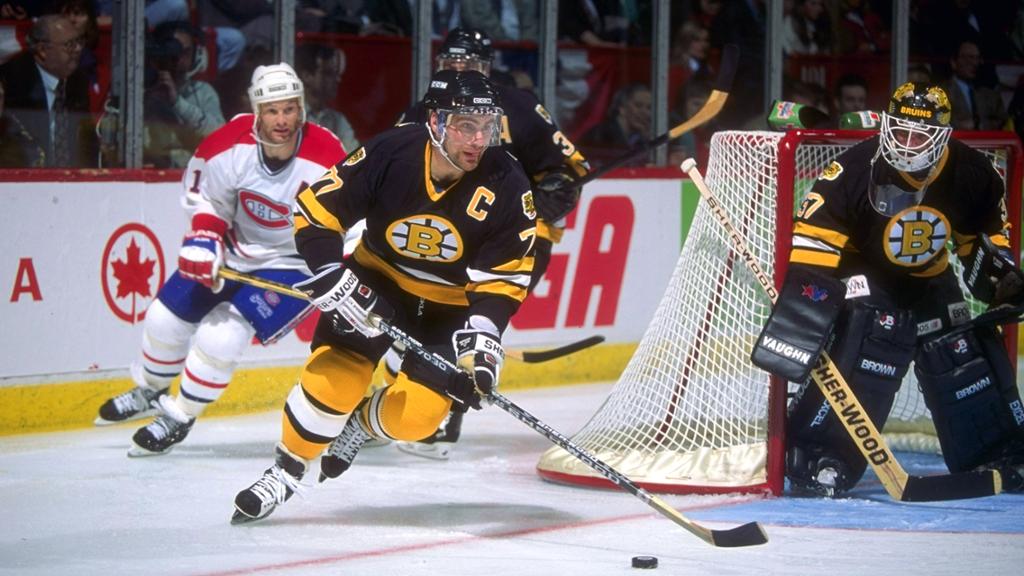
Taking a look back we will start with one of the best bruins ever drafted and one of the best players in history ever drafted, Ray Bourque. Drafted all the way back in 1979 this former eighth overall pick has a resume better than 98% of the rest. Bourque played 1518 games for the bruins out of his 1612 games total, and to his name he has five Norris trophies, one King Clancy trophy and one Calder trophy. He racked up 1506 points for the bruins while also serving as captain. He is a member of the hall of fame and has his number 77 retired at TD Garden. Bourque is an all-time bruin and their top ever draft pick.
Coming in right behind Bourque is a legendary two way forward from the 2003 draft in Patrice Bergeron. Bergeron was drafted in the second round 45th overall, and has turned out to be one of the greatest two way forwards in league history. Bergeron has currently five Selke trophies as leagues best defensive forward. Bergeron currently holds a career total of just over 1000 points in just under 1300 games. He has a Stanley Cup to his name with the bruins and will most certainly be in the hall of fame and have his number in the rafters right alongside Bourque once his career ends.
The third and final top three pick all time will be from the 2006 draft. Brad Marchand was drafted in the third round 71st overall, and has been a top bruin for almost a decade and a top winger in the NHL for over five seasons. One can definitely make a case for Pastrnak being a top all time pick, and he may very well be down the road, but currently Marchand has a longer career and great stats and given that he was a third round pick, all this combined carries him into the top three over Pastrnak. Not to mention his Stanley cup ring with the Bruins as well.
Now moving on from the best picks, we will discuss some of their worst draft picks in their history. First up, in no particular order, is from the 2015 draft. This draft had an immensely talented pool of prospects and given the fact that the bruins had three top half first round picks and did not choose one consistent top six forward of top four defensemen is shocking. Zachary Senyshyn was their first of three picks at number 15 and was nothing more than a former first round bust. He played a total of 14 games with the Bruins and had a total of three points. Senyshyn is currently in the AHL for Carolina’s farm team. Given that the bruins passed on players like Mathew Barzal, picked 16th in 2015, Kyle Connor, picked 17th in 2015, Thomas Chabot, picked 18th in 2015, and Joel Eriksson Ek, and those are just some of the names they passed on, Senyshyn belongs on this list.
Next is Johnathan Aitken, picked eighth overall in 1996 and didn’t stick around for long. Aitken played three games for the Bruins and scored zero points. He played 41 games in his total NHL career with only one assist for his career total points. Given that in this draft were former Stanley cup winners, 15 plus year career players drafted after him and the very short stint in the NHL, Aitken winds up on this list.
Last player on this list for this article is Gord Kluzak. Kluzak was hampered with knee injuries that cut his career very short. Playing only 299 games and being a tougher defenseman who fights he did not have the career normally expected from a first overall selection. This draft had players like Brian Bellows, Scott Stevens, Phil Housley, and Dave Andreychuk. Given the short career, the Hall of Fame names drafted after him. This puts Kluzak on the list because if there were a redo button for this draft knowing the trajectory of all the players, Kluzak wouldn’t have been number one overall.
As of today the Bruins are the best team in the league by far, it’s not even close. But currently their prospect pool is not very deep. In the last six drafts the Bruins have only had three first round picks, choosing Fabian Lysell, and John Beecher who would be considered their top two prospects. The majority of their top picks in the last six drafts since 2017 have been forwards so it would help greatly for the Bruins to look on the blue line for their first pick.
The Bruins currently only have these picks remaining headed for the 2023 draft: 3rd, 4th, 6th, 7th, 7th (LAK). With this, their opportunity to find top tier talent may be a little harder to accomplish. With keeping defence in mind the Bruins could look to use their first pick in the draft in the third round to choose either Paul Fischer, Brady Cleveland, or Quinton Burns. All defences standing over six feet will help with the toughening up of their back end.
For more information on the 2023 NHL Draft class be sure to pick up your copy of the comprehensive DraftPro 2023 NHL Draft Guide.
Top 10 Two-Way Forwards in the 2023 NHL Entry Draft.
By Isaiah Bouchard
The 2023 NHL entry draft is getting ever closer to hockey fans, and the excitement fans have for who their teams are going to draft this year is ever higher as the regular seasons across the globe are coming to an end, and playoff season is just around the corner. And there is a lot for fans to be excited for this year, as the draft is looking like one of the strongest in years.
Connor Bedard is looking increasingly like a franchise-level player, rivaling the likes of Sidney Crosby, Alex Ovechkin, Nathan Mackinnon, Austin Matthews, and Connor McDavid. Adam Fantilli would have been a first-overall pick in arguably the last six drafts, Leo Carlsson is the next big center to come out of Sweden, and he is a must-grab in the top 5. And, of course, there is the Russian sniper: Matvei Michkov, who, despite being signed to the KHL until 2026, is so good that any team picking in the top 5 will be more than willing to wait for the Russian star.
But after the big 4 in this year’s draft, who fills out the remaining slots is always an exciting mystery come draft day. Teams must allocate their scouting resources to best support the organization’s roster on draft day. Who needs the top defensemen? Say, over-the-top sniper or goaltender? That is why we at DraftPro are excited to present an in-depth look at every position and who best thrives in that position. Who is the best sniper? The best power forward? offensive defensemen? Hopefully, after this 8-part series, all these questions will be answered.
Seven DraftPro scouts were asked their top 5-7 players for the following positions: sniper, playmaker, two-way forward, power forward, offensive defenseman, defensive defenseman, two-way defenseman, and goaltender. Their lists were recorded separately, and then once all seven scouts handed in their lists, their results were compared to one another. The final lists you read here determined the average each player placed. This is not a ranking of the best players overall, simply a ranking of who is the best for each given position. Players may be placed on multiple lists, as many players are not one-dimensional, and can not be forced into one category.
Thank you to the following scouts for providing their lists: Jared Brown, Matt Hnatiuk, Tyler Karoway, Andrew LeBlanc, Murray Caldwell, Andy Miller, and Jody Horak.
Two-way forwards are arguably one of the most crucial pieces to any hockey team, on the NHL level or lower. As the name suggests, two-way forwards excel at playing at both ends of the ice. Their ‘jack of all trades’ play style means they aren’t usually king at anything in particular. They can’t shut down offense like the best defensemen, and they can’t rack up points like the best playmaker, but their utility in a multitude of situations makes them a key role when out there on the ice. That is why having an excellent two-way forward is like having an advantage unlike no other. A strong two-way forward often, not always, but often plays center, utilizes incredible stick checking, vision, and is capable of seeing both offensive and defensive plays develop around the ice.
So here are DraftPro’s Top 10 two-way forwards in the 2023 NHL Draft Class:
First, our honorable mentions: Riley Heidt, Carson Rehkopf, Colby Barlow, Koehn Ziemmer, Alex Wiermier, Kalan Lind, Noah Dower-Nilsson, Aydar Suniev, Bradley Nadeau, Nico Myatovic, Danny Nelson, Calum Ritchie, and Gavin Brindley.
Connor Bedard, Regina Pats, WHL, #1 overall (1st Round).
“Bedard is an incredibly smart player on the ice. We all know about his sniper shot and unreal offensive production, but his defensive game is slightly underrated. His anticipation of where the puck is going coupled with his sheer strength and stick work make him one of the greatest prospects we’ve ever seen.” – Tyler Karoway.
Yes, you can be more than one thing. And you can be more than two, three, four, or five things concerning Connor Bedard. The tools Bedard has in his sniper and playmaking game, such as his excellent hockey IQ and vision, can be applied well to his defensive game as well. This makes him efficient at both ends of the ice. But this isn’t a ‘the best defense is an overwhelming offense’ type of player. Bedard is a genuine defensive threat playing center, and his ability to pickpocket will give him even more ways to snuff out opposing offense in the future.
Adam Fantilli, University of Michigan, NCAA, #2 overall (1st Round).
“Fantilli is one of those forwards that can do it all. He has great velocity on his shot, he will bury you into the boards, and with his improving speed, he is always going to find a way to beat his opposition.” – Tyler Karoway.
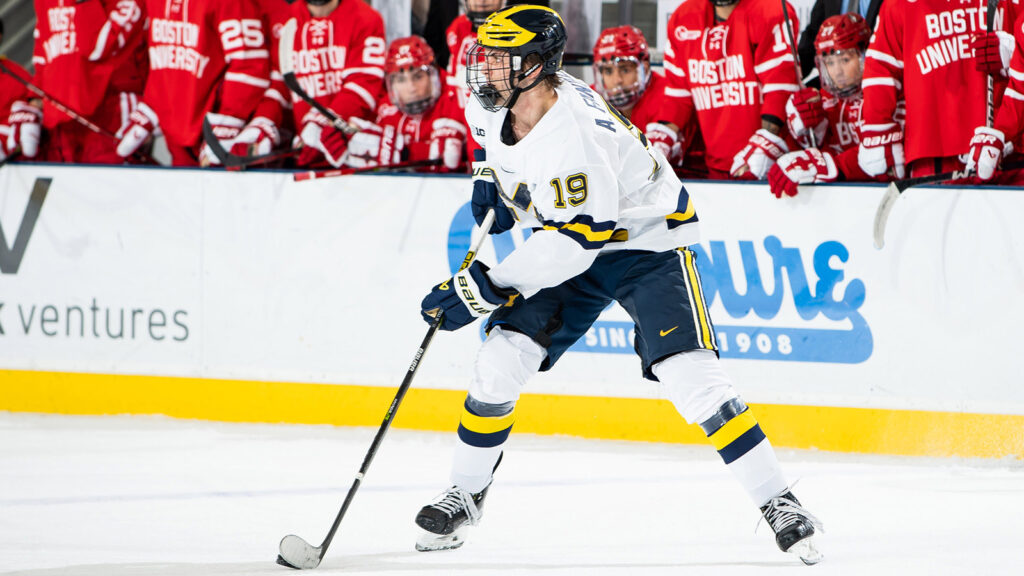
Fantilli is similar to Bedard in that his tools to score goals and make plays can also be applied to his defensive game. He’s a larger-than-average player, standing at 6’2″, making him already built like a defenseman. He’s also excellent at utilizing every ounce of his height and weight advantage. Mainly in his great board play. Coupled with his incredible speed for such a larger player and you got one of the best recovery forwards in the draft. Being able to knock guys off pucks with relative ease and help shift the momentum back for his team makes him an underrated defensive player.
“Dvorský is a fantastic play reader and has excellent anticipation on the defensive side of the puck. He doesn’t cheat for offense and regularly is putting himself in good defensive positions to assist his defensemen.” – Jared Brown.
As Jared mentioned, Dvorský is a player who utilizes his excellent patience and very level-headed style of play. He’s not known to make many big mistakes, which is a great quality for a two-way guy. As Brown said, he consistently positions himself to assist his defensemen. This makes him more effective in the common plays players will find themselves in. While Fantilli and Bedard are more capable of making the big saves and highlight spots, Dvorský will often remain the unsung hero as he grinds his way through every shift, never really missing a beat. Sometimes the greatest defensive players are not the flashiest.
“Has high hockey IQ, hustles all over the ice, and plays just as hard in the defensive zone as he does in the offensive zone.” – Jody Horak.
Benson is capable of taking complete control of a game when he is firing on all cylinders. His overwhelming speed and tenacity make him hard to stop when he gets going. This makes him an effective player in the defensive zone, as he is not one to let the opposing players cycle the puck for long. He’s not a wild bull, however, as he has built up an excellent reputation for his IQ when out on the ice. Making high effort plays to snuff out opposing offense but has the wherewithal not to leave his goalies and defenders hanging while doing so.
Oliver Moore, University of Minnesota, NCAA, #8-#12 overall (1st Round).
“Moore is one of the most demanding working prospects in the 2023 class. Demanding in the sense that he’s always busting his butt to get the puck back when his team doesn’t have the puck. He plays that complete 200ft game that every coach wants their center to play and is a player that can play in all situations for his club.” – Jared Brown.
Moore is sort of the quintessential two-way forward and arguably the first pure two-guy on this list. He has high utility, high work effort and can apply these skills on both ends. This is obviously an excellent quality to have in a prospect, and many players who have this ability to perform effective and consistent two-way efforts are usually guaranteed a future NHL spot in one way or another. Because of this, Moore is seen as a sort of safe pick early on and has been growing in interest as the seasons are ending. That, coupled with his underrated offensive prowess, means Moore could be walking up to the stage a little earlier than many scouts anticipated at the beginning of the year.
Otto Stenberg, Frölunda HC, SHL, #18-22 overall (1st Round).
“Stenberg is a player with great offensive upside, and he uses his skating to cover and, at times, gets really low to support his defense on the breakout. He is a 200-foot player who puts in a consistent effort.” – Andy Miller.
Stenberg is a player that seems to be up in the air as to where he will land in the draft order come July. He’s got many upsides but no real hook that makes him stand out compared to his fellow Swedes, speedy forwards, or two-way forwards. But despite this, Stenberg just doesn’t seem to have many downsides. Like Moore, he is a safe pick, and like Benson, he has an excellent combination of skating and high-effort play styles. The only difference is that Stenberg seems to hone his abilities in the two-way department more so than Benson or Moore. His skating should be praised even more in a sense, as he has some of the best agility in the draft class. This makes him excellent at utilizing his 200-foot game that Andy mentioned.
“Plays with poise, intensity, grit, focus & excellent compete in all three zones.” – Murray Caldwell.
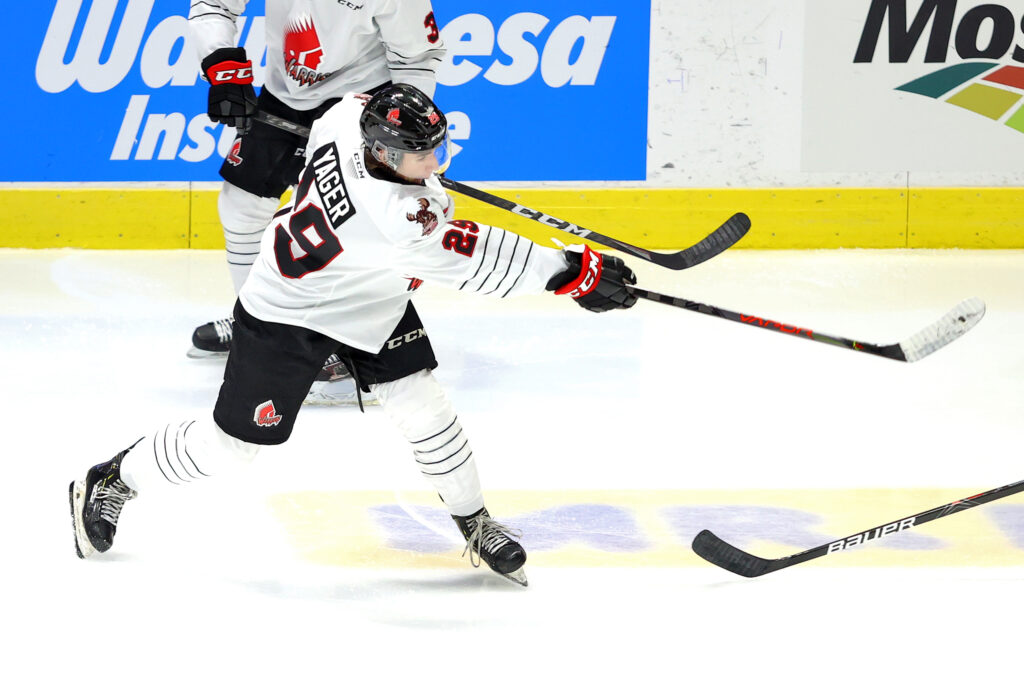
Now we’re getting into the players that our scouts just had to mention. Yager’s name came up a few times when discussing the best two-way forwards in the draft. And likely, his name was mentioned due to Murray’s words: “Poise, intensity, grit, and focus.” Yager is also a smooth and controlling player when on the ice. He has a lot of control and doesn’t make many mistakes. This confidence at all ends and his incredible shot made Yager a favorite to be a potential Top 5 pick. While those aspirations have fallen slightly, Yager is still undoubtedly an excellent prospect, and his two-way game has much to do with that.
Leo Carlsson, Örebro HK, SHL, #3-5 overall (1st Round).
“A young player who has become well known for his two-way, power forward plays in Sweden. His smooth skating allows him to move quickly and cleanly in all areas of the ice. He is able to defend his zone and is a threat to put up points or make a great play in the offensive zone.” – Matt Hnatiuk.
It was a close call between Leo Carlsson and Brayden Yager for the #3 spot. But in the end, Carlsson has just proven to be a bit more dedicated to his defensive game than Yager. Regarding #3 spots, Carlsson practically guaranteed a Top 5 position in July. Not only Top 5, but Carlsson is rumored even to go higher than Michkov. And one can’t help but think that Carlsson’s excellent two-way play is the cause for that, as it makes him excel in more situations. Carlsson is big and can play at both ends. What more do you want in a player?
“Supportive at both ends of the ice, moves the puck effectively from the defensive zone to the offensive zone.” – Jody Horak.
If you’re looking for the purest of two-way forwards, look no further than Nate Danielson. This guy drops anchor as a centerman like no other player in this draft. He falls into a defensive position so naturally and utilizes all the skills of a defenseman to protect the net and drive offense back into his team’s possession. Danielson is a unique player in this draft as he is heavily team-oriented. All players are, to some extent, but Danielson’s entire playstyle depends on the players around him working together. This doesn’t necessarily make Danielson a star compared to some other players, but his ability to play the level-headed style of game he does, and rack up the points that he has, makes him an undeniably crucial player to have on your team.
Will Smith, Boston College, NCAA, #4-6 overall (1st Round).
“Smith gets the most out of whoever he is playing with. Reliable defensive game and a great motor.” – Andrew LeBlanc.
Will Smith and Nate Danielson were neck and neck for this position. But while they both play defensive games and Danielson’s dedication to the defensive end is admirable, Will Smith is just too good on the offensive end. And they are called two-way forwards for a reason. If you have already read our TOP 10 Playmakers list, then you know just how good Will Smith is on the offensive end. No other player in this draft is as obviously dedicated to both ends of the ice as Will Smith, other than maybe Danielson, but again, his offensive prowess places him a little higher than Danielson. Find him on our TOP 10 Playmakers list to see just how good Will Smith is on the offensive end. But he is certainly #1 at something, and that is being the best two-way forward in the 2023 NHL draft class.
For more information on the 2023 NHL Draft class be sure to pick up your copy of the comprehensive DraftPro 2023 NHL Draft Guide.
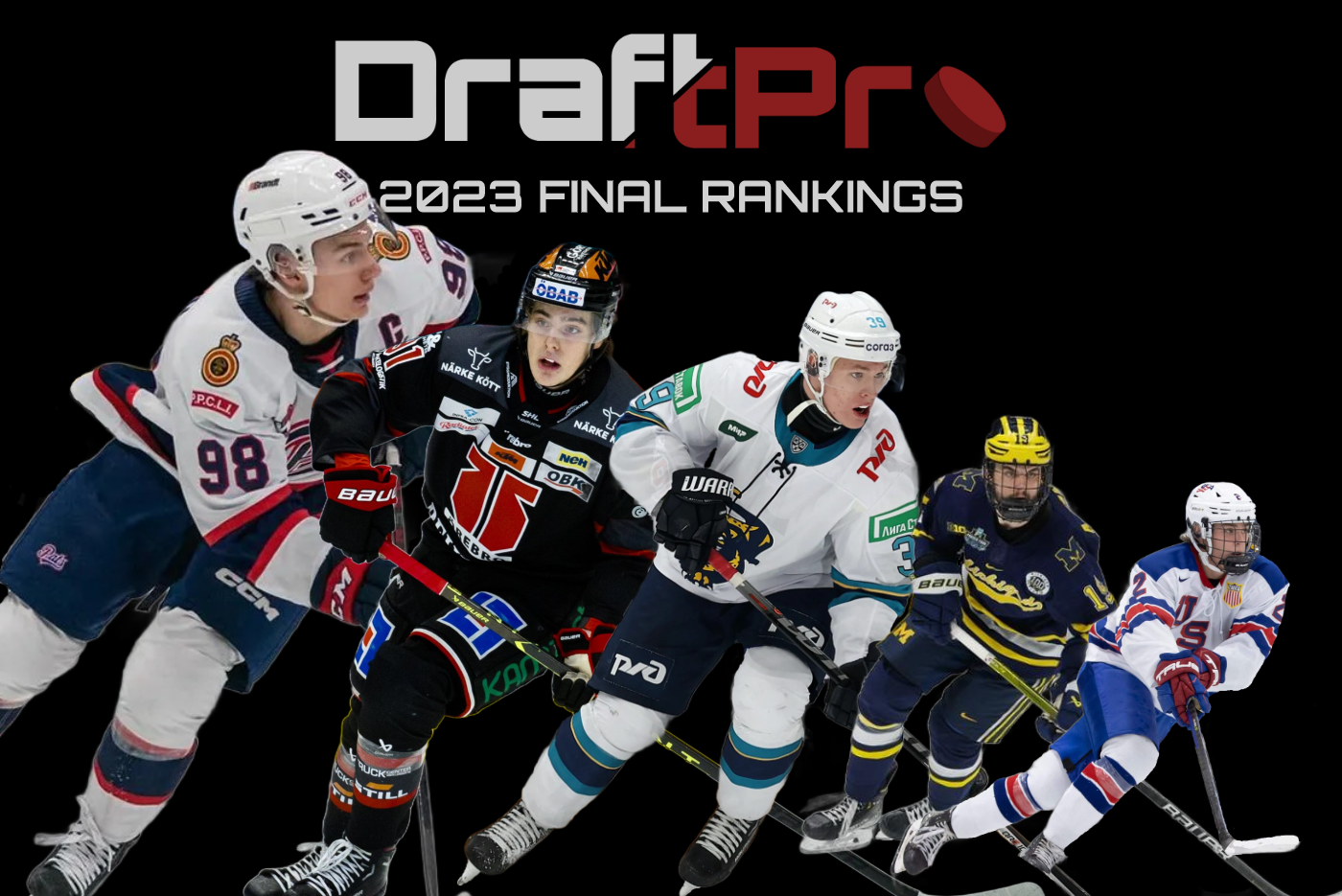
Seems like yesterday. It was back in 2019 we first started tracking one Connor Bedard as a potential top prospect for the 2023 NHL Draft. To see his development and what he is on the cusp of becoming is truly amazing. The projected top prospect is considered a generational talent and one NHL teams have long looked as a future building block. Chicago won the right to select the Regina Pat forward when the ping-pong balls rolled in their favor at the lottery. He projects to set in right away and become a difference maker as early as this fall.
But the 2023 NHL Draft is not just Bedard and him alone making waves. There is a good amount of other top of the lineup future NHL players waiting to hear their names called by NHL teams and make their dream of pulling on an NHL jersey come true later this month in Nashville.
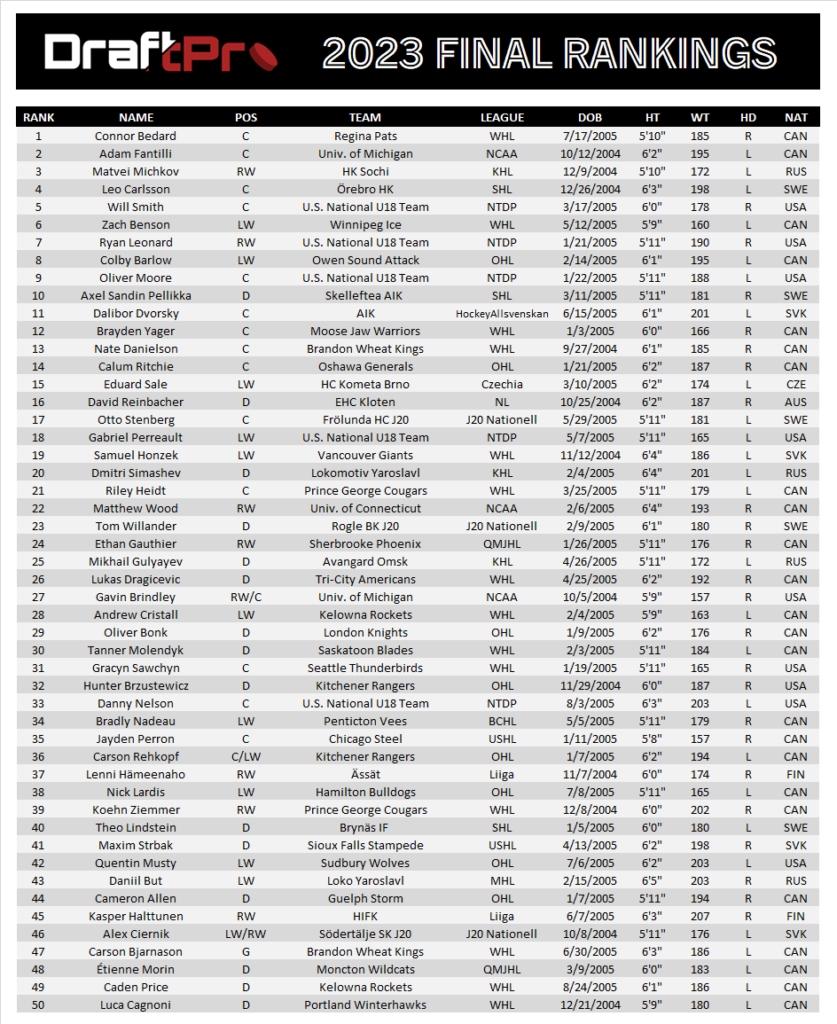
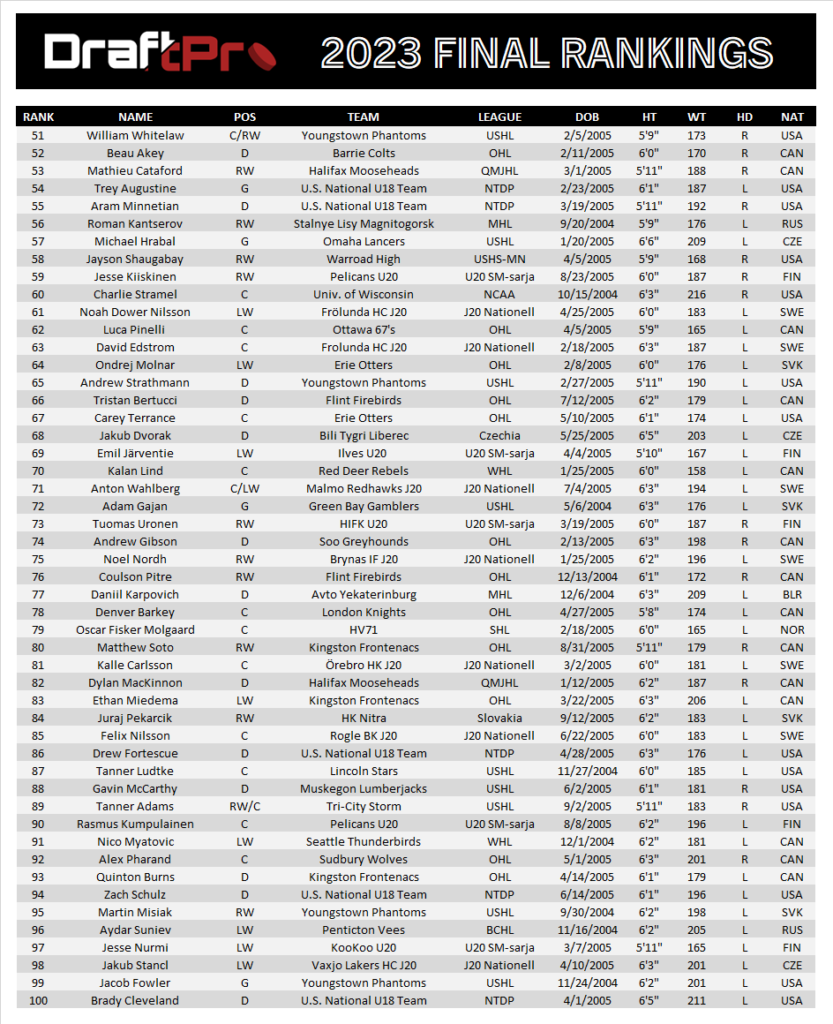
So after hundreds of scouting reports and months of evaluating each prospects development path, we as a group have come up with our final rankings on who we believe will be the best prospects selected at the position we have them slotted.
So, without further ado, here is Draft Prospect Hockey’s Final Top 100 Ranking assessment as compiled by our evaluators for the 2023 season.
For more in-depth information, a final 240 ranking, prospect profiles, and a look at future drafts be sure to pick up your comprehensive DraftPro 2023 NHL Draft Guide.
The 2023 NHL entry draft is getting ever closer to hockey fans, and the excitement fans have for who their teams are going to draft this year is ever higher as the regular seasons across the globe are coming to an end, and playoff season is just around the corner. And there is a lot for fans to be excited for this year, as the draft is looking like one of the strongest in years.
Connor Bedard is looking increasingly like a franchise-level player, rivaling the likes of Sidney Crosby, Alex Ovechkin, Nathan Mackinnon, Austin Matthews, and Connor McDavid. Adam Fantilli would have been a first-overall pick in arguably the last six drafts, Leo Carlsson is the next big center to come out of Sweden, and he is a must-grab in the top 5. And, of course, there is the Russian sniper: Matvei Michkov, who, despite being signed to the KHL until 2026, is so good that any team picking in the top 5 will be more than willing to wait for the Russian star.
But after the big 4 in this year’s draft, who fills out the remaining slots is always an exciting mystery come draft day. Teams must allocate their scouting resources to best support the organization’s roster on draft day. Who needs the top defensemen? Say, over-the-top sniper or goaltender? That is why we at DraftPro are excited to present an in-depth look at every position and who best thrives in that position. Who is the best sniper? The best power forward? offensive defensemen? Hopefully, after this 8-part series, all these questions will be answered.
Seven DraftPro scouts were asked their top 5-7 players for the following positions: sniper, playmaker, two-way forward, power forward, offensive defenseman, defensive defenseman, two-way defenseman, and goaltender. Their lists were recorded separately, and then once all seven scouts handed in their lists, their results were compared to one another. The final lists you read here determined the average each player placed. This is not a ranking of the best players overall, simply a ranking of who is the best for each given position. Players may be placed on multiple lists, as many players are not one-dimensional, and can not be forced into one category.
Thank you to the following scouts for providing their lists: Jared Brown, Matt Hnatiuk, Tyler Karoway, Andrew LeBlanc, Murray Caldwell, Andy Miller, and Jody Horak.
The power forward is a term and title often hard to recognize for casual fans. But here are qualities that most can agree qualifies a player as a power forward: Physicality, Intensity, Strength, and Speed, or ‘P.I.S.S’ for short. In all seriousness, the Power Forward is a fast-growing player archetype in hockey. In the earlier years, what used to be more of a side position now has names such as Gabriel Landeskog, Blake Wheeler, Mark Stone, Brady Tkachuck, and much more. Their rise in popularity is not surprising when you consider their unique abilities to crash through the defense and offer the qualities of a defenseman in a forward position. As the defensemen around the league got better, the need for bigger and stronger forwards grew.
So who are the best Power Forwards in the draft class of 2023? Here are DraftPro’s Top 10 Power Forwards, as voted on by our scouts.
First, our honorable mentions: Eduard Sale, Koehn Ziemmer, Matt Wood, Charlie Stramel, Danny Nelson, and Kalan Lind.
Ryan Leonard, Boston College, NCAA, #7-11 overall (1st Round).
“A Hard-nosed, strong hockey player who goes to the net hard and is good in tight battles in the offensive zone.” – Jody Horak.
While Leonard is only 5’11”, that doesn’t stop him from playing like a power forward in his mind. Leonard is more than willing to get into the thick of it and is a valuable player in the offensive zone. With his excellent combination of hard-nosed playing and just maybe the best shot in the USDP, it’s not a surprise that Leonard is one of the top players in the USDP this year. Because of his height, he will likely not rank highly on many others’ top power forward lists, but his physicality is undeniably effective for him, so he deserves the nod here.
“Overwhelming intelligence, does it all & does it right, controls the ice, has hockey sense, vision, anticipation, extremely quick hands, one of top 3 power forwards in the CHL.” – Murray Caldwell.
Anyone who knows even a little about Nate Danielson knows he is one of the best-defensively-minded forwards in this draft class. Nate Danielson will be fun to watch develop because of his high ceiling. He can skate, has excellent senses, and can score goals, as he broke just over 30 goals this season in Brandon. Danielson stands at 6’1″ and weighs just a bit more than Leonard. If Danielson adds more weight to him, he will develop into a fine power forward. Of course, he is also one of, if not the best two-way guy in this draft (see our TOP 10 two-way forwards to find out), so it will be interesting to see which role Danielson will embrace as he develops.
“A large Finn who plays a grinding, power-forward role. He uses his speed and physical play to hunt pucks down and then uses his skill with the puck to get it to the net or to find his linemates for high-quality chances.” – Matt Hnatiuk.
Now we’re getting into the big boys. Haltunnen is 6’3″ and over 200lbs, making him undoubtedly a power-forward type in shape. He also plays a clear-cut power-forward style of play. He is crushing the U20 leagues in Europe and even has a few games in Liiga. Only time will tell just how effectively he can apply his weight in the bigger leagues, but for now, there is a lot of buzz and excitement for Halttunen, and justifiably so.
“Dvorský is a quick player for a big young man. He works hard and moves his feet well. He combines his size and speed on the forecheck effectively. He has a high skill set too that will certainly have him selected in the mid to last third of round one.” – Andy Miller.
Dvorský is a player who seems to come up a lot on these lists. And that is no surprise as he seems to do it all. He can make big offensive plays, play very physically, and have a solid defensive mindset. What catches a lot of Scout’s eyes is how well he performs in HockeyAllsvenskan. This is a league for adults, and Dvorský competes just fine at this level. While Dvorský is mentioned a lot, I have certainly heard his name plenty as I wrote this series, his ‘jack of all trades’ persona can only carry him so far when we live in such an ‘X-factor’ era of the NHL. But don’t sleep on Dalibor. His high skill ceiling is an excellent quality to have for a power forward, especially when the height advantage is never a given when moving to the big leagues.
“Musty is a pain for anyone to deal with. He can get under the opponent’s skin and is a pain in the side for any defender.” – Andrew LeBlanc.
What’s interesting about Quentin Musty as a Power Forward is his preference to set up plays compared to shooting at the net. Power Forwards are much more synonymous with goal-scoring, so seeing such a change with Musty is refreshing. That’s not to say he can’t score, as he is more than capable of pushing past defensemen and setting up his own goals as well. Musty is a great player to have in deep by the net. He can anchor himself down well and has top-notch stick handling. Definitely a dangerous player. And plays well physically.
“Barlow plays a style that hockey fans love, coaches love, and his teammates probably love as well! He’s physically abrasive and brings a heavy forechecking game that forces many turnovers. He plays inside the guts of the ice and is always willing to get his hands dirty.” – Jared Brown.
If you like the Alex Ovechkin style of player, that is, a strong sniper who is more than capable of forcing his will around, then Colby Barlow is your guy. Like Ryan Leonard, Barlow has a strong sniping game and has fast feet, giving him plenty of options to push pass defenders or score goals. It was a close call between Barlow and Musty for the #5 spot, but overall Barlow’s style of play complements the Power Forward in him slightly better.
Samuel Honzek, Vancouver Giants, WHL, #21-31 overall (1st Round).
“Honzek possesses the build to become a quality power forward at the pro level. He’s tough to knock off the puck, has great puck skills, and has the offensive instincts to drive the net hard if he’s got a step on the defender.” – Jared Brown.
Standing 6’4″, Samuel Honzek has much potential as a power forward in the NHL level. He needs to beef out a bit more, but once he does, he is going to be fun to see develop. As Jared said, he’s hard to knock off the puck, don’t be surprised to see Honzek dish out some checks, as he barely falters his positioning. Besides being slightly slower than the other power forwards you will see on this list, Honzek has great senses and shooting. He’s a point-per-game player with the Giants, who he only joined in 2022. Honzek, like Musty, plays a more well-balanced game between passing and shooting. This makes him harder to predict as his size quickly becomes an issue for defenders trying to piece together how to stop such a big player.
“A player with a rare blend of size, mobility, speed, and skill. He has all of the makings of an excellent power forward who can put up very good numbers offensively. His ability to get into hard areas and be very difficult to move out of those areas makes him a formidable opponent.” – Matt Hnatiuk.
Calum Ritchie is another player who fits the mold well for a Power Forward but needs some more bulking up. But aside from that, he has great playmaking abilities, utilizing excellent shooting and positioning to give him chances. He’s obviously hard to knock off the puck and has some of the best skating so far on this list. Ritchie is another player who will be hard to predict where he will land in the draft come July. But with his combination of speed, size, skill, and shooting, he will be a safe pick no matter where he lands in the draft.
Leo Carlsson, Örebro HK, SHL, #3-4 overall (1st Round).
“Carlsson is a beast on the ice and can impose his will at the U20 level. He not only does that, but he has a high skill set and great vision on the ice that helps him to be a responsible player too.” – Andy Miller.
Many seem to forget that Leo Carlsson is 6’3″ and nearing 200 lbs. He’s, of course, an excellent playmaker and two-way guy and has great senses to assist his game. But his ability to crash through the neutral zone and put defensemen on their heels is already damn-near elite. This awesome power forward in him makes him possibly the #3 guy come draft day. Michkov fans may be triggered to hear that, but Carlsson’s weight and size bring so much more potential to his game and future in the NHL. Carlsson’s utility has led to him being named many times on these lists, but he is always the bride’s maid, never the bride for that #1 spot. The same cannot be said for…
Adam Fantilli, University of Michigan, NCAA, #2 overall (1st Round).
“A power forward if there ever was one. He has the size, mobility, and the ability to put up points. His ability to quickly adjust to a higher level of play is something to take note of. He has been able to use his body and skill to accomplish a lot this season.” – Matt Hnatiuk.
The points leader in the NCAA with 30 goals, 35 assists, and 65 points, Matt Hnatiuk, put it perfectly: Adam Fantilli is a power forward if we have ever seen one. Everything about his game screams the title of P.I.S.S! Or perhaps it should be P.I.S.S.S as Adam Fantilli has plenty of strength, speed, and skill. Arguably the best skater on this list, Fantilli’s skating was even noticeable at the World Juniors this year, which was a much more elite crowd to stand out in. With the NCAA’s growing reputation as a difficult and highly competitive league to play in, Fantilli’s dominance should be greatly admired. As easy as it is to praise a guy like Connor Bedard, Adam Fantilli might be one of the greatest consolation prizes since Patrick Laine. And as Fantilli’s reputation grows, it’s more likely that he will join that list of greatest #2’s in NHL draft history. And Adam Fantilli from the University of Michigan, is the best power forward in the 2023 NHL draft class.
For more information on the 2023 NHL Draft class be sure to pick up your copy of the comprehensive DraftPro 2023 NHL Draft Guide.
The Arizona Coyotes have been drafting in Arizona since 1996 and have had some decent names come up along the way. With one exception to this list, as he was drafted by the jets but only played one season for them before moving to Arizona and then only playing for the Coyotes franchise. Let’s see just how well they’ve drafted throughout their history.
To start off we will go with the most obvious name that comes up when you think of the Arizona coyotes, Shane Doan. Shane was drafted seventh overall in the 1995 draft for what would be the Coyotes franchise. Playing over 1500 games and scoring a little over 400 goals and amassing 972 points in his 21 seasons, which 20 were with the Coyotes jersey on, Doan was the face of the franchise. Doan captained the Coyotes for 13 seasons and retired as the NHL’s longest tenured captain.
Coming up second in the Coyotes best picks would be that of Oliver Ekman-Larsson. The Swedish defensemen was selected sixth overall in the 2009 draft and was considered at top defenseman during parts of his time in the desert. With a handful of 40+ point seasons and one 55 point season Ekman-Larsson was a great pick up for the Coyotes especially when their defence was in need of a consistent too pairing player.
Third on this list would be what would be considered one of their two best picks of the last decade. Clayton Keller, with three 60+ point seasons and this year being his first 30+ goal season and his first season that will finish with over a point per game, Keller has turned into the star the Coyotes thought he would be when they drafted him seventh in 2016.
Now for some less than great picks that the Coyotes have made over the years. We start off with 2010 13th overall pick Brandon Gormley. Gormley played a total of 58 games in his NHL career and only 32 with the Coyotes and amassed 4 points in that time. Gormley had the ability to be a second pair defenseman but never even touched that potential. At 13th you would expect a little more result out of the pick.
Next up we will have to go all the way back to their inaugural draft to see the Coyotes select Dan Fichte 11th overall in the 1996 draft. Focht played a total of 82 NHL games between 2001-2004 before retiring fully in 2006. With the Coyotes he played only 18 games and scored zero points in that time. Considering some of the players drafted after Focht, Daniel Briere, Dainius Zubrus, Marco Sturm and Matt Cullen, this pick is quite disappointing.
Third and final pick of this article would be 2007 third overall pick Kyle Turris. Turris had a ton of hype behind him after being selected third overall in 2007 but after a few rocky years in Arizona (then phoenix), he was traded away to the Ottawa Senators. Trading away your third overall player only four years after drafting him and having one of those seasons full time in the AHL doesn’t bode well for your future. Turris only played 137 games for the Coyotes and scored 46 points. Coupled with the lacklustre return on his trade to Ottawa, David Rundblad and Anthony Stolarz, this pick turned out to be more than it was worth for the Coyotes franchise.
Now flash forward to 2023, the Coyotes sit in the bottom eight teams and are eliminated from the playoffs this year. For the Coyotes in their last 10 years of drafting in the first round, (not including 2019) they have selected 10 forwards and four defence, in which only two defence remain with the club, one being a 2022 draft pick in Maveric Lamoureux. With this information it is clear that the Coyotes lack defensive prospects and defence in general on their team so the Coyotes would be hard pressed not to go with defender Axel Sandin Pellikka, even if the Coyotes select higher than Pellikka’s projected 10th overall choice, it would be the best choice for their future. If they choose to go with someone else between six to eight they would be best going for a winger to go along with the trio of young prospects Guenther, Geekie, and Cooley, the latter two play centre, so their best bets could be Eduard Sale, Zach Benson, or Andrew Cristall.
The 2023 NHL entry draft is getting ever closer to hockey fans, and the excitement fans have for who their teams are going to draft this year is ever higher as the regular seasons across the globe are coming to an end, and playoff season is just around the corner. And there is a lot for fans to be excited for this year, as the draft is looking like one of the strongest in years.
Connor Bedard is looking increasingly like a franchise-level player, rivaling the likes of Sidney Crosby, Alex Ovechkin, Nathan Mackinnon, Austin Matthews, and Connor McDavid. Adam Fantilli would have been a first-overall pick in arguably the last six drafts, Leo Carlsson is the next big center to come out of Sweden, and he is a must-grab in the top 5. And, of course, there is the Russian sniper: Matvei Michkov, who, despite being signed to the KHL until 2026, is so good that any team picking in the top 5 will be more than willing to wait for the Russian star.
But after the big 4 in this year’s draft, who fills out the remaining slots is always an exciting mystery come draft day. Teams must allocate their scouting resources to best support the organization’s roster on draft day. Who needs the top defensemen? Say, over-the-top sniper or goaltender? That is why we at DraftPro are excited to present an in-depth look at every position and who best thrives in that position. Who is the best sniper? The best power forward? offensive defensemen? Hopefully, after this 8-part series, all these questions will be answered.
Seven DraftPro scouts were asked their top 5-7 players for the following positions: sniper, playmaker, two-way forward, power forward, offensive defenseman, defensive defenseman, two-way defenseman, and goaltender. Their lists were recorded separately, and then once all seven scouts handed in their lists, their results were compared to one another. The final lists you read here determined the average each player placed. This is not a ranking of the best players overall, simply a ranking of who is the best for each given position. Players may be placed on multiple lists, as many players are not one-dimensional, and can not be forced into one category.
Thank you to the following scouts for providing their lists: Jared Brown, Matt Hnatiuk, Tyler Karoway, Andrew LeBlanc, Murray Caldwell, Andy Miller, and Jody Horak.
Playmakers are the team’s main offensive force. Playmakers tend to hog all of the MVP awards, all the Art Ross, and the Willie Marshal awards. Playmakers tend to hog the glory. But we love them for it. Playmakers also tend to come in many forms. A sniper tends to fit into an all-encompassing mold of a hockey player, but playmakers are much more flexible in this way. They can be a Joe Thornton, making perfect passes from all areas of the ice. A Sidney Crosby, making space for themselves and their teammates with subtle puck-dangling magic. Or a Matthew Barzal, utilizing excellent rink awareness and hockey sense to see potential plays that other players can’t.
With all that being said, here are DraftPro’s Top 10 Playmakers in the 2023 NHL draft class:
First, our honorable mentions: Leo Carlsson, Nate Danielson, Adam Fantilli, Brett Hyland, and Luca Pinelli.
“One of the best playmakers in the game due to his quick feet. He either shovels a short pass or uses his feet when in tight to kick a pass to a linemate or circles around, drawing the play to himself before distribution of the puck. Extremely dangerous because he elusive.” – Murray Caldwell.
In his first year as a Seattle Thunderbird, Sawchyn is sitting at a point-per-game level and has racked up forty assists. Currently, Sawchyn is seated in a 2nd round position, but with his playmaking potential, we could see him jump up considerably if a team is looking to bolster its pool of offensive prospects.
“He is an exceptional setup man, leading the OHL in assists for first-year draft-eligible players. Musty has good vision, and he has a quick release, so defenders must respect that he could pass or shoot.” – Andy Miller.
Musty has made a considerable impact this year. He’s sitting well over a point-per-game and has improved significantly from his rookie season in Sudbury. He’s also a tall player who can throw his weight around, which is a welcomed feature for any position he plays. Suspect Musty to be grabbed in the second, but his size could let him jump a few slots, maybe even all the way into the first.
Riley Heidt, Prince George Cougars, WHL, #18-28 overall (1st Round).
“A similar version to Benson. (Referring to Benson’s excellent speed and hockey sense) He uses higher speeds to get into areas where he draws opponents in before moving the puck quickly and accurately. Has high-end distribution ability but needs to remain consistent.” – Matt Hnatiuk.
Riley Heidt is absolutely tearing up the WHL’s West division. In 64 games, Riley Heidt has racked up 94 points. 70 of those points were assists. To tell you how good that is, he is tied with Connor Bedard in assists. Riley Heidt has no doubt developed an effective style of play. He is a boom or bust of this year’s draft. With a big boom. If Heidt finds a way to utilize his talents effectively and consistently, he could easily be the Mathew Barzal of this year’s draft, a player that many scouts are comparing him to.
Eduard Šalé, HC Kometa Brno, Czechia, #9-15 overall (1st Round).
“Great patience with the puck and excels using his vision when making passes.” – Jody Horak.
Šalé continues to impress as he battles to remain in a top 10 position come draft day. Despite playing with men over in Czechia, he gets noticed. Despite playing on a stacked team Czechia at the World Juniors, Šalé gets noticed. Despite competing with the likes of Dalibor Dvorský, Zach Benson, and Andrew Cristall, Šalé remains a strong contender for a top-10 draft position. Šalé has the skill set, the height, and the momentum to become an excellent player one day, and only time will tell how successful this young Czech will be.
Gabriel Perreault, USNTDP, USHL, #14-20 overall (1st Round).
“A skilled player who can put up points as both a scorer or a playmaker, but he tends to be the distributor more often than not. His ability to read the play as it develops and move the puck at just the right time is something that very few can do. He has excellent timing and awareness/IQ and the ability to make excellent passes on the regular.” – Matt Hnatiuk.
Our first player to be named three times on our scouts lists, Gabe Perreault, is a point-producing machine in the USHL. He’s going to be an excellent consolation prize for teams out in round 1 of this year’s playoffs or perhaps teams who just missed the playoffs. He’s not a bad piece on any team, and his skills as an excellent play-reader will always come in handy.
Oliver Moore, USNTDP, USHL, #8-12 overall (1st Round).
“Handles hot passes, is on & off the stick in a heartbeat, has hard accurate half slap shots, excellent vision, explosive speed, and can reach top speed in two hard strides.” – Murray Caldwell.
Another player representing the USHL, Moore, barely sneaks into the top five. Moore is a dynamic player who was mentioned many times by our scouts in more categories than just playmaker. He was an honorable mention for our top Snipers list and may also appear later in this series. But for now, Oliver Moore is recognized as one of the top playmakers in this year’s draft. He’s fast, plays hard, and has excellent passing and shooting potential.
“A speedy forward who has excellent hands and vision. Uses his speed to get into position to move the puck to high-danger areas. Threads his passes consistently through tight seams and is incredibly accurate when moving the puck. High-end hockey IQ and passing ability.” – Matt Hnatiuk.
This is Zach Benson’s second mention in this series. See our Top 10 Snipers article to see where he placed there. But clearly, he is building up tons of value in this draft because of his highly dynamic skill set. He can score, make excellent passes, and has incredible hockey sense. Benson is the top runner for the #5 spot for this year’s draft, and with his plethora of upsides, it’s getting hard to argue otherwise. Benson was nominated three times by our scouts, where he placed 1st, 2nd, and 3rd.
Will Smith, USNTDP, USHL, #5-7 overall (1st Round).
“He is an incredibly fast skater who has wonderful hands. Smith uses these skill sets with his vision and sets up his teammates with beautiful passes. He will likely finish with a top 5 single season USNTDP U18 record for points and assists this season.” – Andy Miller.
Since we are talking about the #5 spot, it seems so natural to talk about Zach Benson’s main competitor, not named Šalé or Cristall. Will Smith is right at the top in the USHL’s player standings, and he is building up a reputation as a pure playmaker that needs to be feared. Will Smith was nominated five times by our scouts. Being ranked as the 2nd best playmaker in this year’s draft three times. Very impressive, but not quite as good as our #2 playmaker…
Andrew Cristall, Kelowna Rockets, WHL, #11-17 overall (1st Round).
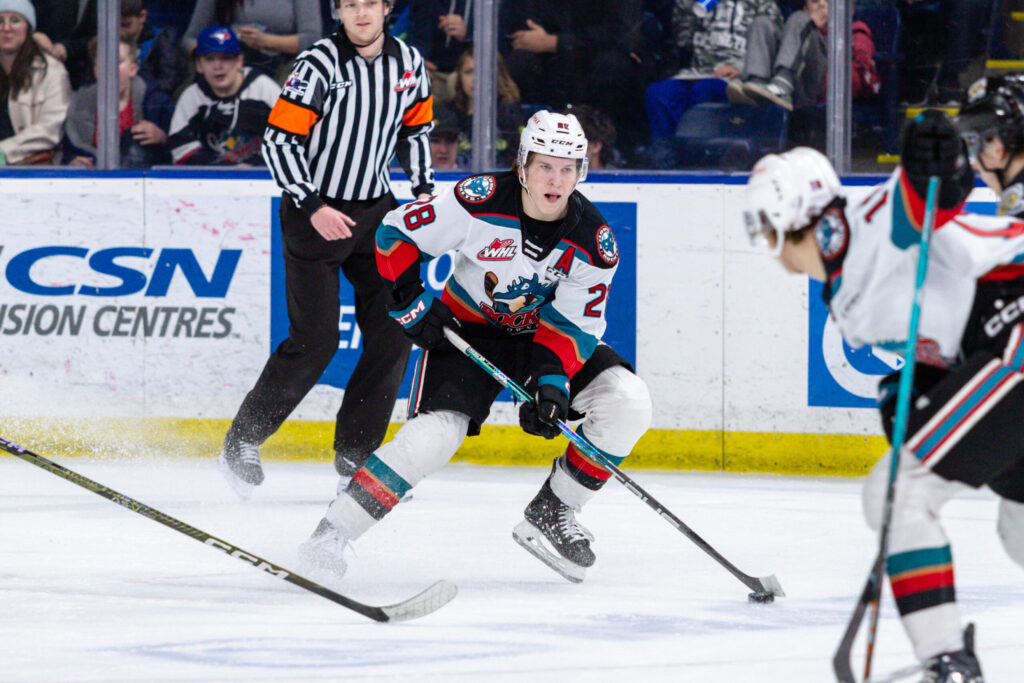
“Enter Rocket Man. Great IQ, whistle beater, incredibly intelligent, the boy can flat-out fly. He creates turnovers, quarterbacks PP, wicked wrist shots, shoots from any place on the ice, down low right along the line, has the patience of a cat, may have the strongest backhand shot in the WHL, capitalizes on his opportunities, the toolbox may only have a small space in one drawer.” – Murray Caldwell.
Though he isn’t ranked as high on the overall rankings as the previous players are, there is no doubt that when it comes to pure playmaking ability, Andrew Cristall may be the top guy. He’s got excellent stick handling. He utilizes good speed and passing, much like the others on this list. But what gives Cristall the edge is his superior hockey senses. He can read plays and make space for plays unlike anyone else. Cristall just got over Will Smith on this list because he was mentioned six times over Smith’s five. He was ranked #1 by one of our scouts and remained in the top 3 positions by the others. He will undoubtedly be a hot commodity for teams looking to add pure playmaking support to their prospect pool.
Connor Bedard, Regina Pats, WHL, #1 overall (1st Round).
“With his pure goal-scoring ability also comes with the skill to deceive his opponents and gravitate players to him, which opens up passing lanes for him to set up his teammates. He possesses that elite touch on the puck and impressive intelligence to execute skilled passes.” – Jared Brown.
Yeah, I mean… obviously? Right? This is also Bedard’s second time being mentioned in this series. See our Top 10 Snipers list to see where he ranks there, (spoiler, he ranks high.) But Bedard is a franchise player. He’s allowed to dominate these lists. If you don’t know what makes Bedard great, here’s a quick list: Amazing wrister, excellent skating, excellent puck movement, excellent stick handling, and excellent hockey senses. There’s more than that, I’m sure, but here are a few of his credentials: As of right now, he’s sitting at 139 points in the WHL. He got 23 points in 7…SEVEN…games at the World Juniors, He’s been on so many all-star teams, and he’s won a gold medal and was the points leader at the World Juniors. AND Connor Bedard of the Regina Pats is the best playmaker of the 2023 NHL draft class.
For more information on the 2023 NHL Draft class be sure to pick up your copy of the comprehensive DraftPro 2023 NHL Draft Guide.
The Anaheim Ducks’ first trip to the draft podium came back in 1993 and have been making draft picks for what will be 30 years this coming June. During this time they have selected both well and poorly, let’s take a look at some of their previous draft day histories.
The Ducks haven’t had much success in their drafting in their earlier years, not until the 2000s did they see some repeated success from the podium. Albeit their most franchise defining selection came all the way in their first draft in 1993 when they selected Paul Kariya.
The Ducks winger had a hall of fame career cut short due to injuries but he made and left his mark on the game with great plays, great goals and a great sense of the game. Kariya finished off his career with 989 points in 989 games, Kariya was very deserving of his high selection at number four and will go down as arguably the best Anaheim Duck of all time.
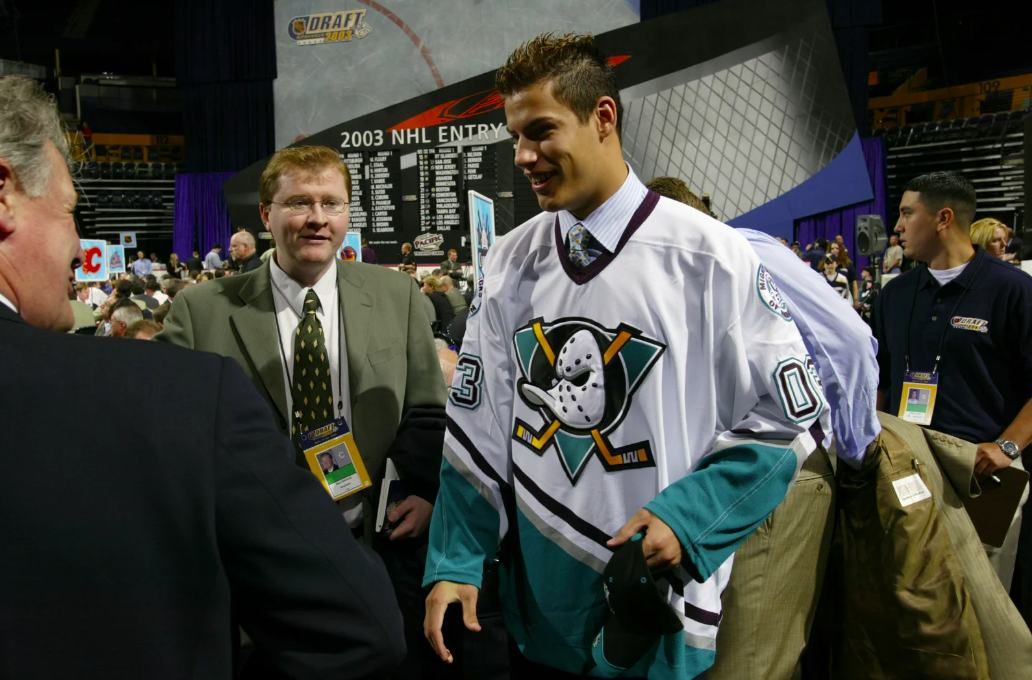
Another top selection in their history came in the 2003 draft where they selected Ryan Getzlaf. The two-way centre had a career spanning three decades, amassing over 1000 points, and one Cup for the team. Along with being the teams longest serving captain. All said and done Getzlaf will have his number 15 up in the rafters sooner rather than later for the Ducks.
One more top pick in their history comes again from the 2003 draft when they selected Corey Perry in the first round, pick 28. Perry was a goal scorer for the Ducks. Along with helping secure their only Stanley cup in franchise history in 2007, Perry also picked up some individual hardware with a Rocket Richard trophy and Hart trophy in 2010-2011. The 2003 draft produced the most long term team success their franchise has enjoyed to date.
But where there is gold there is also fools gold, and this came in the form of three players in particular. Coming up first must be that of 2nd overall pick in 2005 Bobby Ryan. Being picked second overall always adds pressure but when you add in the fact that he was picked right after Sidney Crosby this pick had plenty of prestige to it. While he was not bad at all, he was just not what the Ducks had hoped for, playing in parts of six seasons with the Ducks. Not once being a point per game player and being traded away, Bobby Ryan did not have the most successful tenure in Anaheim and when you consider that his name was second off the board, this makes it all the more of a hard pick.
Second must come from the 2001 draft where the Ducks picked Stanislav Chistov at 5th overall. He only played 136 games with the ducks out of his total 196 and amassed a total points of 61 in his short career in the NHL before leaving to Russia for the next 10 seasons.
Third on this list comes from the 2000 draft which saw them select Alexei Smirnov 12th overall. Smirnov played only 52 games in his total NHL career, all with the ducks scoring 6 points. There was not much from this pick, the six-foot-three centre never panned out too much for the ducks and that brings him on to this list.
Currently in 2023 the Ducks have a nice group of young talent after a few successful drafts in the past handful of years. They sit at 29th in the league and eliminated from the playoffs. With that their eyes are on the draft and who they could possibly pick. Their most recent track history for drafting shows that they do not particularly favour one league more heavily than any others. As well, given their recent history of picks being pretty even between defence and forward prospects and the prospects ranked in and around the top five the Ducks should be targeting players like, Leo Carlsson, Zach Benson, Matvei Michkov and an outside chance at bulking up their defence by looking at Axel Sandin Pellikka.
These potential players to draft will help fill two needs the ducks lack sorely. Goals for per game and goals against per game. The Ducks currently rank dead last in goals against per game with 4.01 goals against per game and they rank second last in the league for goals for per game at a dismal 2.55 goals per game. Benson is a 100-point player in the WHL, Michkov is potentially the second-best player in this draft behind Bedard and Michkov’s offence is dynamic when not trying to do it all. Carlsson will fit well with their wingers and Pelikka will help bolster their defence in a few years with Drysdale and Zellweger.
When it comes down to it the Ducks have not been the best at drafting overall, but in the last handful of years they have really turned it around so on June 28th 2023 we will see what the Ducks come up with next to add to their draft day selection history.
The 2023 NHL entry draft is getting ever closer to hockey fans, and the excitement fans have for who their teams are going to draft this year is ever higher as the regular seasons across the globe are coming to an end, and playoff season is just around the corner. And there is a lot for fans to be excited for this year, as the draft is looking like one of the strongest in years.
Connor Bedard is looking increasingly like a franchise-level player, rivaling the likes of Sidney Crosby, Alex Ovechkin, Nathan Mackinnon, Austin Matthews, and Connor McDavid. Adam Fantilli would have been a first-overall pick in arguably the last six drafts, Leo Carlsson is the next big center to come out of Sweden, and he is a must-grab in the top 5. And, of course, there is the Russian sniper: Matvei Michkov, who, despite being signed to the KHL until 2026, is so good that any team picking in the top 5 will be more than willing to wait for the Russian star.
But after the big 4 in this year’s draft, who fills out the remaining slots is always an exciting mystery come draft day. Teams must allocate their scouting resources to best support the organization’s roster on draft day. Who needs the top defensemen? Say, over-the-top sniper or goaltender? That is why we at DraftPro are excited to present an in-depth look at every position and who best thrives in that position. Who is the best sniper? The best power forward? offensive defensemen? Hopefully, after this 8-part series, all these questions will be answered.
Seven DraftPro scouts were asked their top 5-7 players for the following positions: sniper, playmaker, two-way forward, power forward, offensive defenseman, defensive defenseman, two-way defenseman, and goaltender. Their lists were recorded separately, and then once all seven scouts handed in their lists, their results were compared to one another. The final lists you read here determined the average each player placed. This is not a ranking of the best players overall, simply a ranking of who is the best for each given position. Players may be placed on multiple lists, as many players are not one-dimensional, and can not be forced into one category.
Thank you to the following scouts for providing their lists: Jared Brown, Matt Hnatiuk, Tyler Karoway, Andrew LeBlanc, Murray Caldwell, Andy Miller, and Jody Horak.
The sniper is the main force of pure goal-scoring potential on the team. Snipers can score goals in a multitude of ways, but what sets them aside from other goal-scorers on the team is their ability to score long-distance goals via their powerful and accurate shots. Many players can score goals, but goal-scoring alone does not make them snipers. This critical ability to score from a distance is what makes snipers so feared, and loved.
Here are DraftPro’s honorable mentions, players who were given attention from certain scouts but overall lacked consensus from the rest of the team:
Gabriel Perreault, Noah Dower-Nilsson, Koehn Ziemmer, Nick Lardis, Oliver Moore, Carey Terrance, and Luca Pinelli.
And here are DraftPro’s TOP 10 Snipers in the 2023 NHL draft class:
“Thrives on the powerplay where he’s given space to get shots off. He’s dangerous from the circles and can also clean up rebounds in front.” – Andrew LeBlanc.
This 6’3″ Fin has a lot to sell to scouts. He’s big, and he’s powerful. Being able to play the role of a Power Forward most nights, it’s Halttunen’s power that makes him such a dangerous sniper as well. Kasper Halttunen is suspected of going in the 2nd round this year, making him a safe pick to go for after your first pick is already taken. And for teams who gave up their first-round pick and are picking their first player in the second, the big skater with the wicked shot will not be a bad investment.
“Slippery, slick, intelligent, elite hockey IQ, a composed brilliant player maker, makes excellent passes like someone much older, pure goal scorer.” – Murray Caldwell.
Zach Benson is a high-utility player who can do many things. In other words, this will not be the last time you see Zach Benson on these lists. He can make offensive and defensive plays, and of course, he can score goals from anywhere. The spots between 5-10 are up in the air for most scout rankings, but one thing Benson has over, say, an Andrew Cristal or Will Smith is his ability to snipe as well. As of writing this review, Benson has 36 goals in 60 games. He is not quite a top 5 sniper, but he definitely needs to be mentioned.
Samuel Honzek, Vancouver Giants, WHL, #21-31 overall (1st round).
“Goalies should be scared when he is on the ice. Honzek’s accuracy sets him apart from the other snipers in this draft class. The release he has on his shot gives his shots so much velocity it’s in the net before the goalie can even react.” – Tyler Karoway.
Like Kasper Halttunen, Honzek is a big boy. At 6’4″ tall, Honzek is a threatening offensive presence on the ice. His big body makes him hard to cover and knock off the puck, giving him more space to unleash his awesome shots. Honzek is an excellent pick for teams in the latter end of the 1st. As of writing this review, Honzek just broke over the 20-goal mark in his first season in the WHL. It will be exciting to see him grow as he likely will have another year to tear it up with the Giants.
Matthew Wood, University of Connecticut, NCAA, #28-38 overall (1st-2nd Round).
“Wood is a pure goal scorer who gets to the high danger areas and finishes with the best of them.” – Andrew LeBlanc.
Another late 1st round option, and get this, another BIG boy at 6’3″. This Alberta native had an incredible season in the BCHL last season, where he led the entire league in goals (45) and points (85). Now, in NCAA, Matthew Wood has put up a respectable season, where he is one of the top goal-scorers in his age group. Speaking to former Victoria Royals goaltender: Griffen Outhouse, he had a lot of praise for the young kid, who he stated had an “NHL level shot already,” Matthew Wood is also the first player on this list to be named twice by our scouts. Being ranked as high as 3rd by Andrew Leblanc.
“Excellent release on his shot and super accurate in picking his spots.” – Jody Horak.
Yager just missed out on the top five, but he was mentioned 3 times by our scouts. Being ranked 3rd, 5th, and 6th. Now we’re getting into (almost) our PURE snipers. As a player, Yager brings a lot to the table, but he is a debated name here at DraftPro. But one thing that is impossible to argue against is just how good of a shot he has. Yager has 26 goals and 74 points as of writing this review and continues to be a shining star for in Moose Jaw. After speaking with Yager, for a player feature written earlier this year, it’s clear Yager strives for efficiency and drive as the main influencers for his game. He wants to be a player coaches can count on and keep his performance at a consistently high level.
Adam Fantilli, University of Michigan, NCAA, #2 overall (1st Round).
“Fantilli shoots the puck a lot, and he is incredibly accurate with his shot. If he maintains his shots per game and drops his shooting percentage in half, he will be around a 30-goal scorer, which would be very impressive as a rookie. He has a quick release and hits his spots which will give NHL goalies trouble” – Andy Miller.
Adam Fantilli, as mentioned earlier, would have been the 1st overall pick last year and arguably the first overall pick of every recent draft until Austin Matthews. Perhaps in time, he could rival even him. Fantilli has it all to be great in the NHL. He’s got a good size, he’s an explosive skater, a highly skilled stick handler, and of course, he has a great shot. It’s this shot that puts him at an advantage over Matvei Michkov. While Michkov’s shot is incredible and elite, if the 2nd overall picking team requires goal-scoring, Fantilli is not the downgrade from Michkov that we once expected him to be.
Ryan Leonard, USNTDP, USHL, #7-12 overall (1st Round).
“Uses his big frame to hold defenders off and gets the pick off his stick quickly to beat goaltenders.” – Andrew LeBlanc.
The first thing that jumps out with Leonard’s skill set and play style is his explosiveness. He’s a hard fighter, a pest to deal with, and capitalizes on all his opportunities. He is more than capable of racking up points when he’s hot, making him one of the best-looking options in the first half of the first round. Ryan Leonard was mentioned 5 times in our scout’s lists, being ranked around the 3rd-5th position. He is no doubt a top 5 sniper in this draft. These top 5 are all very close. Leonard being the 4th best sniper is not a blow to him, he’s an excellent player, and any team will be clamoring to have him with their franchise.
“Barlow is a quick player who has a deceptive shot that he can get off quickly and under pressure. He moves laterally well and can change his shooting lane at the last second. Being a 17/18-year-old top 5 OHL scorer bodes well for his future.” – Andy Miller
Goals tend to win games, so players who can provide goals are a hot commodity in the NHL. This makes Barlow likely one of the top players to come out of the OHL this year. Because as of right now, he has 46 goals with the Attack, which is 4th overall and 1st overall for all draft-eligible players. Out of the seven scouts who provided lists, five of them mentioned Colby Barlow and four of those five had him at #3 or higher. Barlow’s skill is so good it’s hard to believe we got two more guys to mention.
Matvei Michkov, HK Sochi, KHL, #2-5 overall (1st Round).
“Michkov’s ability to score from all areas of the offensive zone makes him the most dangerous threat of this class.” – Andrew LeBlanc.
Michkov has come with a lot of questions, but his shot is not one of them. Michkov has arguably the best pure wrist shot in the draft, and while Bedard is a goal-scoring machine, Michkov plays the pure sniper role better than Bedard. He scores through traffic, he scores up close, he scores from afar, he can do it all. He’s good enough to join the HK Sochi in the KHL, so I suspect some growing interest in Michkov’s KHL career, as whoever picks him will be waiting for their own Krill Kaprisov story. Michkov is well worth the wait. Despite him being small, despite him having the looming question of his Russian contract, despite him being questionable in his playmaking and defensive abilities, Michkov is still considered a top 5, maybe even top 3 or 2 level prospect. And that’s all to do with his sniping. That’s how good he is.
Connor Bedard, Regina Pats, WHL.
“What makes Bedard’s goal-scoring potential so unique is his uncanny ability to change the release point of his shot to get around blocking defenders or fool goaltenders. He has the nastiest release I’ve ever seen and has the potential to be the game’s next-best goal scorer.” – Jared Brown.
What else is there to say about Connor Bedard? Connor Bedard was unanimously placed 1st overall by all of our scouts. Bedard, of course, is more than just a sniper, as he has an argument for best playmaker and two-way forward as well. But for now, Bedard is our clear number-one sniper. He finished his season with 71 goals, playing for the lackluster Regina Pats in one of the strongest WHL leagues in recent memory, so yeah, he can score goals. He also wow’d audiences at the World Juniors, taking every scout who called him ‘pretty good’ and smacked them across the face until they said ‘really good.’ And it shouldn’t be too controversial to say that Connor Bedard from the Regina Pats, is the best sniper in the 2023 NHL draft class.
For more information on the 2023 NHL Draft class be sure to pick up your copy of the comprehensive DraftPro 2023 NHL Draft Guide.
The final stretch is upon us for the 2023 NHL Draft.
After watching most of these kids develop for over two years now the last big events of their pre-draft scouting seasons are in full swing with the IIHF U18 World Championships ongoing over in Switzerland, and CHL playoffs also happening with the Memorial Cup yet to come. The USHL playoffs are just starting on route to the Clarke Cup as well. But many other leagues around the world have already wrapped up for the season.
The U18’s become our last chance to see many of these prospects live before we have to rely strictly on film from previous games to finish the season. So each viewing becomes that much more valuable.
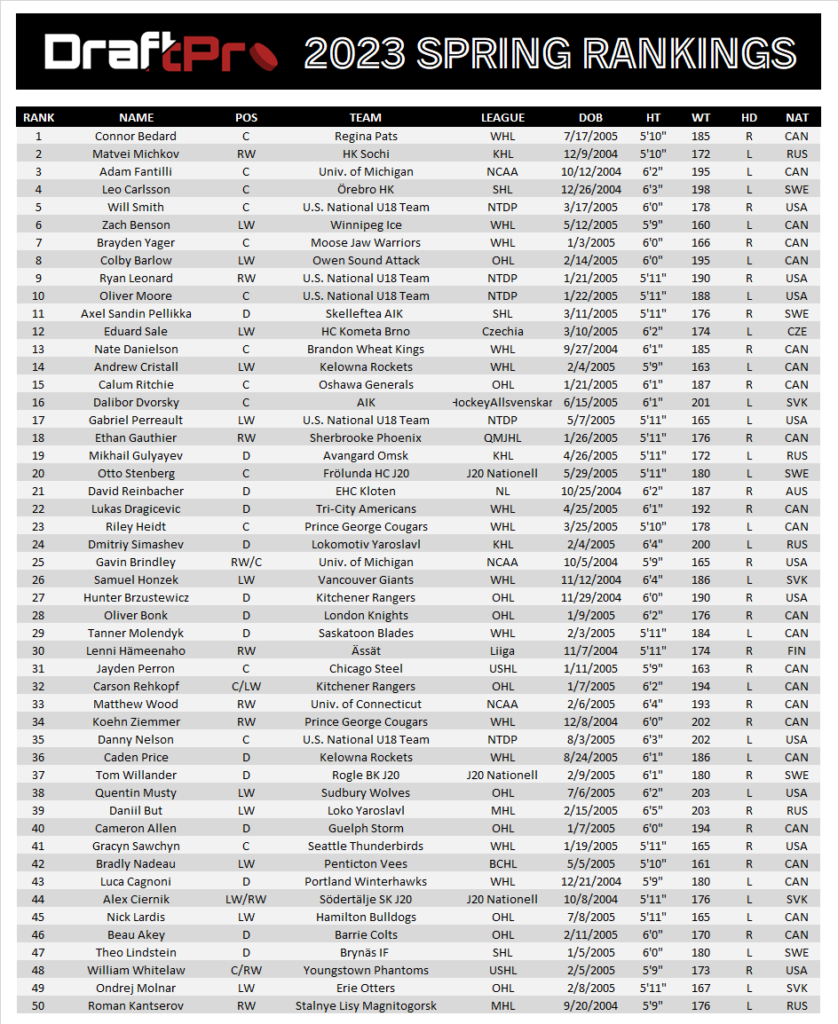
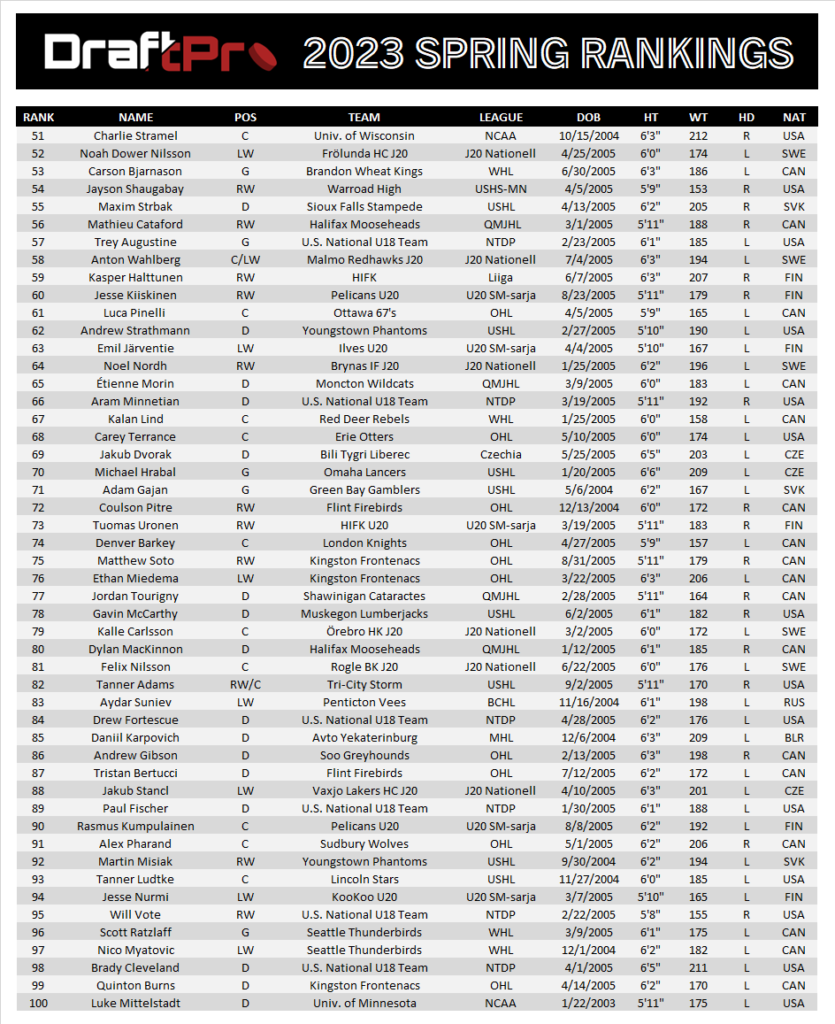
Three weeks ago our also evaluators met up to discuss the DraftPro Spring Rankings, our second last ranking offering of the season, and saw quite a few names to move around based on our evaluators most recent views. As names were discussed, some tumbled down the list while a few also enjoyed a late season jump up the board. For a deep dive into each prospect and where we see them as pros make sure to pick up the comprehensive 2023 DraftPro NHL Entry Draft Guide.
Below is the Draft Prospects Hockey Spring Top 100 Ranking for the 2023 NHL Draft.
Want to know which NHL Draft prospects are thriving? Who might be faltering? Who has taken a big step in the eyes of scouts? Or who might be dropping down rankings due to a developmental red flag?
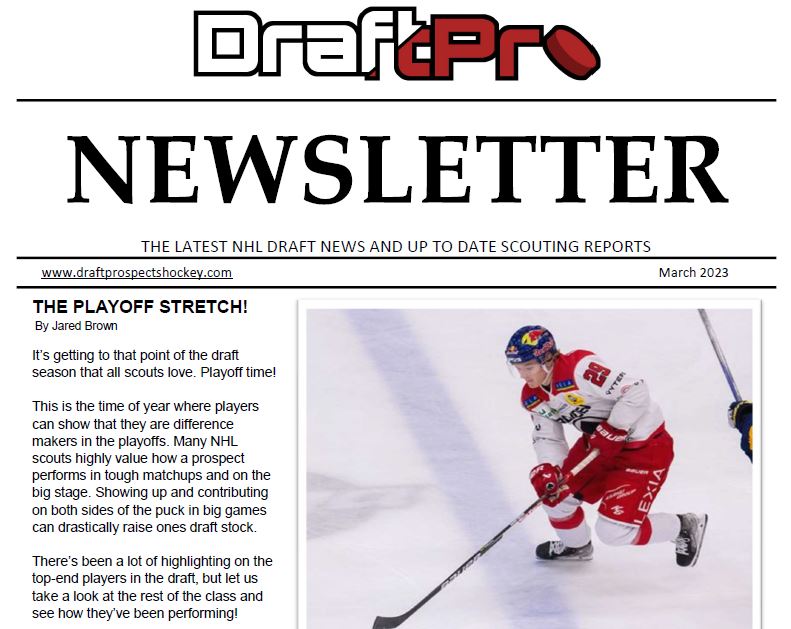
DraftPro is proud to provide all the latest news and prospect developments in a tidy bi-monthly digital newsletter for those who want to stay up to speed all season long on the current draft crop. For the low price of $3.99 (CAD) the crew at DraftPro offers in each Newsletter a season update, an up-to-date rankings, and dozens of recently gathered scouting reports on the current draft crop as our scouts detail the progress of hundreds of eligible prospects throughout the season.
The Newsletter will be release bi-monthly meaning every six to eight weeks so fans can track along with our scouts the development of the prospects NHL teams will be watching.
In the March release you will have access to our teams fresh Top 100 Spring Rankings, a season update from our own Director of Scouting Jared Brown, as well as actual scouting reports from various junior leagues and events in this 25+ page offering. The next Newsletter will be release in early June 2023.
Purchase the DraftPro March Newsletter Issue for just $3.99 by clicking the below link.
IMPORTANT NOTE: This is an instant download pdf so make sure your popup blocker is turned off and save your download before closing.
Lastly, DraftPro is partnering with Western Canada Hockey Exposure Camp (Twitter @hockeyexposure) this spring in an attempt to help junior age (2004-20008) players gain exposure as they strive to realize their hockey dreams. Register for your spot at http://westerncanadahockeyexposurecamp.ca