Blog

  • Jonah Neuenschwander (F | 2027 Eligible) – Hlinka Gretzky Cup Report

    Jonah Neuenschwander is impossible to miss when he’s on the ice. Not only does his gigantic frame tower over every other player on the ice, but he constantly involves himself in the play to search for advantages and opportunities for his team. The biggest contribution he brings to his team is his hockey IQ, being able to read and anticipate plays before they even happen to properly position himself as a passing option, to pick off an opponent’s pass, or be the first to a loose puck. His hockey IQ helps him in every aspect of the game to remain one step ahead while bringing a versatile set of skills to capitalize on being that one step ahead. With the puck, he is great at leveraging his IQ and vision to make quick one-touch passes or carry the puck to open ice while evaluating new options. Offensively without the puck, he is great at driving the net for deflections, rebounds, or even as a passing option. Due to his size, his presence in front of the net creates chaos while his opponents try to restrict his ability from making an impact in the slot. Defensively, he is great at containing his opponents to the perimeter, using his stick to try and create turnovers or intercept passes, and is fairly effective at helping his defencemen when the situation calls for it.

    Though I believe that there is an extremely high likelihood that Neuenschwander will be, at the very least, a top ten pick next June, there are still a few aspects of his game I would like to see him improve on over the season to make that an absolute guarantee. First, his skating would be his biggest aspect to improve upon for me. I would like him to develop more length out of his stride, using his long legs to generate more power per stride as opposed to taking many short strides in quick succession like he does now. His top speed and ability to chase down pucks would greatly improve with a longer stride. Similarly, he needs to improve his agility. Though a longer stride wouldn’t directly improve his agility, being able to conserve more energy from taking fewer strides would indirectly affect his agility due to having more energy readily available for when he needs it in those close quarter situations. Secondly, there are times where he loses his poise with the puck and throws it where he believes he has a teammate, when in reality they’re either not ready for the pass or not there entirely. I would like him to improve on his poise over this season, creating a tendency to hold the puck that extra half second to evaluate his options or take a shoulder check to find his teammates before making the play he decides upon. Lastly, I would like to see him develop his physical game some more. He has a huge frame and utilizes it fairly well, but he isn’t the most effective when using it. He doesn’t have any fear engaging in board or netfront battles, but he isn’t strong enough to guarantee winning those battles consistently. Developing some upper body strength would improve this aspect of his game while preparing him to play in the North American style of game in the future.

  • Michael Tang vs Slovakia – Aug 7, 2026

    Michael Tang vs Slovakia – Aug 7, 2026

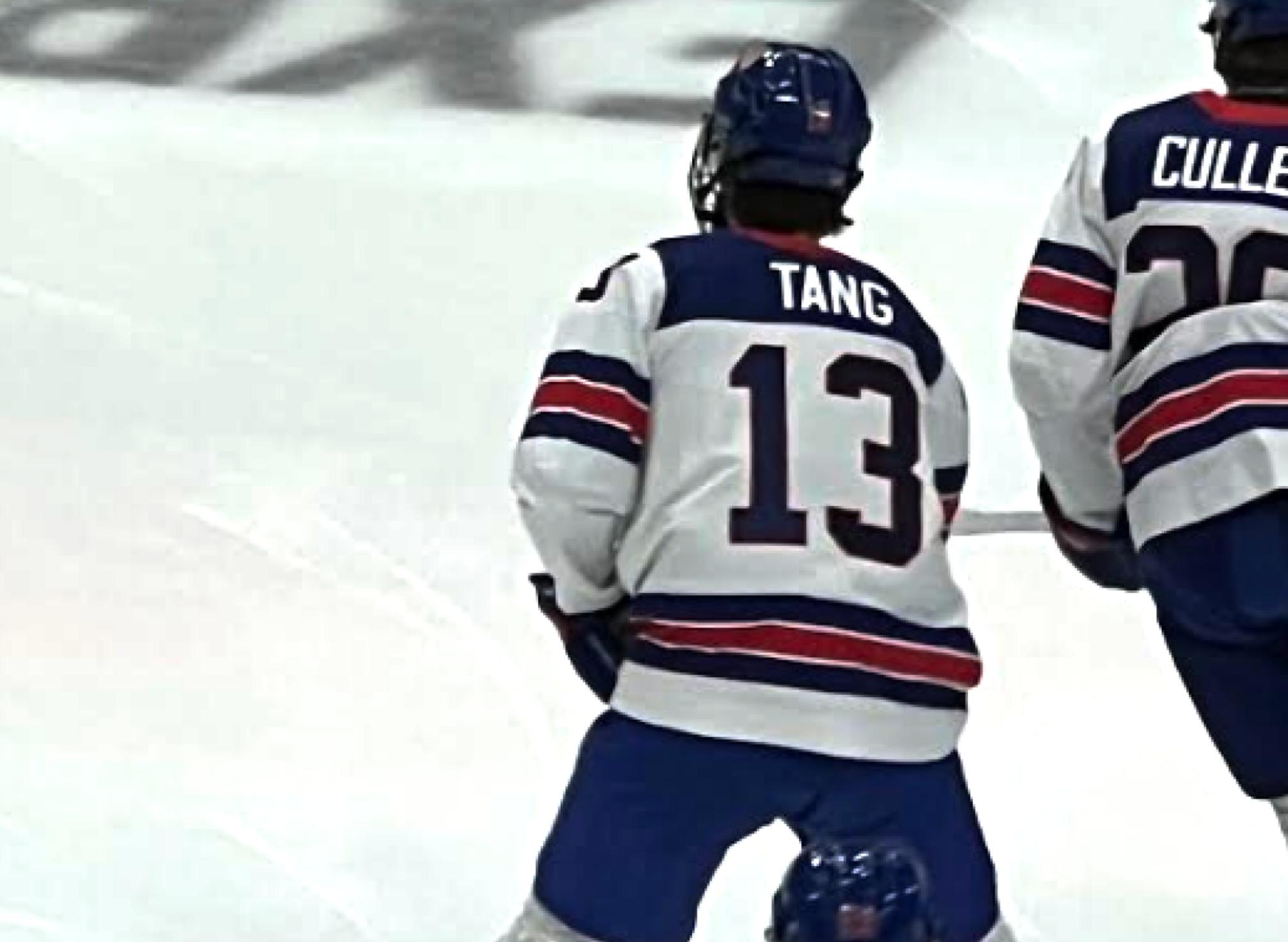
    Tang had about as impressive a performance as a goal scorer can have without actually scoring a goal. On one particularly impressive play, he beat a defender to the inside before driving the net and getting a shot on goal. He then attempted to bat his own rebound out of mid-air with a backhand, cross-body swing, but hit the post.

    On the power play, Tang beat a defender with a toe-drag at the face-off dot before releasing a powerful wrist shot that beat the goaltender high far side, sending the water bottle flying. The goal was ultimately called back for goaltender interference.

    This was by far Tang’s best game of the tournament. While his patience with the puck and ability to beat defenders with his hands allowed him to create offense, I would like to see him move his feet more when he has possession in the offensive zone. Adding more mobility could bring a more dynamic element to his cycle game.

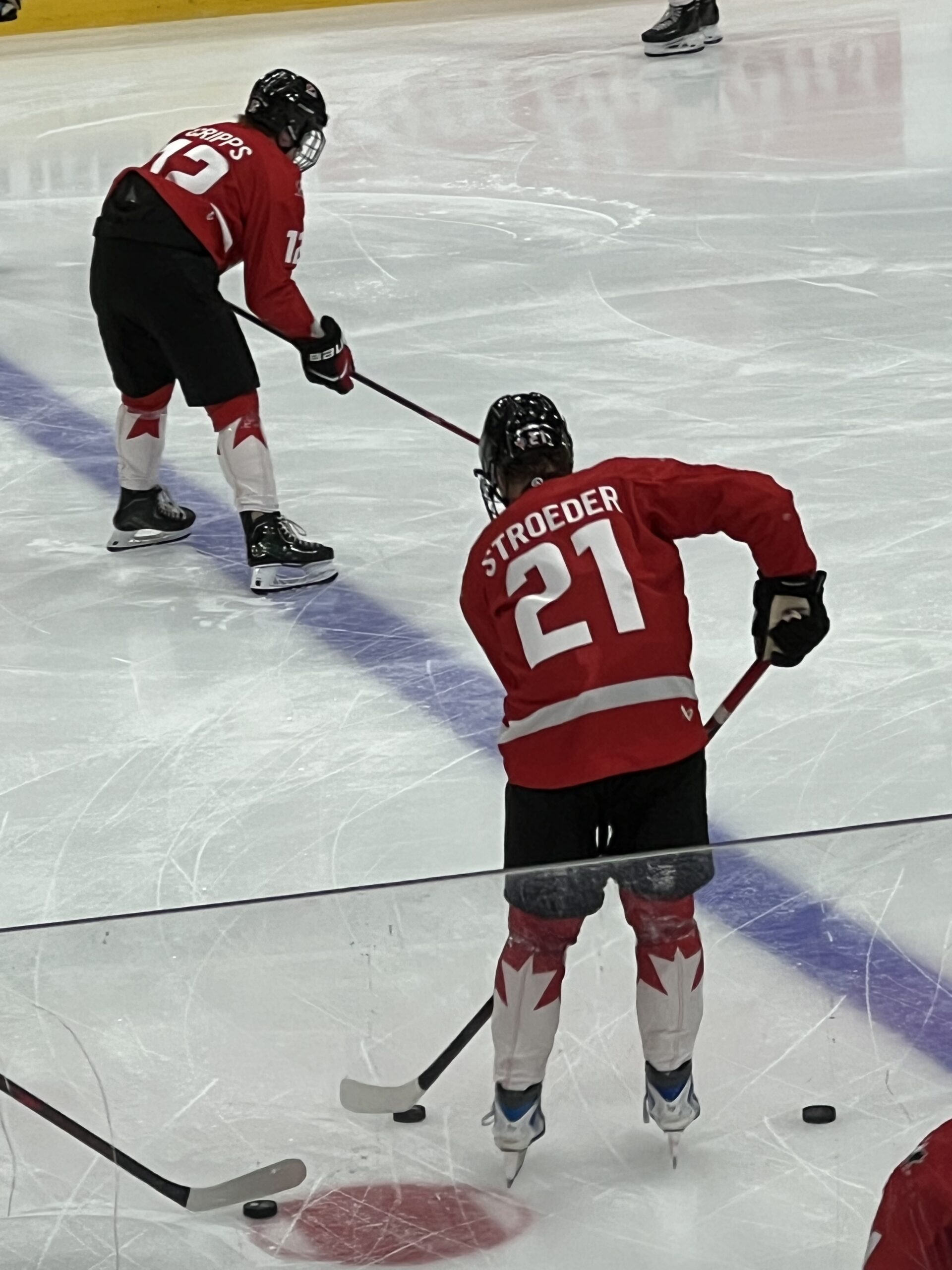
  • Kayden Stroeder vs Sweden – Aug 5, 2026

    Kayden Stroeder vs Sweden – Aug 5, 2026

    Stroeder had a very impressive performance, starting the night by showing off his passing ability with a pair of assists before scoring a goal of his own later in the game.

    His first point of the night came on a no-look pass from behind the goal line that fooled the Swedish defender, giving Benjamin Veitch the space and time to find the back of the net.

    His second assist came on the power play, threading a pass through traffic and perfectly into a gap between the four penalty killers, finding the tape of Ryerson Edgar.

    Stroeder also scored a goal that showcased impressive hand-eye coordination. After receiving a pass from behind the net and getting a shot on goal, he recovered his own rebound despite the puck bouncing. While rotating 180 degrees, he was able to control the puck and beat the Swedish goaltender low far side.

    While Stroeder finished with three points, he could have easily had more. He nearly scored his second goal of the night after taking a great lane to the net to receive a cross-crease pass before getting hooked and drawing a penalty. He also showed great patience and awareness on the power play, getting lost in the Swedish penalty killers’ coverage before emerging in a more dangerous position than where he had started.

  • NHL All-Star Replacement Concept For 2029

    After 4 Nations it became apparent to me that the All-Star game needed a change and with my background in event creation and tournament organizing from working in esports, I decided to give it a shot myself. I originally finished my idea around late March of this year, but only put it all down in a PowerPoint pitch deck. After some free time over the summer I decided to put it into an article style format. For those wondering I will be talking about the new All-Star changes at the end of my article. Please enjoy.

    The Idea: Split NHL players into 8 teams based on birthplace. (4 NA & 4 EU) in a Winner Takes All tournament. Starting roster sizes: 8F, 4D, 2G.

    Team Makeup:

    • Canada East & West 
    • America East & West 
    • Europe East (Belarus, Latvia, Russia) 
    • Europe Central (Czechia, Germany, Slovakia, Switzerland)
    • Sweden-Denmark
    • Finland-Norway

    Format:
    A Group Stage will be held to determine seeding. Stating with two groups one in  North America and the other in Europe. Games in the Group Stage will be 3-on-3 with 10 minute periods until the end of the Group Stage. Once the Group Stage ends, elimination games begin. The winning teams will pick 2 forwards and 1 defenseman from the losing the team. Semi-Final games will be 4-on-4, with 15 minute periods and a roster size of 10F, 5D, 2G. The Final game will be a full 5-on-5 game with normal 20 minute periods and a full NHL roster size of 12F, 6D, 2G. All games are best of 1. Ties at the end of regulation will be determined by 5 Min OT and a shootout if needed, except for the Semi-Final and Final.

    Group Stage LocationsQF and SF LocationsFinals Location
    NA (Seattle, Calgary)NA (Detroit, Buffalo)Toronto or Montreal
    EU (Bern, Prague, Budapest)EU (Riga, Copenhagen)
    • Climate Pledge Arena (Seattle), Scotia Place (Calgary)
    • PostFinance-Arena (Bern), O2 Arena (Prague), MVM Dome (Budapest)
    • Little Caesars Arena (Detroit), KeyBank Center (Buffalo)
    • Xiaomi Arena (Riga), Royal Arena (Copenhagen)

    As you might have already put together, we start out West in North America and move East. In Europe we start in Switzerland and move East before going North to Latvia and finishing in Denmark. Know lets take a look at a possible schedule.

    Trade Freeze: Jan 30st 2029 –  Feb 12th 2029.

    Dates:

    Feb 1st
    – NA Media Day & Travel day for EU players

    Feb 2nd
    – EU Media Day & Game Day 1 NA (1v2,2v3,3v4)
    – Final Travel Day For EU Players

    Feb 3rd
    – Game Day 1 EU (1v2,3v4)
    – NA Travel to Calgary, EU Travel to Prague after

    Feb 4th
    – Game Day 2 NA (1v4,1v3,2v4), EU (1v3,2v4)
    – EU Travel to Budapest

    Feb 5th
    – Game Day 3 EU (1v4,2v3)
    – EU Travel to Riga, NA Travel to Detroit

    Feb 6th
    – Day Off

    Feb 7th
    – Game Day 4 NA (S1vS4,S2vS3), EU (S1vS4,S2vS3)
    – EU Travel to Copenhagen, NA Travel to Buffalo

    Feb 8th
    – Game Day 5 NA (SF1vSF2), EU (SF1vSF2)
    – EU Travels back to NA, NA Travel to TOR/MTL

    Feb 9th
    – Day Off (maybe Skills Comp)

    Feb 10th
    – Final Game

    Now I know what you’re thinking. What would some potential rosters look like for these teams? Well I threw some together for you just for the sake of seeing what they could be in 2029.

    Eastern Canada All-Stars

    F: Nathan MacKinnon, Connor McDavid, Mitchell Marner, Brad Marchand, Sidney Crosby, Wyatt Johnston, Mark Scheifele & Beckett Sennecke.
    D: Matthew Schaefer, Evan Bouchard, Thomas Chabot & Noah Dobson.
    G: Scott Wedgewood & Jet Greaves.

    Western Canada All-Stars

    F: Brandon Hagel, Brayden Point, Seth Jarvis, Macklin Celebrini, Connor Bedard, Jordan Eberle, Gavin McKenna & Dylan Cozens.
    D: Devon Towes, Cale Makar, Josh Morrissey & Travis Sanheim.
    G: Darcy Kuemper & Joel Hofer

    Eastern American All-Stars

    F: Kyle Connor, Jack Eichel, Alex Tuch, Matt Boldy, Jack Hughes, Clayton Keller, Trevor Zegras & Ryan Leonard.
    D: Quinn Hughes, Adam Fox, Jackson LaCombe & Zach Werenski.
    G: Jake Oettinger & Joey Daccord.

    Western American All-Stars

    F: Matthew Knies, Auston Matthews, Jason Robertson, Brady Thachuk, Tage Thompson, Matthew Thachuk, Jake Guentzel & Troy Terry.
    D: Jacob Slavin, Seth Jones, Jake Sanderson & Neal Pionk.
    G: Dustin Wolf & Jeremy Swayman.

    Central European All-Stars

    F: Leon Draisitl, Martin Necas, David Pastrnak, Kevin Fiala, Tim Stutzle, Juraj Slafkovsky, Marco Rossi & Dalibor Dvorsky.
    D: Roman Josi, Moritz Seider, Filip Hronek & Simon Nemec.
    G: Karel Vejmelka & Philipp Grubauer.

    Eastern European All-Stars

    F: Kirill Kaprizov, Aliaksei Protas, Nikita Kucherov, Matvei Michkov, Danila Yurov, Ivan Demidov, Pavel Dorofeyev & Vitali Pinchuk.
    D: Alexander Nikishin, Aytyom Levshunov, Dmitri Simashev & Alberts Smits.
    G: Ilya Sorokin & Arturs Silovs

    Finland-Norway All-Stars

    F: Artturi Lehkonen, Aleksander Barkov, Mikko Rantanen, Michael Brandsegg-Nygard, Sebastian Aho, Kaapo, Kakko, Benjamin Rautiainen & Anton Lundell.
    D: Miro Heiskanen, Henri Jokiharju, Esa Lindell & Emil Lilleberg.
    G: Juuse Saros & Ukko-Pekka Luukkonen.

    Sweden-Denmark All-Stars

    F: Ivar Stenburg, Leo Carlsson, William Nylander, Nikolaj Ehlers, William Eklund, Lucas Raymond, Oscar Fisker Molgaard & Anton Frondell.
    D: Philip Broberg, Rasmus Dahlin, Victor Hedman & Erik Karlsson.
    G: Filip Gustavsson & Mads Sogaard.

    Now lets tie everything up with a Q&A and address the new All-Start format for 2027.

    How are teams made?

    Teams are made up from players’ birth location or hometown. For Canada and the USA it would be best to define a line that splits the population of NHL players so that East and West side represent 50-50 of their NHL player populations. Exceptions may apply to a player like William Nylander who was born in Calgary but is known to play for Sweden so he may be a part of the Sweden-Denmark team. And if a player outside of NA or EU is voted in we can make adjustments to the teams requirements. Fans can vote from a list of player who they want to see play. A captain will be assigned to each team, they will choose the players they take from the other teams during the elimination games.

    Will PWHL players participate?

    This entirely depends on if schedules align. I for one think the PWHL should have its own All-Star game, but for the sake of the argument let’s say they do. I think each team would get 1 player with the same rules applying for selection  based off birth place.  However, they would only play in the group stage so that
    1) They aren’t away from their PWHL teams for too long. & 2) So final rosters remain 12F, 6D, 2G.

    Why are so many games in the EU?

    There are equal amount of games in the EU so that the NHL can generate more revenue and grow the game more in Europe by showing off its European talent. It would do good to spread the game as much as possible while the NHL seems to plan on expanding again very soon.

    Are Russians allowed to play?

    Yes, Russian players are allowed to play as this isn’t an international competition representing a single country, this is an All-Star game representing NHLers from  all over the world and those from Russia are welcomed to play.

    Why can’t European teams be made up of one country?

    The simple answer is that it makes representation from more European countries easier. Both Sweden and Finland could have their own teams but it’s about celebrating as many NHLers as possible. On top of making it easier to have 8 teams participating.

    Skills Competition?

    I think after 4 Nations it really showed that the Skills Competition is a really outdated concept and with NHL Edge we can see all the interesting aspects of fastest skater and harvest shot. That being said you could host it on the day before the Final Game.

    What do the winners get?

    This is TBD maybe a large sum of money (maybe even a charity donation to the winners choosing) but the 4 Nations trophy could be used for this event.

    Finally the NHL announced on June 2nd, 2026 that a new format for the All-Star will be introduced. At a first glance its a good step in the right direction. They are capitalizing on the success of the 4 Nations event by using 5 Nations (1 being the Rest Of World). However, I think if they are obviously playing it safe. I want them to go a step further, it needs to expand. An All-Star Weekend isn’t going to get the same amount of engagement and attention. Expanding to 8 teams and playing games across NA & EU, they will be able to sell more tickets and make the event more worthwhile. All while keeping it a similar length of break in the season that the Olympics causes to keep the schedule consistent every year would be a good thing. That being said, I’m excited to see how the 2027 All-Star event goes.

    That concludes my concept for the 2029 All-Star game. Thank you for spending the time to read it if you made it this far.

  • The Elite Showcase: Scouting the 2026 Hlinka Gretzky Cup

    The Elite Showcase: Scouting the 2026 Hlinka Gretzky Cup

    There is a distinct mid-August magic that blankets any Canadian rink when the premier under-18 talent in the world descends, and that feeling was evident in Edmonton, Alberta.

    The Hlinka Gretzky Cup isn’t just the unofficial opening bell of the scouting calendar; it’s a high-stakes, pressure-cooker furnace where future NHL franchises are built, and where teenagers transform into blue-chip commodities right before our eyes. 

    This year’s edition provided a fascinating, multi-layered narrative. We saw a dominant, deeply structured Canadian squad put on an absolute clinic in the gold-medal game, executing a clinical 8-1 dismantling of their American rivals. But beyond the podium, the real value of this tournament lies in the individual evaluations.

    From sub-six-foot defensive maestros to towering European physical forces, the ice in Edmonton was the premier location for high-end draft stock to showcase themselves. 

    Let’s dive deep into the notebook to break down at least one standout player from every single nation that competed in the tournament. 

    Team Canada: The Class of the Tournament 

    When you outscore your opponents 34-12 over a perfect 5-0 tournament run, your roster is naturally going to be littered with standouts. While the depth of this Canadian program was terrifyingly obvious, a few specific names completely stole the marquee. 

    Landon DuPont, D (2027 NHL Draft Eligible and in contention to become the 1st overall selection)  

    The Tape: 5-foot-11, 192 pounds | Michigan Wolverines (NCAA) 

    The Analysis: If there was any lingering doubt about DuPont’s status as a projected first-overall franchise pillar, he single-handedly erased it in Edmonton. Wearing the captain’s “C” with a quiet, mature confidence, DuPont anchored Canada’s blue line with a masterclass in modern transitional defense. He plays the game with an exceptionally high processing speed, rarely turning the puck over under heavy forechecking pressure. His performance in the gold-medal game, racking up four primary assists on the rush and from the blue line, showcased a flawless hockey IQ. He doesn’t just join the play; he commands it. 

    Liam Pue, RW & Maddox Schultz, LW (2028 NHL Draft Eligibles) 

    The Tape: Regina Pats (WHL) teammates playing as tournament underagers 

    The Analysis: It is difficult to separate the two, yet both stood out individually. It is almost unfair what these two did to older competition. Schultz exploded for 10 points (3 goals, 7 assists), while his partner-in-crime, Pue, led the entire tournament with six goals. Pue possesses a devastatingly quick release that he can uncork from almost any posture, allowing him to surpass Sidney Crosby’s Canadian U17 tournament goal-scoring record of 5 goals. Schultz, meanwhile, was a multi-situational monster, thriving on the power play, at five-on-five, and on the penalty kill. They carried themselves like 10-year pros. 

    Team USA: The Resilient Silver Medalists 

    The United States brought a highly competitive development group that rightfully earned its spot in the final, proving that their grassroots depth continues to rise even when navigating split summer rosters. 

    Gavin Burcar, C (2027 NHL Draft Eligible) 

    The Tape: 6-foot-1, 185 pounds | Spokane Chiefs (WHL) 

    The Analysis: Burcar was the undisputed engine of the American offense, finishing right behind the top Canadians with a spectacular nine points. He set the tone on day one with a ferocious hat trick against Czechia and never looked back. Burcar projects beautifully as a high-end NHL power center; he has a legit 40-goal upside because of how cleanly he protects the puck down low and the sheer heavy velocity of his shot. 

    Nash Roed, F (2028 NHL Draft Eligible) 

    The Tape: 5-foot-11, 187 pounds | USNTDP 

    The Analysis: When the lights were brightest in the tournament’s knockout stage, Roed delivered. His clutch, single-game hat trick in the 5-2 semifinal victory over Slovakia was a pure exhibition of hunting soft ice and executing under immense pressure. 

    Team Finland: The Bronze Finishers 

    Finland executed their classic, suffocating tactical system to precision, ultimately grinding their way to a hard-fought 3-2 bronze-medal win over tournament underdog Slovakia. 

    Luca Santala, RW/C (2027 NHL Draft Eligible) 

    The Tape: 6-foot-2, 190 pounds | London Knights (OHL) 

    The Analysis: Santala used this tournament as a perfect bridge before making his highly anticipated North American transition to the OHL. He is a pure, unadulterated sniper who leans heavily into a volume-shooting mentality. What impresses is his spatial awareness; Santala has an innate ability to let the play develop around him before drifting into dangerous mid-range shooting lanes to release a heavy, heavy wrist shot. 

    Team Slovakia: The Underdogs 

    Slovakia fell just short of the podium, but they played an incredibly entertaining brand of fast, transitional, highly skilled hockey. 

    Tomáš Selič, F (2027 NHL Draft Eligible) 

    The Tape:  6-foot-4, 198 pounds | Flint Firebirds (OHL) 

    The Analysis: Selič was an absolute joy to watch in the offensive zone. Finishing the tournament with eight points, he proved to be one of the most creative playmakers in Edmonton. He plays with an aggressive pace, using deceptive shoulder shakes to freeze defenders at the blue line before slipping precise passes through seams. He is a primary puck-transporter who elevates his linemates. 

    Team Switzerland: The High-Minute Workhorses 

    The Swiss team secured a highly respectable fifth-place finish with a somewhat surprising 5-1 win over Czechia, heavily anchored by their veteran junior leadership. 

    Jonah Neuenschwander, C (2027 NHL Draft Eligible) 

    The Tape: 6-foot-4, 185 pounds | Biel NLA (Switzerland) 

    The Analysis: Neuenschwander played heavy, demanding minutes against every country’s top defensive pairings and never faltered. Finishing with six points (3 goals, 3 assists), he demonstrated a complete two-way profile. He uses his long reach to disrupt plays in his own zone and possesses the vision to transition those turnovers into instant odd-man rushes. He looks completely ready to impact pro hockey back home this fall. 

    Team Czechia: The Physical Ground Game 

    While Czechia faced a tough placement round, their roster showcased an identity built on heavy, imposing physical traits. 

    Maxmilian Mares, C (2027 NHL Draft Eligible) 

    The Tape: 6-foot-6, 229 pounds | Rimouski Oceanic (QMJHL) 

    The Analysis: You simply cannot miss Mares when he steps onto the ice. He is an absolute mountain of a teenager who completely understands how to leverage his massive frame to protect the puck. Tallying three goals and three assists, Mares anchored the middle of the ice with a punishing power-forward game. If he can continue to refine his short-area foot speed in the QMJHL this season, NHL general managers will be lining up to draft his rare athletic profile. 

    Lukáš Kachlíř, D (2027 NHL Draft Eligible) 

    The Tape: 5-foot-8, 160 pounds | Bílí Tygři Liberec (Czechia) / Edmonton Oil Kings (WHL) 

    The Analysis: If you want pure, unadulterated hockey fun from the blue line, Kachlíř is your guy. At 5-foot-8, he immediately faces the obvious size and structural strength questions that NHL scouts obsess over, and yes, there are shifts where he can get pinned down or outmuscled in his own zone, but he is rarely, if ever, outworked. But the second the puck lands on his stick? He transforms into a one-man breakout machine. Kachlíř possesses some of the most fluid, deceptive edge-work in this entire draft class, allowing him to dance away from heavy forecheckers and walk the blue line with total lateral freedom. He finished tied as one of Czechia’s most lethal offensive drivers, logging five points in four games, including a massive power-play one-timer that nearly blew the back of the net out against the Americans. His east-west passing lane vision is elite, and though he occasionally gets caught trying to pull off the extra move, his capacity to dictate the absolute tempo of an offensive possession is undeniable. Having been selected by the Edmonton Oil Kings in the CHL Import Draft, a full season adjusting his quick-strike game to North American ice will tell us exactly how high his draft ceiling can climb. 

    Team Sweden: The Undersized Innovators 

    Sweden’s tournament didn’t go quite as planned, finishing seventh with a 4-2 win over Germany, but their developmental pipeline remains incredibly intriguing. 

    Douglas Johnsson, D (2027 NHL Draft Eligible) 

    The Tape: 5-foot-10, 169 pounds | Skellefteå J20 (Sweden) 

    The Analysis: Johnsson is yet another example of the modern, undersized, highly intelligent puck-moving defenseman that Sweden is becoming famous for developing. He mitigates his lack of raw physical size with elite edge-work, an active defensive stick, and an incredibly fast outlet pass. He rarely absorbs direct physical contact because his lateral mobility allows him to dance away from oncoming forecheckers, making him a fascinating long-term project. 

    Team Germany: The Resilient Foundation 

    Germany found themselves outmatched on the scoreboard at times, but individual bright spots showed clear high-end development. 

    Max Calce, C 

    The Tape: 5-foot-11, 190 pounds | Brantford Bulldogs (OHL) 

    The Analysis: Calce was the heart and soul of the German squad. Playing a relentless, 200-foot style, he constantly forced turnovers through sheer work ethic and heavy backchecking. He didn’t get a ton of offensive support, but his ability to win defensive-zone faceoffs and clear the front of his net against massive opposing forwards showed immense character and a projectable pro floor. 
  • Brock Cripps (D) – 2027 NHL Draft Prospect Report

    Cripps showcased the puck skills and hockey sense that make him such a dynamic offensive defenceman.

    He scored shorthanded after making a slight move, waiting for the defender to overcommit and slide right past him before beating the Swedish goaltender on the far side from the top of the circle.

    Later in the game, he repeatedly kept cycles going by keeping the puck in the offensive zone while under heavy pressure with little room to work at the blue line.

    This was highlighted by one shift where he did it three separate times before cutting through the Swedish defence with a stutter step to create another scoring chance.

    At even strength, Cripps and defensive partner Boston Tait controlled play from the offensive blue line. Their combination of passing ability and hockey IQ allowed them to toy with the Swedish forwards, moving the puck seamlessly back and forth while maintaining possession and giving the Canadian forwards time to get into scoring position.

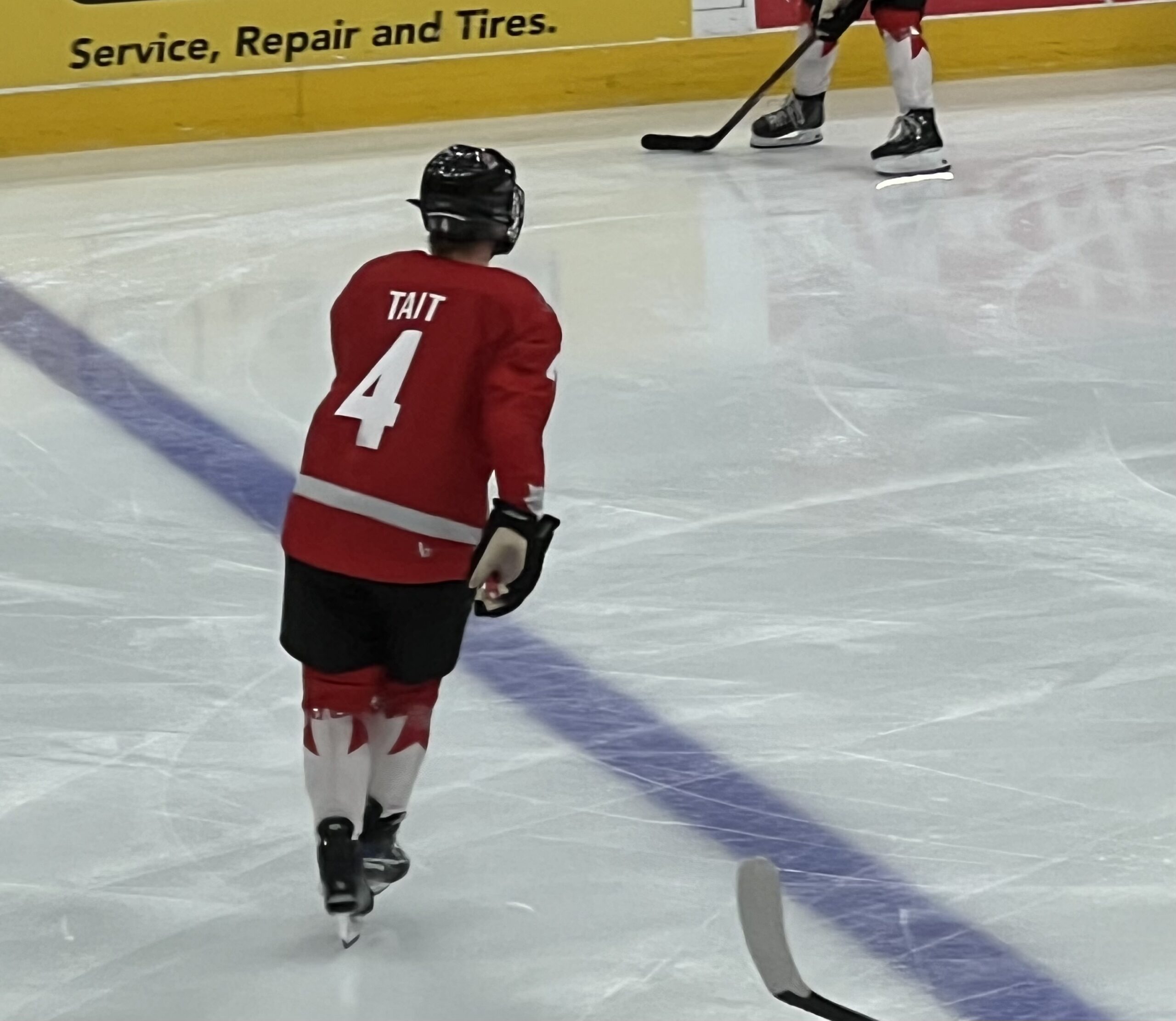
  • Boston Tait (D) – 2027 NHL Draft Prospect Report

    Boston Tait (D) – 2027 NHL Draft Prospect Report

    Tait quietly played one of the most complete games on Canada’s blue line, impacting the game in all three zones.

    His puck movement was a constant throughout the game, helping Canada sustain its dominant performance by consistently moving the puck in the direction it needed to go.

    Rather than forcing difficult plays, he showed the poise to make the correct read, highlighted by a fantastic stretch pass that started the sequence leading to Camryn Warren’s goal.

    Offensively, Tait activated when the opportunity presented itself, but never at the expense of his defensive responsibilities.

    He looked most comfortable creating from the blue line, playing aggressively when needed to extend possessions before seamlessly recovering to his position.

    That balance allowed him to contribute offensively without leaving Canada vulnerable in transition.

    Tait consistently closed gaps and broke up plays through excellent stick and body positioning, including one sequence where he completely shut down an attacker one-on-one before immediately turning the play back up ice.

    Tait looked like your modern two-way, do-it-all defenceman, not shying away from any aspect of the game.

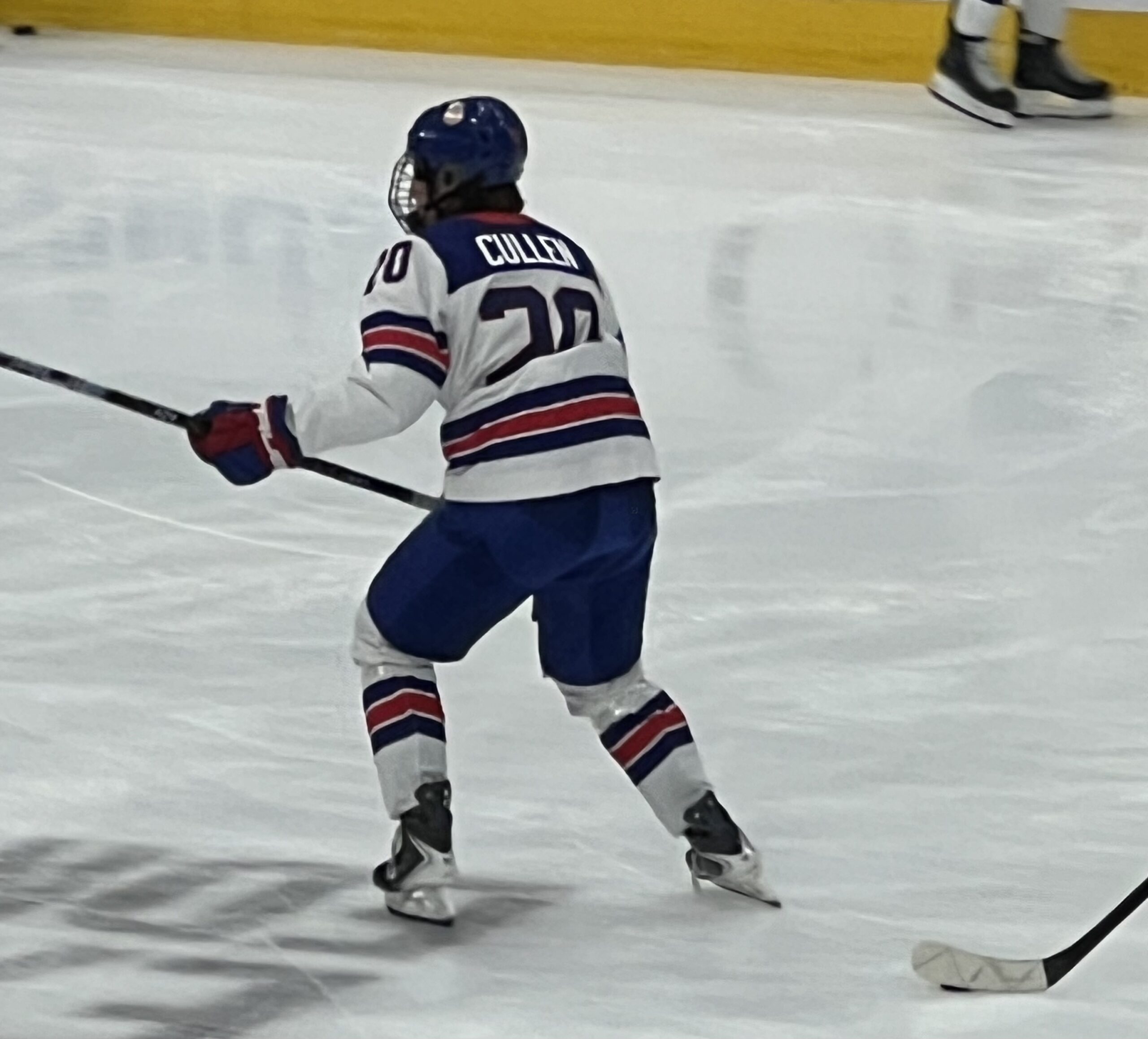
  • Joey Cullen (F) – 2028 NHL Draft Prospect Report

    Joey Cullen (F) – 2028 NHL Draft Prospect Report

    At just 16 years old, Joey Cullen was by far USA’s most talented forward, even in a high-intensity semifinal matchup.

    He always keeps his head up, scanning the ice for the right pass, and once he gets a good look, he has the elite hockey sense to know where everyone is and where they are going, allowing him to make plays before others can see them develop.

    He recorded a secondary assist on USA’s opening power-play goal. While he did not directly create the goal, he showed good poise with the puck, waiting until the right pass opened up. Though that was his last point, it was far from the last time he contributed offensively.

    Later in the game, Cullen beat one defender to the inside before taking another to the outside and ringing the puck off the post.

    On another play, he set up Gunnar Conboy with a completely open net, but Conboy missed. Cullen was also trusted to be a focal point of the American power play when he was on the ice.

    Another thing that impressed me was his ability to stay with plays even when they broke down. He was constantly able to recover and get to loose pucks before defenders.

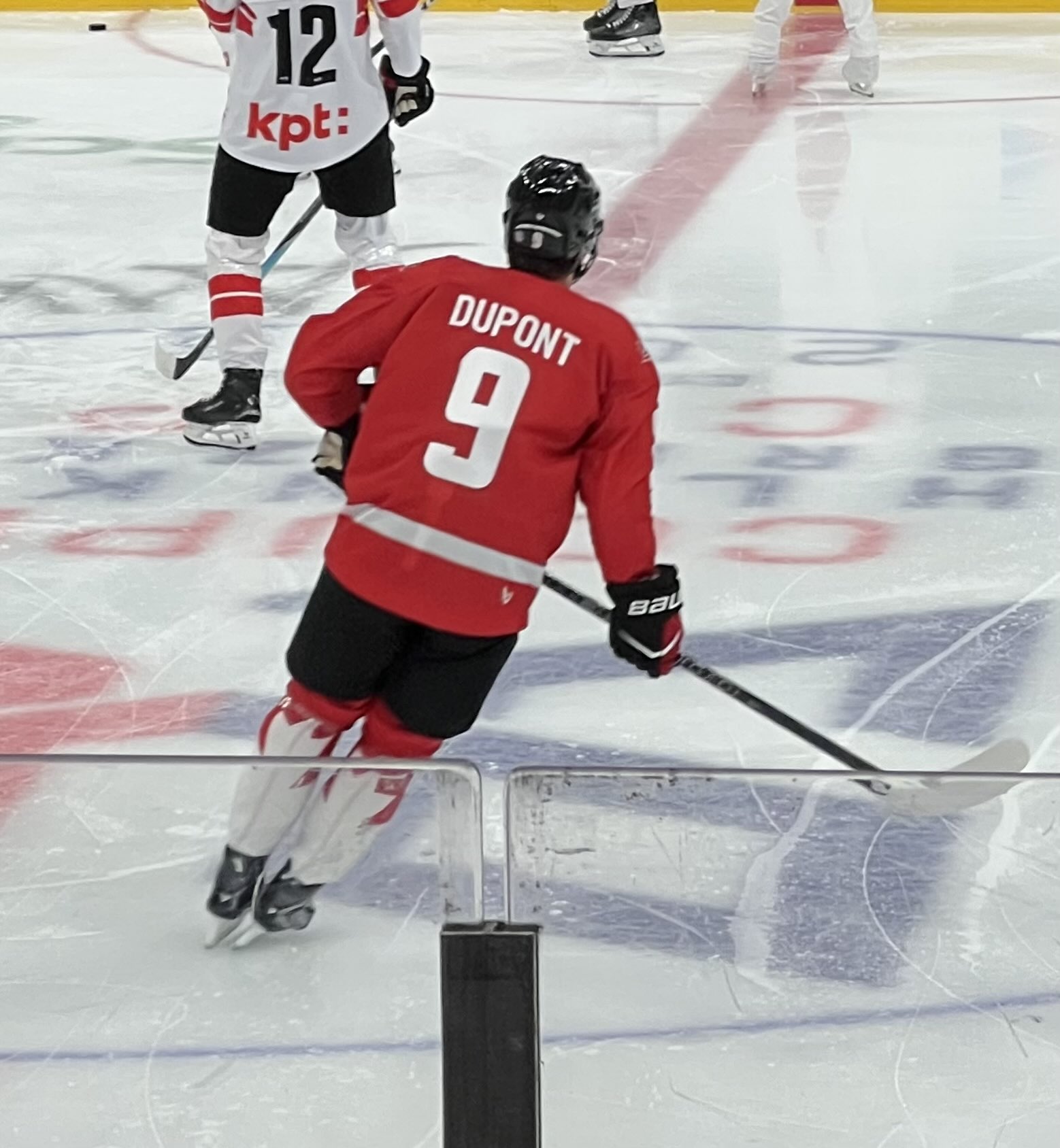
  • Landon DuPont Dominates Beyond the Scoresheet

    Landon DuPont Dominates Beyond the Scoresheet

    Landon DuPont had a game that was indicative of his entire tournament, finishing with only one point despite being by far the most dominant player on the ice. Canada was in rough shape early, being outshot 10-1, but DuPont never let that get to him and continued making plays on every shift even while the players around him were struggling. Earning the C on his jersey, he dragged Canada back into the game with a slap shot from the high slot to tie it late in the first period.

    While he didn’t find the scoresheet again, DuPont remained dynamic in the offensive zone, whipping the puck around and controlling play. His second point of the night nearly came when he set up Maddox Schultz in the dying seconds of the first period, but time ran out. He didn’t receive a point on Malik L’Italien’s goal to give Canada a 3-2 lead either, but the play couldn’t have happened without him. DuPont caused havoc in the offensive zone, crashed the slot and drew all the attention away from L’Italien, giving him the time and space to score.

  • USA Offense Explodes in 7-2 Victory Over Canada

    Team USA dominated Team Canada 7-2 on the final day of World Junior Summer Showcase action.

    What began as a hesitant first period with both teams feeling each other out quickly erupted into a shooting gallery for the rest of the game.

    The first goal came shortly after the first intermission when Sammy Nelson stole the puck and took off to the races, beating Lukas Beckman low glove side for the shorthanded tally.

    Canada responded quickly. Ethan Belchetz forced an offensive zone turnover, then fired it home to tie the game 1-1. 

    Minutes later, following a dominant shift that included a breakaway attempt, Cole Reschny was rewarded when his shot deflected off teammate Dima Zhilkin and in to give Canada a 2-1 lead.

    Then the USA rallied back, scoring 4 unanswered goals to close out the second period. Ethan Wyttenbach potted 2 back-to-back goals in tight, one of which was on the power play. Then Sean Barnhill scored from long distance on a seeing-eye shot before Brooks Rogowski showed off his speed going end to end and blasting one blocker side to beat Lukas Beckman. 

    The Americans didn’t slow down in the third. Wyatt Cullen picked up the period’s opening goal when a broken-up 2-on-1 pass bounced right back onto his stick. Blake Fiddler then capped off the scoring following an extended sequence of zone pressure in the Canadian end.

    Team USA closed out the 2026 World Junior Summer Showcase with an emphatic 7-2 victory over Canada.

    Both teams will now shift their focus to Edmonton and Red Deer, where they’ll look to carry this momentum onto the podium in search of gold.

    Standouts:

    Carter Sanderson – Brooks Rogowski – Mason West (USA)

    What’s the quote again? “All for one and one for all?” In all seriousness, what a standout performance from this entire unit. Setting the tone from the opening puck drop, they were physical, skilled, and relentless, helping Team USA find its offensive groove in the second period. The trio combined for five points while wearing down the Canadian defence all night.

    Mikey Berchild – Wyatt Cullen – Ethan Wyttenbach (USA)

    Again. This entire line has been exceptional all tournament long. While it remains to be seen if coaching keeps them together come December, this showcase proved the Americans have a legitimate top line capable of doing serious damage. Combining for another eight points tonight, they made a compelling case to stay intact for the main event.

    Cole Reschny (Canada | Calgary Flames)

    One of the few highlights for Canada, Reschny flashed his high-end skill during a dominant second-period shift, one of the best of the entire tournament. He split the defenders with speed to create a prime scoring opportunity before picking up an assist 30 seconds later, shooting it off Zhilkin and in. Reschny will need to be a major presence if Canada wants to succeed in Edmonton.