Team Sweden defeated Team Finland 5-2 on the final day of World Junior Summer Showcase action.
Both Kevin Törnblom and Patrik Kerkola made their Showcase debuts in today’s rivalry game. Kerkola is the projected starter for Finland’s official World Junior team while Törnblom is expected to serve as the backup to Love Härenstam.
The game started hot, with both teams generating chances early. Viktor Klingsell opened the scoring on the power play, firing one over the shoulder of Kerkola to give Sweden the 1-0 lead.
Jeremi Virtanen responded shortly after, cutting in from the halfwall off the rush, beating the Swedish defender to the inside and scoring to tie the game at 1.
From there, Finland took control of the game until a stroke of bad luck: an Alexander Command shot deflected off the visor of Jesper Kotajärvi and trickled into the net. Just 43 seconds later, Filip Ekberg scored on the doorstep off a beautiful no-look pass from Torkel Jennersjö to make it 3-1.
Needing a spark, Finland opened up offensively in the third. Sweden took full advantage with Jennersjö tipping a William Håkansson point shot past Kerkola to extend the lead to 4-1.
Finland continued to push, generating several high-quality chances, including a goal that was called back for goaltender interference, but couldn’t capitalize. Isac Nilsson added an empty-netter to seal the win for Sweden before Vilho Vanhatalo added a late tally with 66 seconds remaining. Sweden claimed the 5–2 victory as both teams wrapped up the showcase.
After dropping their first two showcase games against USA White and USA Blue, Sweden bounced back in a big way, winning three straight against Canada, USA (Merged), and Finland. They will look to carry that momentum into December’s IIHF World Junior Championship.
Standouts:
D Vertti Svensk (Finland | Los Angeles Kings)
It’s hard to believe Svensk didn’t log a point today. He was a relentless engine in the offensive zone, once again showcasing the high-end speed that’s defined his tournament. That pace translated to the defensive end as well, where he shut down gaps quickly and disrupted Sweden’s attack. Coming in, he felt like a lock for December’s roster; his Showcase performance sealed the deal.
G Kevin Törnblom (Sweden | 2027 Draft Eligible)
In his lone appearance of the tournament, Törnblom impressed. He stopped everything expected of him and made several high-quality saves to keep Sweden alive early in the second period. While Sweden’s World Junior goaltending room is crowded with Måns Goos and Love Härenstam also in the mix, Törnblom continues to stay in the conversation, especially coming off a gold-medal run at the U18 World Championships, where he played in all seven games.
F Torkel Jennersjö (Sweden | 2027 Draft Eligible)
For a guy who wasn’t expected to make the WJC team for Sweden, Jennersjö has certainly turned some heads over these last 2 games. Tallying another goal and primary assist to add to a strong defensive performance, Jennersjö has earned a closer look for the Swedes. He will close the tournament with 3 goals and an assist in his final 2 games.
F Jeremi Virtanen (Finland | 2027 Draft Eligible)
Virtanen was a standout for Team Finland today, scoring the tying goal in the first period on a strong cutback move using his size to get in tight before finishing. Beyond the offensive production, he played a quiet, reliable defensive game and consistently broke up plays in passing lanes. Finishing the World Junior Summer Showcase with four points (2G, 2A), we will see if he has done enough to secure a spot on December’s 25-man roster.
The game opened cautiously, with both teams playing a tight, defensive style, waiting for the other to make a mistake. It wasn’t until the final minute of the period that Finland broke the ice, with Julius Saari picking up the loose puck off a faceoff draw and firing it past William Lacelle.
Canada began to put the pressure on but couldn’t convert. Exploiting Canada’s aggressive push, Eetu Orpana showed off his speed, wheeling around Keaton Verhoeff and wrapping it around the inside of the post to beat Lacelle to the far post, doubling Finland’s lead.
Shortly after, Jesse Pärssinen blasted one home on the power play, giving Finland a commanding 3-0 advantage.
Canada, championing their motto to return to the “old Canadian style,” did exactly that. They rallied back with three goals in the final five minutes of the second period, including two in the last minute alone. Dima Zhilkin led the charge with two breakaway goals, before Keaton Verhoeff buried a one-timer off a pass from Cole Reschny with just 14 seconds left.
Caleb Desnoyers kicked off the third-period scoring by jamming a puck in on the power play during a scramble in the crease. Minutes later, Jackson Smith unleashed a screened shot from the point to extend Canada’s lead to 5-3. Finland mounted a late push, but with Lacelle locked in, the comeback effort came too late to stop Canada from sealing the victory.
In accordance with the Showcase format, both teams agreed to play an additional overtime period and shootout regardless of the regulation score.
It was a slow overtime period with Finland dominating all of the possession. Vertti Svensk was the OT hero, scoring one just over the left pad of Lacelle.
The shootout ended 3-1 in favour of Canada across 5 shooters. Desnoyers, Reschny, and Tynan Lawrence all scored for Canada, with Somervuori being the only goal scorer for Finland.
Both teams will enjoy a day off tomorrow before the final day of Showcase action on Saturday, where Finland takes on Sweden, and Canada will take on Team USA.
Standouts:
F Cole Reschny (CAN | Calgary Flames)
This was a completely different Cole Reschny than the one on display at last year’s World Juniors. Sitting out the first game against Sweden, I was interested to see what Reschny would provide for this Canadian team, but he was excellent tonight. He generated numerous high-quality chances, assisting on both Zhilkin and Verhoeff’s goals as well. His physical presence stood out as well, using strong positioning to separate body from puck and delivering several heavy hits. He had the best game of anyone on Day 4 and will be a must-watch player in Canada’s game against Team USA.
F Caleb Desnoyers (CAN | Utah Mammoth)
Desnoyers was a standout in all three periods as a hard-nosed forechecker who forced turnovers all game long. On one sequence, his relentless pressure forced a giveaway that drew a hooking penalty, which he later capitalized on himself. As a returning player, he’ll be relied upon to log heavy minutes and anchor the penalty kill for Team Canada come December.
F Dima Zhilkin (CAN | 2027 Draft Eligible)
One of the most intriguing prospects for the 2027 NHL Entry Draft, Zhilkin showed exactly why he’ll hear his name called early next June. While his speed jumps off the highlight reel, scoring both of his goals on breakaways, his game offers much more. He brought noticeable physicality and a drive to get to the dirty areas of the ice, generating several quality chances in tight. If Zhilkin maintains this level of play, he’ll make a compelling case to be a top five pick.
G Jester Rossi (FIN | 2027 Draft Eligible)
Though Finland let the game slip away late, Rossi was the sole reason they stayed ahead early. The 2027 draft-eligible netminder was positionally sound all night, rarely leaving himself out of place. He made a compelling case to push for the backup job despite two strong goalies ahead of him on the depth chart, setting up a key test if he gets the start against Sweden.
Team Sweden defeated Team USA 5-2 in comeback fashion on Day 4 of the World Junior Summer Showcase.
Sweden started red-hot in the opening frame, generating several high-quality chances while outshooting Team USA 10-3, but the game remained scoreless.
In the second period, the Americans bounced back in a big way. Carter Amico appeared to open the scoring when he found the back of the net on a long-range shot, but the goal was quickly called back due to a crease violation.
Carter Amico (USA | #LetsGoFlyers) fires one home for what would’ve been Team USA’s first goal of the game.
Undeterred, Team USA kept the pressure on and capitalized on two quick goals shortly after. LJ Mooney put the US on the board with his first goal of the showcase on a play in tight, roofing the puck over the goaltender. Just 38 seconds later, Nick Bogas beat Måns Goos with a wrist shot from the point to give the Americans a 2-0 lead.
Sweden refused to back down, though. Linus Funck found the back of the net through a heavy screen on the power play, bringing Sweden back within a goal before the end of the second period.
Early in the third, Team USA earned an extended 5-on-3 power play, but Sweden successfully killed it off. The momentum generated by that kill carried over immediately: Funck scored his second of the game shortly after, rifling one over the shoulder of Ryan Cameron to tie it up. Torkel Jennersjö then won a faceoff draw and capitalized to give Sweden its first lead of the contest.
Both teams will enjoy a day off tomorrow before the final day of Showcase action on Saturday, where Sweden will face Finland and the Americans will take on Canada.
Standouts:
G Ryan Cameron (USA | Edmonton Oilers)
Not dressed in yesterday’s game, we weren’t sure if Cameron would be on the official US merged roster, but given the start today, we were quickly reminded why he deserved to be. Cameron displayed strong lateral movement and made several A-grade saves throughout the game, helping the US survive the Swedish onslaught, especially during that tough first period.
F Torkel Jennersjö (SWE | 2027 Draft Eligible)
Jennersjö was just about everywhere today. Finding the scoresheet, he jammed one home in the dirty area while also tallying an empty-net goal in which he outskated the American defender the full length of the ice. On the defensive side, he looked strong as well, rarely being caught out of position on the wing and getting into the lanes when needed.
D Henry Brzustewicz (USA | Los Angeles Kings)
It was another strong day for Brzustewicz in this one. He hasn’t found his offensive game quite like we’d expect, but his defensive work has more than made up for it. With Chase Reid and Tommy Bleyl likely driving the offensive opportunities for the American blueline, Brzustewicz playing a steady, reliable defensive game could be the exact reason he makes the final roster in December.
D Linus Funck (SWE | Colorado Avalanche)
By way of scoring two big goals for Team Sweden, Funck is an obvious standout from today. A guy who isn’t well known for an offensive goal-scoring presence, Funck really stepped up today while also playing a solid defensive game.
Sweden won their first game of the World Junior Summer Showcase, taking down Canada 5-3 in a back-and-forth game.
For Canada, it was their first game of the tournament, while Sweden had already played twice, losing to USA Blue 6-1 and then USA White 6-4.
The game started quickly for both sides, trading chance after chance. Jimmy Lombardi got on the board first for Canada with a nice move in front of the net to make it 1-0 Canada.
With Canada on the power play and only 3 seconds left on the clock, Milton Gastrin scored shorthanded after Jackson Smith had his stick implode trying to force the puck up the middle.
In the shootout frame, Sweden won 2-0 with goals from Elton Hermansson and Viktor Klingsell. Isak Sorqvist for Sweden was tremendous in the shootout, stopping all 4 shooters he faced.
Sweden will play Team USA tomorrow at 3 p.m. EDT/ 9 p.m. CEST, while Canada will take on Finland at 7 p.m. EDT.
Standouts:
F Caleb Malhotra (CAN | Vancouver Canucks)
Malhotra showed exactly why Vancouver selected him third overall. Although he didn’t find the scoresheet tonight, he was a driving force offensively, consistently pushing the pace and overwhelming Swedish defenders. He won countless puck battles along the boards and created second-chance opportunities all night. He will be an important player for this Canadian team come Boxing Day.
D Jackson Smith (CAN | Columbus Blue Jackets)
If you followed along with our coverage on X/Twitter, you saw us highlight the flaws in Smith’s game early on. Watching him live at last year’s World Juniors pre-tournament games, his impatience stood out where he frequently forced pucks into high-risk areas. That habit lingered through the first period and a half tonight before he finally settled in. Once comfortable, his elite recovery ability took over; even when caught out of position, his strong skating allows him to recover quickly. Offensively, he uses quick edges to walk the line and create space effortlessly. If Smith finds consistency, he has top-pair potential. But if he plays jumpy, as he did in Kitchener, he can quickly become a liability for this Canadian team.
D Daxon Rudolph (CAN | Buffalo Sabres)
When we heard Rudolph’s name be called at pick four on Draft night, it was somewhat of a surprise, but this kid can play. He was heavily involved on the offensive side of the puck tonight for this Canadian team, more so than typical, and looked good doing so. With strong vision and good skating, he will play a big part for this Canadian team in December.
F Milton Gästrin (SWE | St Louis Blues)
A veteran presence for Sweden’s U20 squad, Gästrin put together another complete performance. The former U18 captain scored his second goal of the Showcase on a sharp penalty-kill read and showed noticeable improvements in his defensive detail. He will be a core leader for Sweden on and off the ice.
F Theo Stockselius (SWE | Calgary Flames)
It was another strong game for Stockselius in this one, potting two more goals to add to his existing 2 points (1G, 1A) on the Showcase. Responsible and trusted at both ends of the ice, he is rapidly solidifying his place as a core forward on this roster.
Team Finland edged out Team USA 3-2 to begin Day 3 of the World Junior Summer Showcase after a practice day on Tuesday.
Although Tuesday morning’s official announcement for USA’s merged roster never came, we did see the players who are now left take the ice today. Given that this showcase is a precursor to the World Junior tournament, making this merged roster goes a long way to making the official 25-man roster.
After a back-and-forth start to the game, Vilho Vanhatalo scored on the breakaway after a missed breakaway attempt by Ethan Wyttenbach, putting Finland on the board.
From that goal onward, the USA was in complete control through the rest of the first period. Ethan Wyttenbach scored on a long-distance shot through traffic to tie the game with 4:54 left in the period.
The second period was very similar to the end of the first, with the US dominating the pace of play and Finland counterattacking when the opportunity presented itself.
Mikey Berchild jammed one home on the power play early into the second period, but the play was reviewed and later overturned due to the US entering the zone offside.
Finland was on their back foot most of the period, but a long-distance shot from Jesse Parssinen kicked out a rebound directly onto the stick of Ilari Kapanen, who shot it in, giving Finland the 2-1 lead.
The bad rebound luck continued for the US with Eetu Orpana finding the loose puck off a Chase Reid blocked shot, making a quick cutback move, and firing it past Harrison Boettiger.
The third period was much more competitive, with different exchanges of both teams dominating the pace of play and their looks. With Finland on the power play, the puck got rimmed around the boards, and Sammy Nelson outskated the Finnish backchecker to get to the puck first, shooting it past Patrik Kerkola to bring the game within a goal.
Although the US pushed Finland to the brink, they could not beat Kerkola in the end, and Finland took home the victory 3-2.
Team USA will play Sweden tomorrow at 3 p.m. EDT, while Finland will take on Canada at 7 p.m. EDT/ 2 a.m. EEST
Standouts:
F Ethan Wyttenbach (USA | Calgary Flames)
Team USA’s entire top line with Wyttenbach, Cullen and Berchild was incredible, but the standout performance again today was Wyttenbach, who continued as the offensive catalyst for Team USA. Scoring a goal and generating numerous high-quality chances throughout the game, it felt like a different team whenever Wyttenbach and his line jumped over the boards.
F Carter Sanderson (USA | Pittsburgh Penguins)
After scoring a hat trick in his opening game and adding another goal in his second, Sanderson was one of the most deserving players to make this US merged team, and today he rewarded the decision with another strong game. Creating opportunities with his speed and size, he had a number of high-quality looks while taking care of his responsibilities in his own end.
F Sammy Nelson (USA | 2027 Draft Eligible)
Turning out to be Team USA’s MVP of the game, Nelson put together another strong performance for the US squad, picking up a shorthanded goal in the process. The expected top 5 pick at the 2027 NHL draft will look to continue his strong showcase ahead of the World Junior tournament that could propel him into the top 3.
G Patrik Kerkola (FIN | 2027 Draft Eligible)
Strong goaltending will, like always, play a major factor in Team Finland’s success when they embark upon Edmonton and Red Deer. Today we saw a solid all-around performance from Kerkola, who strung together some key saves late in the game to give Finland the victory. If Kerkola can continue to play the way he did at the end of this game, the Finns might just be able to pull off the miracle and return to gold for the first time since 2019.
F Eetu Orpana (FIN | 2027 Draft Eligible)
It was another strong game from Orpana tonight on both ends of the ice. On the offensive side, he was all around it, picking up the eventual game-winning goal in the process. On the defensive side, he was lights out, in one instance chasing down Carter Sanderson back the full length of the ice to deny the American the chance.
Carter Sanderson (USA | #Pens) comes out of the box for another breakaway opportunity. A solid back check and late stick lift from Eetu Orpana (FIN | 2027 Draft Eligible) to deny him the goal.#WJSS | #WJCShowcase | @DraftProHockeypic.twitter.com/GZd6ewUbv5
USA White pulled off a big bounce-back win in an offensive marathon, defeating Sweden 6-4 on Day 2 of the World Junior Summer Showcase.
After a tough start for both teams on the opening day of the tournament, all eyes were on this game to see how they’d respond.
As expected, it was an offensive start to this game with both teams trading chance after chance. It took just over 14 minutes for the first goal to be recorded, but the flurry came quickly after.
Carter Amico broke the deadlock, tipping one home off the shot-pass from Landon Nycz, putting USA White up a goal.
USA White had a quick response, just 15 seconds later, Jacob Kvasnicka used his quick speed to create the chance, firing the puck just past the outstretched glove of Måns Goos and into the back of the net.
They weren’t done there, though. After a slashing penalty taken by Alexander Command, Chase Reid blasted one from just above the faceoff dot to complete the 4-goal run in 3:42.
The second period continued much like the first, both teams trading chances, forcing their goaltenders to make some big saves. Filip Ekberg took a cross-checking penalty halfway through the second, and the US power play was buzzing, eventually scoring with a nice passing play that Sammy Nelson back-doored into the net.
The high-octane pace continued with a 4-goal third period. Jack Murtagh scored with a nifty move on the power play, Jacob Ihs-Wozniak banked one off the mask of Ryder Fetterolf and in, Mason West found the loose puck in a scramble and fired it into the back of the net, and then Viktor Klingsell scored off the rebound in the final minute, which finished USA White’s 6-4 win.
For Sweden, it has been a tough start to the World Junior Summer Showcase, losing both of their games in ugly fashion, and they will look to bounce back in a big way when they take on Canada on Wednesday.
USA White will await their merge with USA Blue, with the announcement expected tomorrow morning. The merged USA team will take on Finland on Wednesday.
Standouts:
F Jacob Kvasnicka (USA | New York Islanders)
We had talked about Kvasnicka in our recap video yesterday as a guy who needed to have a big day today if he wanted to be on the merged USA team. From scoring a goal to blocking a number of shots, Kvasnicka had one of the best games we saw the entire day, also picking up game MVP in the process. Looking forward to tomorrow, you can expect to see his name on USA’s merged roster, which looks strong heading into the real tournament starting on Wednesday.
We talked pretty extensively about Jacob Kvasnicka (USA | #Isles) yesterday on our recap video and how he’d need a bounce back day today. In addition to a goal, he now adds this blocked shot. Real impressive from the 18-year old.#WJSS#WJCShowcase@DraftProHockeypic.twitter.com/65nxriNUWi
In a 10-goal game, you’d expect the standouts to be someone who scored a lot of goals or, at the very least, got a point, but for Brzustewicz, he was extremely effective in all three zones tonight. On the defensive side, he got into shot lanes, broke up passes and was clean on his breakouts. On the offensive side, I lost track of the number of high-grade opportunities he generated, and although he didn’t find himself on the final stat sheet, you can expect to see Brzustewicz on the final USA roster come Tuesday morning.
The USA White Power Play (USA)
Yeah, that’s right, all of it. One of the hardest, yet most important things to do in international tournaments is to execute an effective power play. Seeing USA White snap around the puck as quickly as they did all night long reminded me of Sweden’s gold medal-winning run last year, which operated at a 43.48% rate throughout the tournament. A sign of good things to come for a US team that was operating on a split squad? Time will tell.
F Filip Ekberg (SWE | Carolina Hurricanes)
Can’t say I didn’t warn you of what to expect from Ekberg’s game. A guy who we talked quite extensively about in our preview of this World Junior Summer Showcase as a potential game-breaker if he could get hot after his 18-point performance in 7 games at the 2025 IIHF U18 World Championships. Now is one goal enough to hang a hat on? No. But expect his success to continue throughout if the Swedes continue with this kamikaze offensive style.
F Jacob Ihs-Wozniak (SWE | Vegas Golden Knights)
It was a very strong game from Ihs-Wozniak tonight, getting in the goal column and generating a handful of chances throughout the game. For a Swedish team that has struggled mightily to this point, they will need him to find the back of the net much more often if they want to be successful.
For a guy who is considered a bubble player for the roster in December, Klingsell made a really good case tonight for his spot on the 25-man roster. Racking up 1 goal and 2 assists, Klingsell found gaps, generated chances, and led the Swedish team’s counterattack throughout the night. Now, one night won’t be enough to earn him a spot on that roster, but it’s a step in the right direction and if he can continue his success, keep an eye out for what could be a sneaky middle-6 option for the Swedes.
Day 2 of the World Junior Summer Showcase kicked off with the two best teams from Day 1 facing off, seeing USA Blue take down Finland 5-1.
As they did in Game 1, Finland came out of the gates hot, controlling much of the play and generating a handful of high-quality chances.
Ryan Cameron, who started for USA Blue, was perfect through his opening period and a half, being a key reason why the game remained knotted at zeros through the opening frame.
It was just past the 30-minute mark when we saw the opening goal of the game, this time coming off the stick of Ethan Wyttenbach, scoring on the breakaway past the glove of Juuso Ainasto.
After a strong forecheck from Wyatt Cullen, which knocked the puck off of Max Laatikainen’s stick, Wyttenbach picked it up and fired it home for his second of the game.
Wyttenbach put together another great performance today after yesterday’s game, where he tallied 3 assists en route to a 6-1 win for USA Blue. Today we saw the goal-scoring side come out for him, potting 2 goals en route to the win for USA Blue.
F Aapo Katavisto (FIN | 2027 Draft Eligible)
Yesterday, we highlighted Katavisto as a standout performer for what he did with the puck, collecting a goal and an assist on the day. Today we saw a more complete game, getting into lanes, blocking shots, and playing very well defensively throughout the game, a role you can expect him to play on the main roster come December.
D Vertti Svensk (FIN | Los Angeles Kings)
An extremely strong skater, we saw Svensk continue to control the pace of play around him throughout today’s game. If he can use his speed and edges to get around defenders while also continuing to play well defensively, he could emerge as a minute leader for this Finnish team as they continue the showcase.
G Ryan Cameron (USA | Edmonton Oilers)
What previously felt like a set goaltending rotation for the United States could become much more interesting after Cameron’s performance today. The 221st overall pick was lights-out today for USA Blue, with strong positioning, the ability to battle through screens, and good lateral movement. Whether Cameron has done enough through 2 separate 30-minute appearances to make the merged US roster, which will be decided tomorrow, still remains to be seen, but there will be plenty of excitement with what he’s been able to do.
The World Junior Summer Showcase continued with Team USA Blue taking down Sweden 6-1 in dominant fashion at the WFCU Centre in Windsor, Ontario.
Coming off a 4-goal first period for Finland in the earlier game, it felt like both teams were trying to match it, with chances being traded both ways throughout the opening frame.
It took 16 minutes before Carter Sanderson recorded the first goal of the game off a beautiful setup play from Wyatt Cullen.
Despite the first period ending with only 9 total shots on net, there were plenty of high-quality chances generated throughout.
A great chance for Isac Nilsson (SWE | 2027 Draft Eligible) to wrap up the first period. Team USA Blue will take the 1-0 lead into the intermission.#WJSS#WJCShowcasepic.twitter.com/C3E0oM09JV
Goaltenders close your eyes… Brooks Rogowski (USA | #Canucks) puts the US up by 3 goals after a bank shot off the back board. pic.twitter.com/SgeBITF4Gq
It didn’t take long into the third period for Sweden to respond. After two US turnovers, Theo Stockselius deposited it into the back of the net to bring the Swedes back within 2.
That didn’t last long! Theo Stockselius (SWE | #Flames) gets Sweden on the board after a beautiful passing play early in the 3rd! pic.twitter.com/x980AiVUH5
Both teams will be back tomorrow with USA Blue taking on Finland at 3 p.m. EDT / 10 p.m. EEST and Sweden taking on USA White at 7 p.m. EDT / 1 a.m. CEST.
The Standouts:
Brooks Rogowski
When you think of Rogowski’s 6’7”, 236lbs frame, speed wouldn’t be the first thing you’d expect, but it’s easily one of the most impressive parts of his game. He uses his sneaky speed to slip by defenders and get into the danger areas around the crease. If he can play like he did today throughout the upcoming season, he’ll be a lineup lock for Boxing Day.
Carter Sanderson
Sanderson felt like someone who was in the right place at the right time all day today. Capping off his day with a hat trick, he’s going to be one of the most intriguing players to watch as the showcase progresses.
Wyatt Cullen
A guy who we talked about in our preview of the tournament, Cullen was outstanding today. A beautiful skating play to set up USA Blue’s first goal while also getting a goal of his own towards the end of the game, it felt like a different USA team when he was on the ice.
Tommy Bleyl
A tremendous skater who continues to show his talents on the big stage. Going coast to coast and jamming in a goal that ended up being called back for goaltender interference, Bleyl will be a must-watch player come December.
Theo Stockselius
One of the few highlights from this game for the Swedes, Stockselius generated a number of chances and picked up a goal as a silver lining on an otherwise disappointing day.
The World Junior Summer Showcase kicked off with a bang Sunday afternoon, with Team Finland taking down Team USA White 4-1 at the WFCU Centre in Windsor, Ontario.
Finland came out of the gates flying, taking only 22 seconds to get on the board with a goal from Jeremi Virtanen.
It didn’t stop there for Team Finland; Aapo Vanninen tipped in a shot from Jesper Kotajarvi at the blue line some three minutes later to give the Finns a two-goal lead.
The Finns kept pouring it on from there; Aapo Katavisto scored off his own breakaway rebound, and then Jere Somervuori jammed home a rebound to take a 4-0 lead into the intermission.
In the second period, we saw the return of USA White. Brent Solomon one-timed it home from a beautiful pass from Teddy Mutryn to get USA White on the board.
You could feel the desperation set in for the USA White team throughout the third period, but Finland remained sound defensively and secured the win, taking it 4-1.
Both teams will be back tomorrow with Finland taking on USA Blue at 3 p.m. EDT / 10 p.m. EEST and USA White taking on Sweden at 7 p.m. EDT / 1 a.m. CEST.
The Standouts:
F Aapo Katavisto (Finland | 2027 Draft Eligible)
It was a very strong opening game of the World Junior Summer Showcase for Katavisto. The 6’0”, 183-pound winger was a force all game long, creating high-quality chances with his speed and grit whenever he stepped on the ice. He finished the game tied for the point lead with 1 goal and 1 assist for 2 points.
G Jester Rossi (Finland | 2027 Draft Eligible)
Rossi had a busy game in this one and looked very strong. In what is expected to be a fierce competition for the starter’s net, Rossi put together a very strong case in today’s game as to why he should be the starter for Finland come Boxing Day.
G Ryder Fetterolf (USA | Carolina Hurricanes)
Starting on the bench for today’s game, Fetterolf was not on my bingo card to be a standout for today. Coming in for Xavier Wendt after a four-goal first period, Fetterolf was a key reason why this game remained as close as it did right to the end. Utilizing strong edges and good positioning, Fetterolf looked good throughout his 40 minutes of action, and with a projected start on Monday, he will look to solidify his spot on the merged team in hopes of making the World Juniors team come December.
July may usually belong to the heart of the hockey offseason, but the arrival of the World Junior Summer Showcase, hosted from July 26-August 1, at the WFCU Centre in Windsor, Ontario, marks the official kickoff of the road to the World Juniors.
This ten-game annual Showcase features many of the top under-20 prospects from Canada, Finland, USA, and Sweden who have hopes of securing a nomination to their country’s respective 25-man 2027 IIHF World Junior Championship roster, which will be named closer to Boxing Day.
Video: World Junior Summer Showcase Roster & Tactical Breakdown
The Storylines:
Canada’s International Struggles
The World Juniors have been a tough go for Canada since they took back-to-back golds in 2022 and 2023. Three years in a row, Canada has lost in the knockout stage against Team Czechia, and although they will not play them at the showcase tournament, Canada will look to shake the demons when the tournament comes home in December after snapping their 2-year medal drought in 2026.
In addition to the demons that come with this tournament, 2026 has also been one of the worst years in Canadian international hockey history. Since 1990, Canada has never gone more than a month without holding a gold medal at a major IIHF tournament, which only adds to the pressure. (Note: The 2026 IIHF Women’s World Championships will take place from November 6-16 in Herning, Denmark, which will conclude the 2026 season). Canada will look to bounce back in a big way at the upcoming 2027 World Junior Championships on home ice in Edmonton and Red Deer.
USA Looking to Get Back on Track
All eyes were on Team USA at the 2026 World Juniors as they searched for the ever-elusive three-peat. A team which never found their rhythm until it was too late saw themselves fall at the hands of Team Finland in the quarterfinals after a back-and-forth game that ended in overtime.
Coming into this WJSS tournament, Team USA will look to get back on track after a tough go at the IIHF U18 Men’s World Championships, losing to Latvia in the quarterfinals. It will be a must-watch tournament for the US as they will bring a much better team than last year and will hope to establish themselves in the WJC favourite conversation at the end of the showcase.
FinlandHas Something to Prove
One of the hardest teams to play against is back for yet another year with hopes to return to the podium after a fourth-place finish in 2026. With Petteri Rimpinen aging out of the U20 group, Team Finland will look to the WJSS in hopes of solidifying the starting goaltender position, with a close battle expected to unfold throughout the showcase between Patrik Kerkola, Jester Rossi, and Juuso Ainasto.
Finland will bring a total of 18 NHL 2027 draft-eligible players to the WJSS, with a handful expected to hear their names called come June of next year. With the World Juniors being a highly touted event, expect an extra effort from these players throughout the showcase to demonstrate why their names deserve to be on the roster.
Sweden’s World Juniors Gold Medal Defence
Coming off their first gold medal since Mika Zibanejad’s golden goal against Russia in 2012, Team Sweden will look to defend their title when they come to Edmonton and Red Deer in December. With an already impressive squad filled with returnees and potential NHL-caliber talent, Sweden is expected to be amongst the favourites walking into the 2027 edition of the World Juniors. With their recent gold medal at the U18 Men’s World Championships, it feels that there’s an overwhelming amount of momentum propelling this team.
One of Sweden’s biggest World Junior storylines is whether Viggo Björck will be available come Boxing Day. After being barred from the U18s for prioritizing his U20 club finals, Björck bounced back with a 6-point showing at the Men’s World Championship. Now signed with Winnipeg and expected to start the season in the NHL, his potential release by the Jets would immediately make Sweden the tournament favourite.
The Schedule:
Team USA, who will bring an initial 47-player roster, will begin the tournament with 2 teams divided into USA Blue and USA White. Expected on July 28, the US team will merge into 1 unified team for the remainder of the tournament.
2026 World Junior Summer Showcase Schedule
July 26
USA White vs Finland – 12 p.m. EDT / 7 p.m. EEST USA Blue vs Sweden – 4 p.m. EDT / 10 p.m. CEST
July 27
USA Blue vs Finland – 3 p.m. EDT / 10 p.m. EEST USA White vs Sweden – 7 p.m. EDT / 1 a.m. CEST
July 28
No Games (Practice Day) + Team USA Roster Merge
July 29
USA vs Finland – 3 p.m. EDT / 10 p.m. EEST Canada vs Sweden – 7 p.m. EDT / 1 a.m. CEST
July 30
USA vs Sweden – 3 p.m. EDT / 9 p.m. CEST Canada vs Finland – 7 p.m. EDT / 2 a.m. EEST
July 31
No Games (Practice Day)
August 1
Finland vs Sweden – 12 p.m. EDT / 9 p.m. CEST / 10 p.m. EEST Canada vs USA – 4 p.m. EDT
Players to Watch:
Team Sweden
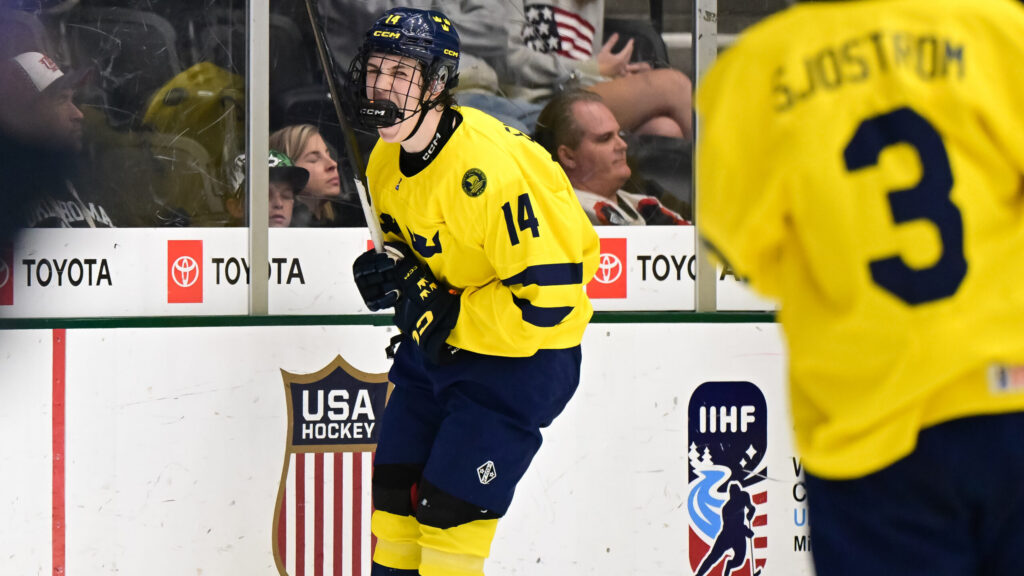
Filip Ekberg #14 (Photo by Micheline Veluvolu/IIHF)
Filip Ekberg (F): Ekberg previously lit up the 2025 Under-18 Men’s World Championship with 18 points in 7 games to earn Tournament MVP honours. After a quieter 2026 OHL campaign with the Ottawa 67s, the WJSS provides him the perfect bounce-back stage to earn a go-to role for a Swedish team looking to win back-to-back golds in Edmonton and Red Deer.
Elton Hermansson (F): Hermansson brings dynamic offensive talent which is only elevated when representing the Tre Kronor. At the Hlinka Gretzky Cup, he finished with 11 points over 5 games played, plus he is fresh off a strong U18 campaign where he racked up 12 points over 7 games. He will look to continue his international success into this year’s WJSS.
Malte Gustafsson (D): Selected 13th overall at the 2026 NHL Draft by the New York Islanders, Gustafsson is a blue-line lock. A smooth-skating, defensively responsible defender (+7 at the U18s) who can push the pace off the rush, he projects to play heavy minutes for the Swedes at the WJSS and the World Juniors later this year.
Team USA
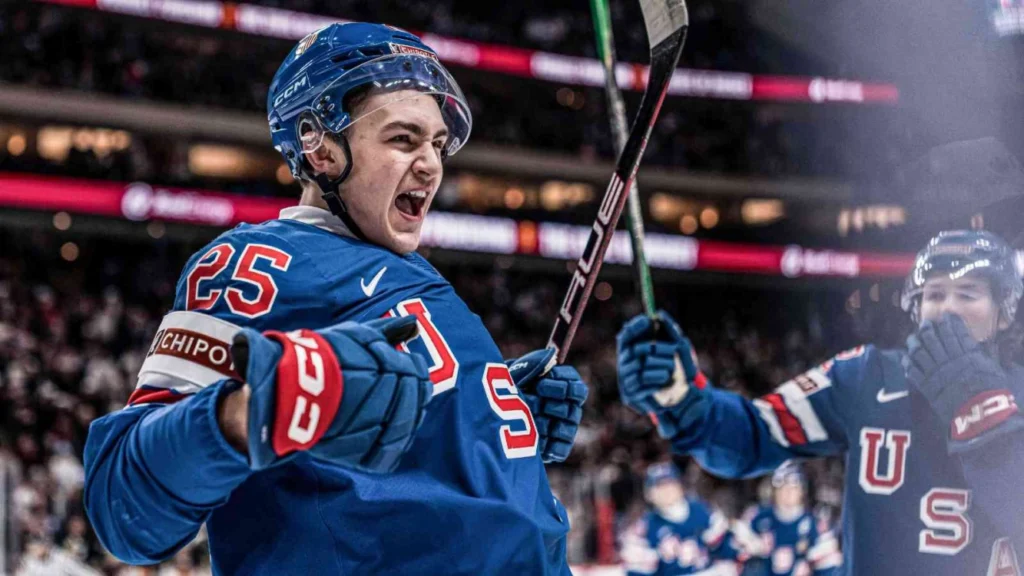
Chase Reid #25 (Photo By Joel Marklund/Bildbyrån)
Wyatt Cullen (F): One of the rapid risers of the 2026 NHL Draft class, Cullen has been a fascinating player to track over the past two seasons, growing over 8 inches and developing his game into a top 10 pick. Cullen produced 9 points in 5 games at the U18 Worlds on a US team which lost to Latvia in the quarterfinals. He possesses high-end goal-scoring talent and looks poised to become a central figure for the U.S. program over the next few years.
Chase Reid (D): One of the biggest surprises of Draft night was seeing Chase Reid’s fall to 7th overall being selected by the Seattle Kraken. A returning player to the World Junior roster this year, Reid logged over 20 minutes of ice time per game at the last World Juniors and is expected to take on an even bigger role this year. This WJSS presents an opportunity to remind US brass of what he’ll bring to the table on Boxing Day.
Sammy Nelson (F): A top-5 projected prospect for the 2027 NHL Entry Draft, Nelson is one of the most intriguing under-age players at the showcase this year. A strong showing here could lock down his spot on the December roster ahead of his draft year.
Team Finland
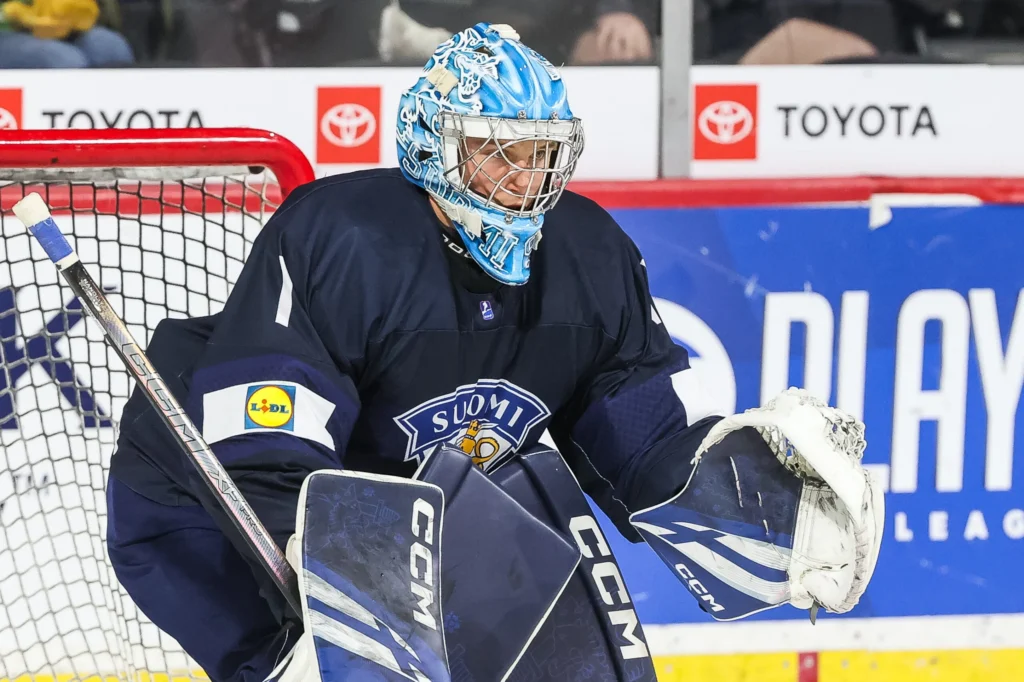
Patrik Kerkola #1 (Photo By IIHF)
Samu Alalauri (D): Drafted 66th overall by the Chicago Blackhawks in 2026, Alalauri is a physical, reliable defenseman with a strong skating ability which will continue to help him throughout the showcase and later into the tournament. Also strong on the international stage, we saw him record 4 points over 5 games at both the Hlinka Gretzky Cup and U18 Worlds. He projects as an anchor for the Finnish blue line.
Jere Somervuori (F): Somervuori seemed like the last cut for the Finnish World Junior team last year after putting together strong performances with Finland’s U20 team while also serving a full-time role with HIFK in Liiga. He is arguably one of the most deserving players to make the roster in December and will look to make another good impression in Windsor.
Patrik Kerkola (G): A steadying presence between the pipes, Kerkola (2.44 GAA at the 2025 U18s) enters camp in a competitive battle for the starting job ahead of December. Although he did not dress at the 2026 World Juniors, Kerkola was named to the Finnish roster and will look to take on a much bigger role in Edmonton this year, which will all start with his performance at the WJSS.
Team Canada
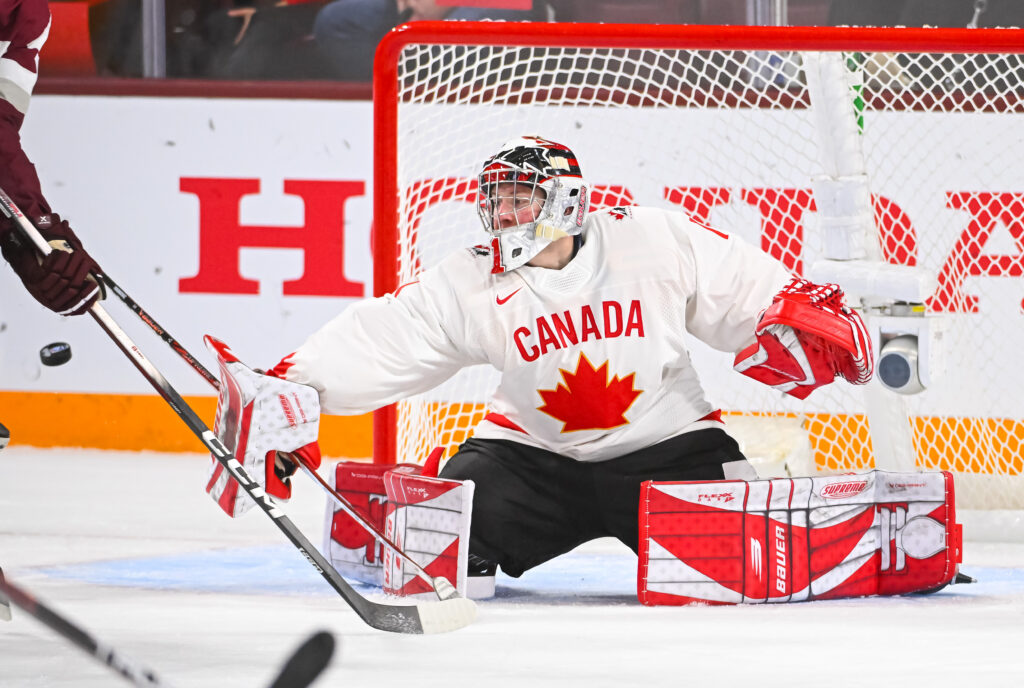
Jack Ivankovic #1 (Photo by Tim Austen/IIHF)
Keaton Verhoeff (D): Projected as a top-three pick for most of the year, Verhoeff slipped on draft night before going 9th overall to the San Jose Sharks. A returning defender from Canada’s 2026 World Junior squad, the 6-foot-4 blueliner will be heavily relied upon to lock down high-leverage defensive minutes and kill penalties in Windsor. With extra eyes on his skating ability, watching his mobility after an off-season of work will be a key storyline.
Jack Ivankovic (G): After a tough 2025 WJC debut, losing to Latvia in a shootout, Ivankovic returned in 2026 with something to prove. He exacted quick revenge with a group stage win over Latvia, and later took over Canada’s starting crease for the playoff rounds, finishing with a tournament-leading 2.34 GAA to claim bronze. Boasting an impressive international resume, Ivankovic enters the WJSS as the clear-cut starter for Canada’s WJC team come Boxing Day.
Tynan Lawrence (F): Lawrence took a calculated risk leaving the USHL mid-season to jump straight to the NCAA with Boston University in his draft year. Although adapting to the collegiate pace came with a steeper learning curve than originally expected, we saw his potential on full display at the U18 World Championships, posting 6 points over 5 games. Lawrence will look to build on that momentum in Windsor as he pushes to lock down a top-six center role for Canada.
What is shaping up to be one of the most competitive World Junior tournaments in history will begin with a preview of four legitimate gold medal contenders over the next week in Windsor. Stay tuned for more coverage throughout the week.